How to Make a Long-Distance Relationship Work
Make a Long-Distance Relationship Work When You Miss Them So Much
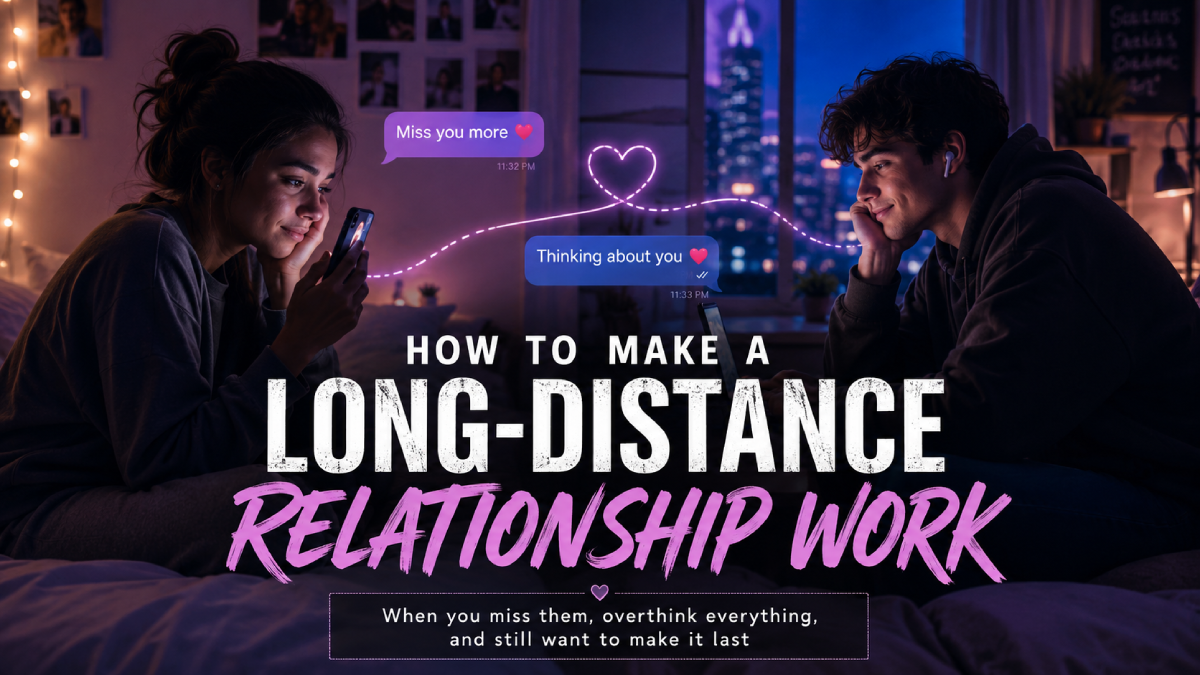
How do you make a long-distance relationship work when your heart wants closeness, but your reality gives you distance?
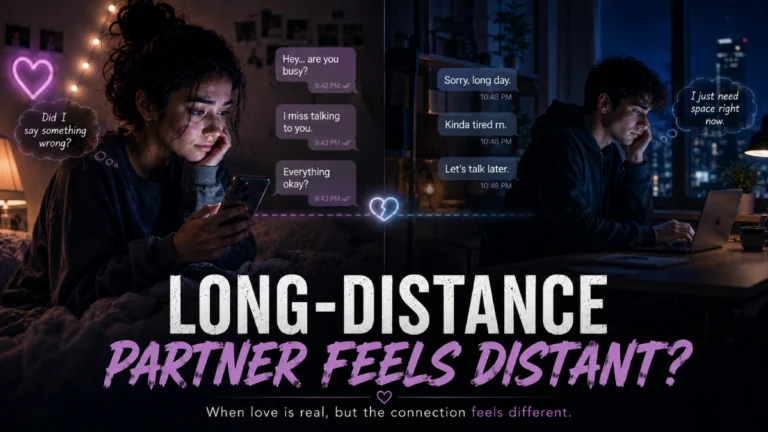
Maybe you wait for their text longer than you admit.
Maybe one missed call changes your whole mood.
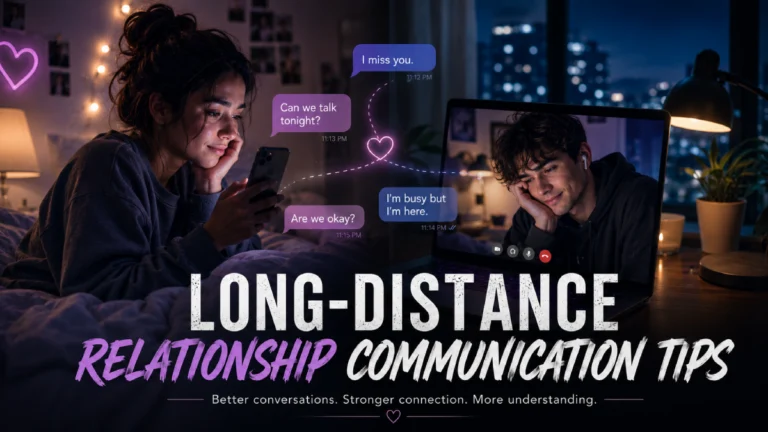
Maybe you know they love you, but when they are far away, your mind still starts asking, “Are we okay?”
Long-distance relationships are not hard only because two people live in different places. They are hard because love starts depending on things that can feel fragile: texts, calls, timing, tone, effort, reassurance, trust, and plans.
Kabhi kabhi distance sirf kilometres ka nahi hota. Kabhi kabhi distance ek unread message, ek cancelled call, ya ek dry reply mein bhi feel hota hai.
And that is what makes it confusing.
Because you may not want to be “too much.”
You may not want to sound needy.
You may not want to fight over small things.
But inside, you still want to feel chosen.
So if you are trying to understand how to make a long-distance relationship work, the answer is not just “communicate more” or “trust each other.”
That sounds nice, but it is too vague.
A long-distance relationship works when both people create emotional safety from far away.
It works when love has structure.
It works when both people understand that distance needs extra care, not extra drama.
In this guide, we will talk about how to make a long-distance relationship work without losing yourself, forcing connection, or pretending distance does not hurt.
Can a Long-Distance Relationship Really Work?
Yes, a long-distance relationship can work.
But it usually does not work by accident.
It works when both people are emotionally honest, consistent, patient, and willing to build a relationship that does not depend only on physical presence.
Because love may start with feelings, but long-distance love survives through effort.
Not dramatic effort.
Not begging.
Not proving your love every day.
But steady, mature, visible effort.
Yes, But Love Alone Is Not Enough
This part can feel uncomfortable, but it is important.
Love alone is not always enough to make a long-distance relationship work.
You can love someone deeply and still feel emotionally disconnected.
You can miss someone badly and still not know how to communicate with them.
You can be loyal and still feel insecure because the relationship has no rhythm, no reassurance, and no future clarity.
Long-distance relationships need love, but they also need emotional systems.
They need:
- Trust
- Communication rhythm
- Emotional reassurance
- Conflict repair
- Future planning
- Mutual effort
- Personal stability
- Romantic creativity
Without these, even strong feelings can start feeling heavy.
Because when someone is far away, your relationship cannot survive only on “I love you.”
It needs “I am still here.”
It needs “I am making time.”
It needs “You matter even when I am busy.”
It needs “We are not just waiting, we are building.”
What Makes Long-Distance Relationships Different From Normal Relationships?
Long-distance relationships are not impossible, but they are different.
You do not have the same daily physical comfort that close-distance couples often have.
You cannot casually sit beside them after a bad day.
You cannot fix a misunderstanding with a hug.
You cannot always see their face and know whether something is wrong.
So the relationship starts depending more on emotional communication.
And that is where most long-distance couples struggle.
Not because they do not love each other.
But because distance makes every small gap feel bigger.
You Depend More on Communication Than Physical Presence
In a normal relationship, sometimes presence itself repairs things.
Sitting together, holding hands, sharing food, laughing randomly, meeting after work, walking together — these small moments build closeness without needing too many words.
But in long-distance, words carry more responsibility.
Texts matter more.
Calls matter more.
Tone matters more.
Timing matters more.
When physical presence is missing, communication becomes the main way your partner feels loved.
That does not mean you need to talk all day.
It means your communication needs to feel emotionally alive.
Not forced.
Not mechanical.
Not like attendance.
But connected.
Small Changes Can Feel Bigger From Far Away
In a long-distance relationship, a small change can trigger a big emotional reaction.
A shorter reply.
A missed goodnight text.
A cancelled video call.
A sudden change in energy.
One day they are warm, the next day they feel distant.
And your mind starts filling in the blanks.
“Are they bored?”
“Did I do something?”
“Are they talking to someone else?”
“Is this relationship slowly fading?”
Maybe nothing is actually wrong.
Maybe they are tired.
Maybe work is heavy.
Maybe life is overwhelming.
But because you cannot see their full reality, your brain starts creating stories from small signals.
That is why long-distance needs more emotional clarity than a normal relationship.
Not because you are insecure.
But because uncertainty hurts more when someone is far away.
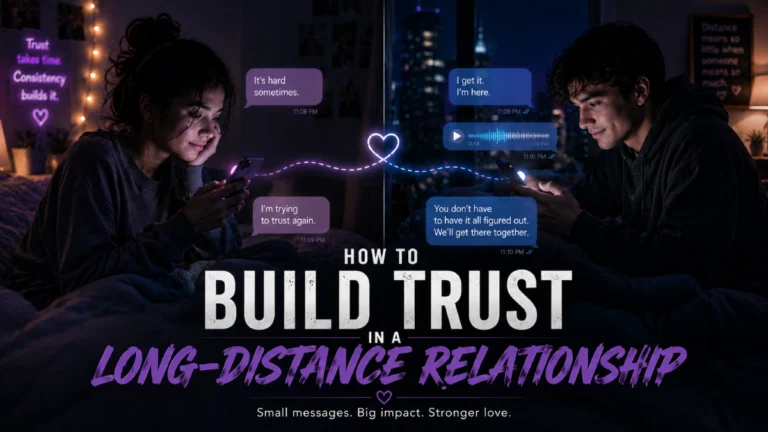
Trust Has to Carry More Emotional Weight
Trust in a long-distance relationship is not only about loyalty.
It is also about emotional consistency.
Can I trust that you will show up?
Can I trust that you will tell me if something is wrong?
Can I trust that your love is not disappearing just because your replies are slower today?
Can I trust that we are moving toward something?
This is why trust cannot be built only through promises.
It has to be built through patterns.
A person can say, “Trust me,” but if their actions keep making you feel confused, your nervous system will not feel safe.
Real trust is not forced.
It is created through repeated emotional reliability.
Micro Takeaway
A long-distance relationship works when both people stop treating distance as the enemy and start treating emotional consistency as the bridge.
Distance is hard, yes.
But emotional inconsistency is what makes it unbearable.
Why Long-Distance Relationships Feel So Hard Emotionally
Long-distance relationships feel hard because your love is real, but your access to each other is limited.
You have emotions, needs, longing, insecurity, attraction, care, and attachment.
But you cannot always express them through normal couple things.
You cannot always meet.
You cannot always hold each other.
You cannot always be there physically when one person is hurting.
So the relationship can start feeling like a strange mix of deep love and quiet loneliness.
You are together, but not fully together.
You are committed, but still missing something.
You are loved, but still craving presence.
And that emotional contradiction can be exhausting.
You Miss Their Presence, Not Just Their Words
Sometimes people say, “At least you can call and text.”
And yes, calls help.
Texts help.
Video calls help.
But they do not completely replace presence.
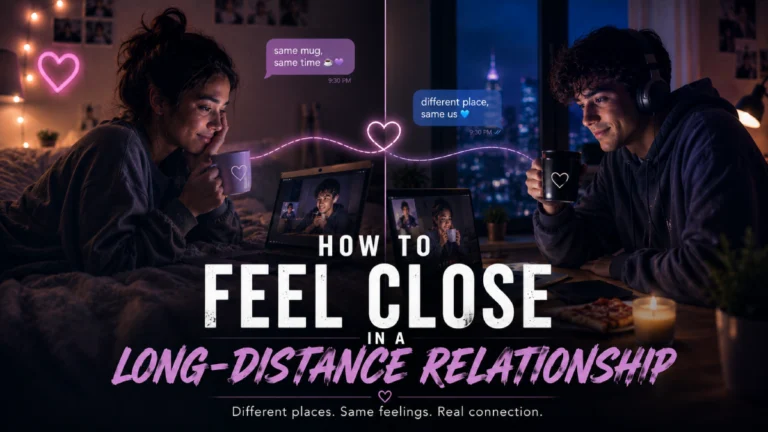
Because sometimes you do not just miss talking to them.
You miss sitting near them without saying anything.
You miss seeing their face randomly.
You miss their smell, their laugh, their hand, their ordinary presence.
You miss the version of love that does not need Wi-Fi, battery, timing, or a scheduled call.
That missing can become heavy.
And it is okay to admit that.
Texts Help, But They Cannot Fully Replace Touch, Body Language, and Daily Warmth.
A text can say, “I miss you.”
But a hug can make your whole body believe it.
A call can say, “I am here.”
But sitting next to someone can make your nervous system relax differently.
This does not mean long-distance love is weaker.
It means it needs more intentional emotional care.
Because when physical comfort is missing, emotional comfort has to become stronger.
That means your words, routines, reassurance, and efforts need to carry more warmth.
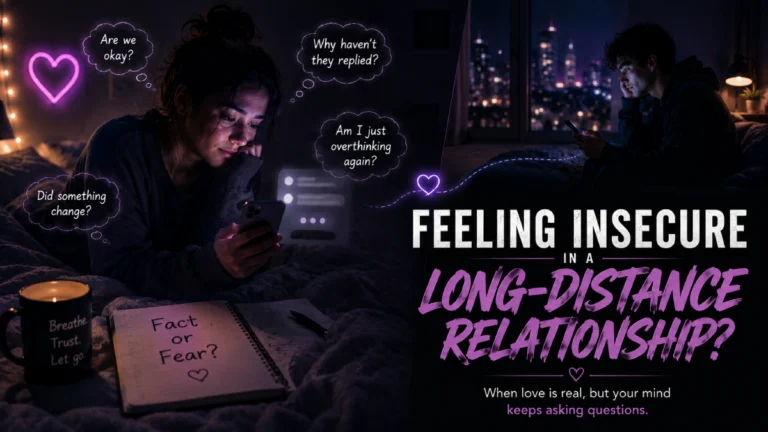
Silence Creates Space for Overthinking
Silence is one of the biggest emotional triggers in a long-distance relationship.
Not peaceful silence.
Unclear silence.
The kind where they disappear for hours without explanation.
The kind where you see them online but they have not replied.
The kind where the call ends weirdly, and you do not know what changed.
In close-distance relationships, you might be able to read the room.
In long-distance, you read the silence.
And that can be dangerous for an overthinking mind.
A Late Reply Can Start Feeling Like Rejection
A late reply is not always a red flag.
But when you already miss someone, a late reply can feel personal.
Your mind may start creating emotional meanings:
“They are bored with me.”
“They do not care like before.”
“Maybe I am asking for too much.”
“Maybe I am more attached than they are.”
It can be confusing when your logical mind says, “They are probably busy,” but your emotional mind says, “Something feels wrong.”
That does not make you dramatic.
It means your attachment system is reacting to distance and uncertainty.
Emotional Impact Line
Sometimes the hardest part is not the distance.
It is not knowing what their silence means.
You Need Reassurance More Often
Long distance can make reassurance feel more necessary.
Not because you are weak.
Not because you do not trust them.
But because your relationship does not get the daily proof of closeness that physically present couples often receive naturally.
When you meet often, reassurance comes through little things.
A smile.
A touch.
A shared moment.
A random plan.
A small act of care.
But in long-distance, reassurance has to be communicated more intentionally.
A simple “I know we have both been busy, but I still feel close to you” can calm the heart more than a hundred dry texts.
Distance Can Make Normal Insecurity Feel Louder
Everyone has emotional needs.
Everyone wants to feel wanted.
Everyone wants to feel remembered.
But distance can make those needs feel louder because there are fewer physical signs of love.
That is why a healthy long-distance relationship does not shame reassurance.
It creates space for it.
Not every minute.
Not through emotional pressure.
But through small, thoughtful reminders that say, “You are still important to me.”
You May Start Comparing Your Relationship to Other Couples
This is another quiet pain of long-distance love.
You may see other couples going on dates, taking photos, spending weekends together, celebrating small moments, and doing normal couple things.
And suddenly your relationship starts feeling harder.
Not because your love is less real.
But because your love asks for more patience.
You might feel happy for others but still feel a little ache inside.
“Why can’t we have that?”
“Why does our relationship need so much waiting?”
“Will we ever become normal?”
That comparison can hurt.
Especially when you already feel emotionally tired.
Seeing Couples Together Can Make Your Love Feel Incomplete
It is not jealousy in a bad way.
It is longing.
You are not necessarily wishing for someone else’s relationship.
You are wishing for your own relationship to feel easier.
And that is deeply human.
But comparison can become harmful when it makes you forget what you and your partner are building.
Your relationship may look different.
But different does not always mean doomed.
It just means it needs a different kind of care.
Micro Takeaway
Long-distance feels hard because your emotional needs are real, but the usual ways of meeting them are limited.
So instead of judging yourself for struggling, ask:
What emotional need is this distance making harder to meet?
That question can change everything.
How to Make a Long-Distance Relationship Work: 9 Things That Actually Help
Here is the simple answer first:
To make a long-distance relationship work, both partners need clear expectations, consistent communication, trust-building habits, emotional reassurance, conflict repair, personal independence, romantic effort, and a shared plan.
But let’s go deeper than a list.
Because knowing what to do is one thing.
Knowing how to do it without feeling needy, pressured, or emotionally exhausted is the real challenge.
1. Set Clear Expectations Instead of Guessing Each Other’s Needs
A lot of long-distance relationship pain comes from unspoken expectations.
One person thinks daily calls are normal.
The other thinks texting throughout the day is enough.
One person needs goodnight messages.
The other does not understand why it matters.
One person expects weekend video calls.
The other assumes plans can stay flexible.
And then both people start feeling hurt without fully explaining why.
This is where resentment begins.
Not because either person is bad.
But because both are loving from different emotional maps.
Talk About How Often You Both Want to Communicate
You do not need a strict rulebook.
But you do need clarity.
Ask each other:
- Do we both like daily texting?
- How often do we want proper calls?
- What should we do when one person is busy?
- Do good morning/goodnight texts matter to us?
- How do we communicate when we need space?
- What makes us feel ignored?
- What makes us feel pressured?
These questions may sound simple, but they prevent unnecessary emotional damage.
Because sometimes the problem is not lack of love.
Sometimes the problem is lack of shared expectations.
Decide What Feels Reasonable, Not Perfect
Do not create a routine that looks romantic but feels impossible.
A three-hour call every night may sound cute, but if one person has work, studies, family pressure, or different time zones, it can become exhausting.
The goal is not perfect communication.
The goal is sustainable connection.
A relationship rhythm should feel supportive, not suffocating.
Example Conversation Starter
“I don’t need us to talk all day, but I feel safer when I know when we’ll properly connect. Can we decide a rhythm that works for both of us?”
This kind of sentence is honest without blaming.
It tells your partner what you need without attacking them.
That is how emotional maturity sounds.
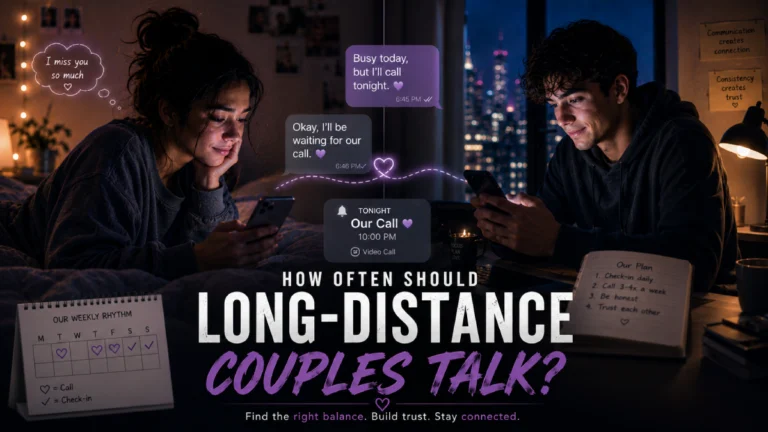
2. Build a Communication Routine That Feels Natural
Long-distance relationships need rhythm.
Not because love should be scheduled like a meeting.
But because distance creates uncertainty, and rhythm creates emotional safety.
When you know you will talk properly at night, you do not panic over every delayed reply during the day.
When you know weekends are your deeper connection time, you do not feel forgotten during a busy week.
Routine reduces emotional guessing.
Daily Updates Keep the Relationship Emotionally Alive
Small daily updates matter.
Not because your partner needs to report every move.
But because updates help them feel included in your life.
A simple message like:
“Just reached work.”
“Today is hectic, but I’ll call you later.”
“Saw something that reminded me of you.”
“I’m tired today, but I miss you.”
These are small things.
But in long-distance, small things are not small.
They are emotional bridges.
Deep Calls Build Closeness Better Than Random Texting Alone
Texting all day does not always mean emotional intimacy.
Sometimes couples text constantly but still feel disconnected.
Why?
Because logistical updates are not the same as emotional closeness.
You need deeper moments too.
Ask questions like:
- What felt heavy for you this week?
- Did you miss me more on any particular day?
- Is there anything you have not said because you did not want to start a fight?
- What made you feel loved recently?
- What do you need more from me right now?
These conversations create emotional intimacy.
Not every call needs to be deep.
But if every conversation is only memes, updates, and “what did you eat,” the relationship may start feeling emotionally thin.
Simple Routine Example
Try this:
- Morning text
- Small daytime update
- Proper evening or night call when possible
- One weekly emotional check-in
- One weekly fun activity together
This does not have to be strict.
But having a basic rhythm helps both people feel less lost.
3. Do Not Make Communication Feel Like Attendance
This is where many long-distance couples accidentally hurt each other.
Communication should feel like connection, not attendance.
If every call becomes proof of love, both people may start feeling pressured.
If every late reply becomes a fight, the relationship may start feeling emotionally unsafe.
If one person feels like they are constantly being monitored, they may pull away.
And if the other person feels constantly ignored, they may become more anxious.
Both experiences are painful.
So the goal is balance.
Forced Calls Can Create Pressure Instead of Closeness
A call made out of fear does not feel romantic.
A call made only to avoid conflict does not create connection.
Of course, effort matters.
But forced communication can slowly create emotional resistance.
One person starts thinking:
“If I don’t call, they’ll get upset.”
And the other starts feeling:
“I had to ask, so it doesn’t even feel real.”
That dynamic hurts both people.
Instead of demanding constant availability, build a rhythm where both people willingly show up.
Quality Matters More Than Constant Availability
You do not need to talk every second to have a strong relationship.
You need to feel emotionally remembered.
There is a difference.
A partner can be busy and still make you feel secure.
A partner can text less and still show warmth.
A partner can need space and still reassure you.
The problem is not always less communication.
The problem is emotionally careless communication.
4. Build Trust Through Predictable Behavior
Trust is not built by saying, “Trust me.”
Trust is built when someone’s actions become emotionally predictable.
They say they will call, and they call.
They say they are busy, and they explain.
They say they miss you, and their effort reflects it.
They say you matter, and you feel it in small repeated ways.
Predictability is powerful in long-distance relationships.
Because when your partner’s behavior feels steady, your mind does not have to panic over every gap.
Trust Is Not Built by Promises Alone
Promises can comfort you for a moment.
Patterns comfort you over time.
Someone can say:
“I love you.”
But if they disappear whenever things get difficult, the relationship will not feel safe.
Someone can say:
“You are important to me.”
But if they never make time, the words start losing weight.
Trust needs action.
Not dramatic action.
Repeated action.
Consistency Makes the Nervous System Feel Safer
This is the emotional psychology behind long-distance trust.
When someone is consistent, your body starts relaxing.
You do not need to decode everything.
You do not need to chase.
You do not need to keep checking whether they still care.
Consistency tells your nervous system:
“This connection is safe.”
That is why consistency is one of the strongest forms of love in long-distance relationships.
5. Create Emotional Rituals, Not Just Conversations
Long-distance relationships need rituals.
Rituals are small repeated actions that make love feel alive.
They give the relationship emotional texture.
Because if your connection only depends on random texting and occasional calls, it can start feeling dry.
Rituals create a sense of “us.”
They remind both people that the relationship is not paused.
It is still happening.
Watch a Show Together
Pick a show and watch one episode together every week.
It sounds simple, but shared experiences matter.
They give you something to laugh about, discuss, and look forward to.
In long-distance, shared memories need to be created intentionally.
Send Voice Notes
Voice notes feel warmer than texts.
A tired “I miss you” in their voice can feel more real than a perfectly typed paragraph.
Voice carries emotion.
It carries softness.
It carries presence.
Sometimes, when you cannot hold someone, hearing them is the next best thing.
Share Photos From Your Day
Not only selfies.
Send small pieces of your life.
Your coffee.
Your desk.
The sunset.
A random street.
The book you are reading.
The messy room.
The little moments.
This makes your partner feel included in your daily world.
And that matters when they cannot physically be there.
Create a Weekly “Us Time”
Have one fixed time where the relationship gets full attention.
No multitasking.
No scrolling.
No half-listening.
Just both of you.
It can be a video call, virtual dinner, movie night, game night, deep conversation, or even silent study/work time together on call.
The activity matters less than the intention.
6. Plan Visits or Future Milestones When Possible
Long-distance relationships become harder when there is no future.
Not every couple can meet often.
Money, family, studies, work, visas, distance, and life situations can make visits difficult.
But even if you cannot meet soon, you need some kind of direction.
Because endless waiting can emotionally drain a relationship.
A Relationship Needs Something to Look Forward To
Hope matters.
A visit date.
A possible month.
A future city.
A savings plan.
A career step.
A conversation about closing the distance.
Even if the plan is not perfect, having something ahead can reduce emotional helplessness.
It reminds both people:
“We are not just surviving this. We are moving somewhere.”
Even a Tentative Plan Can Reduce Emotional Uncertainty
You may not know the exact date.
But you can still talk about possibilities.
For example:
- “Can we try to meet during the next holiday?”
- “Can we start saving for a trip?”
- “What would closing the distance look like for us?”
- “Are we both serious about eventually living closer?”
- “What timeline feels realistic?”
These conversations can be scary.
But avoiding them creates more fear.
A long-distance relationship without future clarity can start feeling like emotional waiting with no promise of arrival.
7. Keep Your Own Life Emotionally Alive
This one is important.
Very important.
Your life cannot stop because your partner is far away.
Sometimes, in long-distance relationships, people slowly make the relationship their whole emotional world.
They wait for texts.
They plan their mood around calls.
They stop going out.
They feel guilty enjoying life without their partner.
They become emotionally dependent on the next notification.
And slowly, love starts feeling less like connection and more like survival.
Missing Them Should Not Mean Losing Yourself
You can miss someone deeply and still live your life.
You can love someone and still have friends, goals, hobbies, routines, and personal joy.
In fact, your relationship becomes healthier when both people have emotionally full lives.
Because then you come to each other with love, not emptiness.
With presence, not panic.
With choice, not dependency.
Your Life Cannot Pause Until They Return.
Please remember this gently:
Your relationship is part of your life.
It should not become the place where your whole identity disappears.
Long distance already creates emotional pressure.
If you abandon yourself too, the distance becomes heavier.
So keep living.
Study.
Work.
Create.
Meet friends.
Move your body.
Build your future.
Take care of your mind.
A healthy long-distance relationship should support your growth, not freeze your life.
8. Talk About Conflict Before It Becomes Resentment
Conflict is not the biggest danger in a long-distance relationship.
Unrepaired conflict is.
Because when you are far away, unresolved hurt does not always get softened by physical closeness.
There is no hug after the fight.
No sitting beside each other.
No shared silence that slowly melts the anger.
So repair has to be more intentional.
Do Not Fight Only Through Text
Text fights are dangerous.
Tone gets misunderstood.
Small sentences look colder than they are.
One person sends paragraphs.
The other shuts down.
Screenshots happen.
Old issues come back.
And suddenly the fight becomes bigger than the original problem.
For sensitive topics, use voice or video whenever possible.
You need tone.
You need pauses.
You need softness.
You need to hear that the other person is not your enemy.
Use Voice or Video for Sensitive Topics
If something is important, do not reduce it to angry texting.
Say:
“I want to talk about this properly. Can we call when we are both calmer?”
That one sentence can save the relationship from unnecessary emotional damage.
Repair Script
“I don’t want this to become a fight. I want us to understand what happened because I miss feeling close to you.”
This is a beautiful repair line because it shifts the conversation from blame to connection.
It says:
“I am hurt, but I still want us.”
That is the energy long-distance relationships need.
9. Make Love Visible From Far Away
In a long-distance relationship, love needs to be visible.
Not performative.
Not show-off.
Visible.
Your partner should not have to constantly guess whether they still matter.
Small gestures can carry a lot of emotional weight.
A thoughtful message.
A random voice note.
A playlist.
A handwritten letter.
A surprise food order.
A memory scrapbook.
An “open when you miss me” note.
A photo of something that reminded you of them.
Love from far away needs creativity.
Because when touch is missing, effort becomes touch in another form.
Send Reassurance Before They Have to Beg for It
Reassurance feels different when it is offered freely.
If someone has to beg for reassurance every time, it starts feeling painful.
But when reassurance comes naturally, it feels like emotional safety.
Say things like:
“I know we have both been busy, but I still love us.”
“I miss you today. Just wanted you to know.”
“I know distance is hard, but I am still choosing this.”
“You are not forgotten just because I am busy.”
These lines are simple.
But simple love, said at the right time, can calm a very tired heart.
Small Gestures Matter More in Long Distance
In long-distance, small gestures become big because they cross the gap.
A five-minute call can mean:
“I made time.”
A voice note can mean:
“I wanted you to hear me.”
A surprise letter can mean:
“I thought about you even when you were not here.”
A playlist can mean:
“These songs felt like us.”
This is where Lafz Amor’s emotional gifting side fits beautifully.
Lafz Amor Gift Bridge
Open when letters, love notes, voice messages, small surprise gifts, playlists, and memory scrapbooks can make distance feel more emotionally held.
Because sometimes your partner does not need an expensive gift.
They need something that says:
“Even from far away, I still know how to love you.”
How to Communicate in a Long-Distance Relationship Without Feeling Needy
One of the hardest parts of long-distance love is asking for connection without feeling embarrassed.
You may want more effort, but you do not want to sound demanding.
You may want reassurance, but you do not want to look insecure.
You may feel hurt, but you do not want to start another fight.
So you stay quiet.
Or you hint.
Or you act cold.
Or you say, “It’s fine,” when it is clearly not fine.
But emotional needs do not disappear because you hide them.
They only come out later as resentment, anxiety, or overthinking.
Ask for Connection Clearly, Not Indirectly
Indirect communication creates confusion.
When you want a call but say, “You’re always busy,” your partner hears blame.
When you want reassurance but say, “Forget it,” your partner may not understand the real need.
When you want effort but stop replying to test them, the relationship becomes a guessing game.
And guessing games damage trust.
Clear communication is not neediness.
It is emotional honesty.
Avoid Testing Them With Silence
Silent tests are tempting when you feel hurt.
You may think:
“Let’s see if they notice.”
“Let’s see if they care.”
“Let’s see if they text first.”
But testing creates more anxiety.
Because even if they fail the test, you still do not get the connection you needed.
And if they pass, the relief is temporary.
Healthy love should not depend on emotional exams.
Ask directly instead.
Avoid Saying “Do Whatever You Want” When You Actually Feel Hurt
This sentence usually does not mean freedom.
It means pain.
It often means:
“I wish you understood without me explaining.”
But your partner may take it literally.
And then you feel even more hurt.
Instead, try saying what is actually true.
“I am not trying to control you. I just felt unimportant when our plan got cancelled without any proper conversation.”
That is much clearer.
And much more emotionally mature.
Use “I Feel” Instead of “You Never”
The words “you never” usually make people defensive.
Even if your pain is valid, the conversation can quickly become a fight.
Instead of:
“You never make time for me.”
Try:
“I feel disconnected when we do not get proper time together for days.”
Instead of:
“You don’t care anymore.”
Try:
“I have been feeling a little unsure lately, and I need some reassurance from you.”
This does not mean you soften your truth until it disappears.
It means you express your truth in a way that can actually be heard.
Better Message Example
“I feel a little disconnected when we go the whole day without a proper conversation. Can we plan some time tonight?”
This message is strong because it does three things:
- It names the feeling.
- It explains the situation.
- It asks for a specific action.
No attack.
No drama.
No emotional manipulation.
Just honest communication.
Make Space for Their Reality Too
This part matters.
Your emotional needs are valid.
But your partner’s reality also matters.
They may be tired.
They may be stressed.
They may have family pressure.
They may be working long hours.
They may be struggling silently.
Long-distance relationships become healthier when both people stop assuming the worst and start asking better questions.
Instead of:
“Why are you ignoring me?”
Try:
“You feel a little distant today. Is everything okay, or are you just tired?”
That one shift can change the whole conversation.
Work, Studies, Family, Time Zones, and Tiredness Can Affect Availability
Availability does not always equal love.
A busy partner is not automatically an uninterested partner.
But here is the important difference:
A healthy busy partner communicates.
They do not leave you confused for days.
They do not make you feel guilty for wanting basic connection.
They may not always be available, but they still make you feel considered.
That is the difference between being busy and being emotionally careless.
Micro Takeaway
Healthy communication is not about demanding attention.
It is about expressing emotional needs without attacking the other person.
And in long-distance, this skill can save the relationship from so many unnecessary wounds.
Long-Distance Relationship Rules That Actually Help
Rules should not make your relationship feel like a prison.
But helpful agreements can protect your connection.
Think of these less like strict rules and more like emotional promises.
They help both people know what love should look like from far away.
Rule 1: Do Not Leave Each Other Guessing
If you are busy, say it.
If your mood is off, say it.
If plans change, say it.
If you need space, say it with reassurance.
Long-distance relationships suffer when one person keeps guessing, and the other assumes everything is obvious.
Clarity is kindness.
Rule 2: Be Honest About Your Social Life
You do not need to report everything.
But secrecy creates insecurity.
If you are going out, say it normally.
If you are meeting friends, be open.
If someone makes your partner uncomfortable, discuss it maturely.
Trust grows when transparency feels natural, not forced.
Rule 3: Have a Conflict Repair Habit
Every couple fights.
But healthy couples repair.
Have a simple repair habit like:
- We do not disappear after fights.
- We do not insult each other.
- We pause when things get heated.
- We come back to the conversation.
- We remind each other that the relationship matters.
This is especially important in long-distance because unresolved fights can feel emotionally huge.
Rule 4: Schedule Quality Time, But Stay Flexible
Scheduling time is healthy.
But rigidity can create pressure.
If a call gets cancelled, the solution is not immediate panic.
The solution is repair and rescheduling.
For example:
“I can’t call tonight, but I don’t want you to feel ignored. Can we talk properly tomorrow?”
That one sentence can prevent so much hurt.
Rule 5: Talk About the Future Honestly
Long-distance love needs future conversations.
Not every week.
Not obsessively.
But honestly.
Are you both serious?
Is there a plan to close the distance eventually?
What needs to happen first?
How long can both of you realistically continue like this?
Avoiding these questions may feel easier now, but it creates deeper anxiety later.
Rule 6: Keep Romance Alive Through Effort, Not Drama
Romance does not have to mean grand gestures.
It can be simple.
A sweet voice note.
A surprise message.
A handwritten letter.
A virtual date.
A shared playlist.
A photo with “this reminded me of you.”
Romance in long distance is not about expensive gestures.
It is about making your partner feel remembered.
Rule 7: Do Not Use Distance as an Excuse for Emotional Neglect
Yes, distance is hard.
Yes, life gets busy.
Yes, time zones can be difficult.
But distance should not become an excuse for repeated emotional neglect.
If someone consistently makes you feel unwanted, ignored, or unimportant, that needs to be addressed.
Long distance explains some challenges.
It does not excuse carelessness.
Common Mistakes That Can Slowly Damage a Long-Distance Relationship
Sometimes long-distance relationships do not break suddenly.
They fade slowly.
Not because love disappeared overnight, but because small patterns kept hurting the connection.
Let’s talk about the mistakes that can quietly damage long-distance love.
Mistake 1: Expecting Constant Texting
It is natural to want to stay connected.
But expecting constant texting can turn love into pressure.
When every delay becomes a problem, communication starts feeling stressful.
Your partner may begin to feel watched.
And you may begin to feel anxious all day.
Why It Is Harmful
It turns love into monitoring.
Instead of feeling connected, both people start feeling trapped in a cycle of proving and checking.
Emotional Consequence
Your partner may start feeling controlled, and you may start feeling anxious all the time.
A better approach is to build predictable communication, not constant communication.
Mistake 2: Avoiding Difficult Conversations
Many couples avoid hard conversations because they do not want to fight.
But avoidance does not protect the relationship.
It only delays the truth.
If something hurts, it needs a safe place to be discussed.
Not dramatically.
Not aggressively.
But honestly.
Why It Is Harmful
Small disappointments become quiet resentment.
And resentment is dangerous because it does not always look like anger.
Sometimes it looks like emotional distance.
Less excitement.
Less warmth.
Less effort.
Less patience.
Mistake 3: Not Having Any Future Plan
A long-distance relationship without any future direction can become emotionally exhausting.
You may love each other, but if neither person knows where the relationship is going, the waiting starts feeling painful.
At some point, the heart asks:
“Are we building something, or am I just waiting?”
Why It Is Harmful
The relationship starts feeling endless and emotionally tiring.
Future planning does not mean you need all answers immediately.
But it does mean both people should be willing to talk about reality.
Mistake 4: Comparing Effort Without Discussing Needs
Sometimes you may think:
“I do more.”
“I care more.”
“I always adjust.”
“They don’t love me the same way.”
Maybe that is true.
Maybe it is not.
But before concluding, discuss the actual needs.
What does effort mean to you?
Calls?
Texts?
Planning visits?
Emotional reassurance?
Remembering details?
Making time?
Your partner may not understand what makes you feel loved unless you explain it clearly.
Why It Is Harmful
One person feels accused, the other feels unseen.
Comparison turns love into a scoreboard.
Clarity turns it into teamwork.
Mistake 5: Making Your Whole Life About the Relationship
This mistake usually comes from love, not weakness.
You miss them so much that everything starts revolving around them.
Their text decides your mood.
Their call becomes your whole day.
Their absence makes everything feel empty.
But slowly, this creates emotional dependency.
And emotional dependency can make long-distance feel unbearable.
Why It Is Harmful
Distance becomes heavier when you have nothing emotionally nourishing outside the relationship.
You need your own life.
Not as a backup plan.
But as emotional grounding.
Healthy love does not ask you to disappear into waiting.
Mistake 6: Ignoring Emotional Red Flags Because “Long Distance Is Hard”
This is important.
Long distance is hard, but not every painful behavior should be excused by distance.
Repeated lying is not just distance.
Disappearing during conflict is not just distance.
Making you feel needy for basic emotional needs is not just distance.
Never making time while expecting loyalty is not just distance.
Some things are not “LDR problems.”
They are relationship problems.
Why It Is Harmful
Some pain is normal distance pain.
But repeated disrespect, lying, manipulation, or emotional neglect should not be romanticized.
You can be patient without abandoning your self-respect.
Signs Your Long-Distance Relationship Is Working
Sometimes when you are in a long-distance relationship, you may focus so much on what is hard that you forget to notice what is healthy.
So here are signs that your long-distance relationship is actually working.
You Both Make Consistent Effort
Effort does not have to be equal every day.
Some weeks one person may be busier.
Some days one person may have less energy.
But overall, you should feel that both people are trying.
Not one person chasing while the other only responds.
You Feel Emotionally Safe Bringing Up Concerns
A relationship is working when you can say:
“I miss you.”
“I feel disconnected.”
“I need reassurance.”
“Can we talk about this?”
And your partner does not shame you for it.
They may not be perfect.
But they listen.
They care.
They try to understand.
That is emotional safety.
You Have a Communication Rhythm That Works for Both
You do not need to copy other couples.
Some couples talk every night.
Some talk a few times a week deeply.
Some text often.
Some prefer calls.
The right rhythm is the one that makes both people feel connected and respected.
You Still Feel Like a Part of Each Other’s Daily Life
Even from far away, you feel included.
You know what is happening in their world.
They know what is happening in yours.
You share little things.
You remember details.
You feel like partners, not strangers waiting for the next big call.
You Talk About the Future Without Avoidance
This is a strong sign.
If both people can talk about the future honestly, the relationship has direction.
Even if the plan is not perfect, willingness matters.
Avoidance creates fear.
Honesty creates grounding.
Conflicts Get Repaired, Not Buried
Healthy long-distance couples do not avoid every conflict.
They repair.
They apologize.
They explain.
They come back.
They choose the connection even after discomfort.
That is how love becomes stronger.
Not by never fighting.
But by learning how to return to each other.
When to Worry: Signs a Long-Distance Relationship May Not Be Working
This section is not meant to scare you.
It is meant to give you clarity.
Because sometimes people stay in painful long-distance relationships by telling themselves:
“It’s just the distance.”
But sometimes it is not just the distance.
Sometimes the relationship itself is becoming emotionally unsafe.
They Only Communicate When It Is Convenient for Them
If they only talk when they want to, but disappear when you need them, that imbalance matters.
A relationship cannot survive on one person’s convenience and the other person’s patience.
You deserve effort that considers you too.
You Feel Like You Are Begging for Basic Effort
There is a difference between asking for support and begging for basic care.
If you constantly have to beg for one call, one honest conversation, one reply, one sign of effort — your heart will get tired.
Love should not make you feel like you are auditioning for attention.
They Avoid Every Conversation About the Future
If every future conversation makes them uncomfortable, dismissive, or vague, pay attention.
A long-distance relationship needs some direction.
Without it, you may be emotionally investing in something that has no real plan.
They Make You Feel Guilty for Having Normal Emotional Needs
Wanting communication is not toxic.
Wanting reassurance is not clingy.
Wanting clarity is not dramatic.
Of course, needs should be expressed respectfully.
But if someone makes you feel guilty for having normal relationship needs, that is not emotional safety.
They Disappear During Conflict
Disappearing during conflict is deeply painful in long-distance.
It leaves the other person alone with anxiety, confusion, and fear.
Taking space is okay.
But vanishing without reassurance is not healthy.
A better response is:
“I need some time to calm down, but I am not leaving. We will talk later.”
That is space with care.
Their Words and Actions No Longer Match
They say they love you, but you do not feel loved.
They say they are serious, but avoid plans.
They say they miss you, but make no effort to connect.
They say they care, but dismiss your feelings.
When words and actions keep disagreeing, trust becomes difficult.
And your confusion is not random.
It is your mind noticing inconsistency.
Reality Check
Long distance is hard, but it should not make you feel permanently unwanted, invisible, or emotionally abandoned.
A relationship can require patience.
But it should not require you to keep shrinking your needs just to keep someone close.
When to Walk Away From a Long-Distance Relationship
Walking away is not always about lack of love.
Sometimes it is about lack of emotional safety.
Sometimes it is about repeated hurt.
Sometimes it is about realizing that you are the only one trying to carry the relationship.
And that truth can be painful.
Because when you love someone from far away, you may keep hoping:
“Maybe next month will be better.”
“Maybe they are just stressed.”
“Maybe if I ask differently, they will understand.”
“Maybe I should be more patient.”
Patience is beautiful.
But self-abandonment is not.
Walk Away When Effort Is One-Sided for Too Long
Every relationship has uneven seasons.
But if the relationship has become permanently one-sided, you need to be honest with yourself.
Are you always initiating?
Always adjusting?
Always forgiving?
Always explaining your hurt?
Always waiting?
If yes, the problem may not be distance.
It may be lack of mutual effort.
Walk Away When Trust Is Repeatedly Broken
Trust can be repaired when both people are honest and accountable.
But if trust is broken repeatedly and the other person expects you to simply “move on,” the relationship becomes emotionally unsafe.
You cannot build long-distance love on constant doubt.
Your heart needs stability.
Walk Away When You Keep Shrinking Your Needs to Keep the Relationship Alive
This is one of the clearest signs.
If you have stopped asking for calls because you do not want to annoy them…
If you hide your sadness because they call it drama…
If you pretend to be okay with less because you are afraid they will leave…
Then the relationship is costing you your emotional truth.
And love should not require that.
Walk Away When There Is No Future, No Repair, and No Emotional Safety
Distance can be survived.
But emotional neglect cannot be romanticized forever.
If there is no plan, no repair, no effort, no honesty, and no safety, then staying may only deepen the wound.
Sometimes the bravest thing is not holding on.
Sometimes the bravest thing is admitting:
“I love them, but this version of love is hurting me too much.”
Emotional Clarity Line
A relationship can be long-distance, but love should not feel permanently out of reach.
You deserve a love that feels present, even when the person is far away.
Final Thoughts: Long Distance Works When Both People Keep Choosing the Connection
So, how do you make a long-distance relationship work?
You make it work by building emotional safety from far away.
You make it work by communicating clearly, not constantly.
You make it work by creating trust through consistency.
You make it work by offering reassurance before the other person has to beg for it.
You make it work by repairing conflicts, planning the future, keeping romance alive, and staying emotionally honest.
But most importantly, you make it work when both people keep choosing the connection.
Not just when it is easy.
Not just when the call is romantic.
Not just when everything feels exciting.
But also when time zones are annoying.
When schedules are messy.
When missing each other feels heavy.
When one person is anxious, and the other is tired.
When the distance starts testing both hearts.
Reassurance
Long-distance relationships do not need perfect couples.
They need emotionally honest couples.
They need two people who can say:
“This is hard, but I still want to understand you.”
“I miss you, but I do not want to control you.”
“I need reassurance, but I am also willing to trust.”
“We are far away, but I do not want us to become emotionally careless.”
That is what makes the relationship stronger.
Not pretending distance does not hurt.
But learning how to love each other through it.
Emotional Closure
If both of you are willing to communicate, repair, reassure, plan, and keep showing up, distance does not have to destroy the relationship.
It can teach you patience.
It can teach you emotional honesty.
It can teach you the difference between real effort and empty words.
It can teach you how to love someone without holding them every day, but still making them feel held.
And maybe that is the real test of long-distance love.
Not whether you miss each other.
Of course you do.
But whether you both keep making the relationship feel safe, chosen, and alive even when life keeps you apart.
If distance has made you anxious, insecure, or stuck in overthinking, you may also like reading:
How to Stop Overthinking in a Long-Distance Relationship
Because sometimes the relationship is not ending.
Sometimes your mind just needs emotional clarity, reassurance, and a safer way to understand the silence.