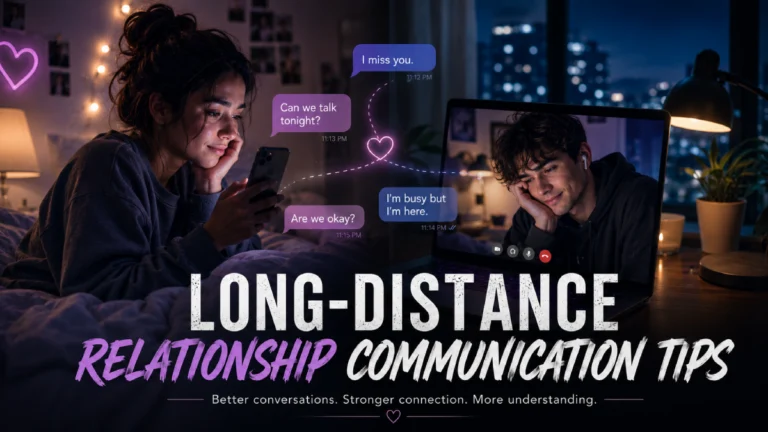
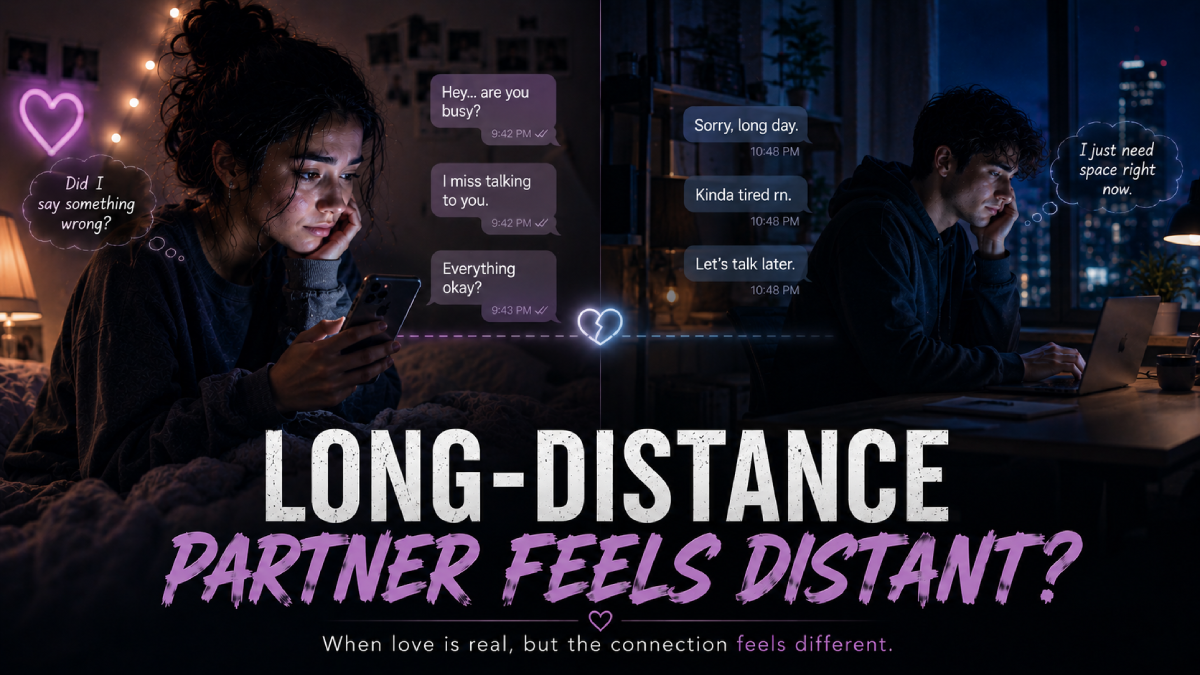
Long-Distance Partner Feels Distant? Read This Before You Panic
Why does it hurt so much when your long-distance partner feels distant, even if they say nothing is wrong?
Maybe their replies are shorter now.
Maybe the calls feel rushed.
Maybe they do not initiate like before.
Maybe they still say “I love you,” but something in their energy feels different.
And that difference is what keeps you awake.
You are not exactly fighting.
You are not exactly broken up.
They are not clearly saying they want to leave.
But still, your heart feels unsettled.
Maybe you keep telling yourself:
“They are just busy.”
“Maybe I am overthinking.”
“Maybe this is normal in long-distance.”
“Maybe I should give them space.”
But another part of you keeps asking:
“Then why does it feel like I am slowly losing them?”
That is the painful thing about emotional distance in a long-distance relationship.
You cannot easily read their face.
You cannot sit beside them and feel the energy.
You cannot hold their hand and know if something is wrong.
So you start reading everything else.
Their reply speed.
Their tone.
Their effort.
Their excuses.
Their silence.
Their willingness to call.
Their interest in plans.
Kabhi kabhi long distance mein problem distance nahi hoti. Problem yeh hoti hai ki person emotionally bhi door feel hone lagta hai.
And when your long-distance partner feels distant, the silence does not feel empty.
It feels full of questions.
The truth is, you do not need to assume the worst immediately.
A distant long-distance partner may be stressed, overwhelmed, emotionally tired, avoidant, disconnected, or genuinely pulling away. Emotional distance can happen because of stress, burnout, communication fatigue, unresolved conflict, routine boredom, or real loss of interest. The key is to watch patterns, ask calmly, create space for honesty, and notice whether they are willing to reconnect.
This guide will help you understand why your long-distance partner feels distant, what signs matter, how to talk about it without sounding needy, and when emotional distance becomes a red flag.
Why Does My Long-Distance Partner Feel Distant?
When your long-distance partner feels distant, your mind naturally wants one clear answer.
“Are they losing feelings or not?”
But emotional distance is not always that simple.
Sometimes people pull back because they are stressed.
Sometimes they are emotionally overwhelmed.
Sometimes they are avoiding a conversation.
Sometimes the relationship routine has become dry.
Sometimes they feel disconnected too, but do not know how to say it.
And sometimes, yes, they may be slowly losing interest.
That is why the goal is not to panic in one moment.
The goal is to understand the pattern.
They May Be Stressed or Emotionally Overwhelmed
Stress can make people act distant, even when they still care.
Your partner may be dealing with work pressure, studies, family issues, mental tiredness, financial stress, health problems, or emotional burnout.
And instead of saying, “I am overwhelmed, and I do not know how to be emotionally present right now,” they may simply become quiet.
They may reply less.
They may sound distracted.
They may avoid long calls.
They may say, “I’m fine,” even when they are not fine.
This can hurt, especially when you are far away and cannot see what is really happening.
Stress Can Make People Withdraw Instead of Communicate
Some people communicate more when they are stressed.
Others withdraw.
They go silent.
They become short.
They avoid emotional conversations because they do not have the energy to explain themselves.
This does not automatically mean they do not love you.
But it does mean the relationship needs more clarity.
Because even if their distance is not about you, it still affects you.
Emotional Impact Line
Sometimes distance is not about you, but it still affects you.
And you are allowed to say that.
You can be compassionate toward their stress without pretending their emotional absence does not hurt.
Micro Takeaway
Do not assume, but do not ignore the pattern either.
One tired week is human.
A long pattern of emotional withdrawal needs a conversation.
They May Be Experiencing Communication Fatigue
Long-distance relationships depend heavily on communication.
Texts.
Calls.
Video calls.
Goodnight messages.
Updates.
Reassurance.
Check-ins.
Future talks.
And sometimes, even loving couples get communication fatigue.
This means the routine starts feeling tiring, repetitive, or pressured.
Not because the love is gone.
But because the way you are communicating has become emotionally draining.
Constant Texting and Scheduled Calls Can Start Feeling Like Pressure
If every call feels like a duty, both people may start pulling away.
If every text becomes proof of love, communication can feel heavy.
If every silence turns into a fight, your partner may start associating communication with stress.
This does not mean your need for connection is wrong.
It means the communication pattern may need a reset.
A long-distance relationship needs communication, but it also needs communication that feels alive.
Not forced.
Not mechanical.
Not like attendance.
Example
They may still love you, but the routine may feel repetitive, forced, or emotionally tiring.
Maybe the relationship does not need less love.
Maybe it needs a different rhythm.
More warmth.
More play.
More honest conversations.
More shared moments.
Less pressure to perform closeness.
They May Be Avoiding an Unresolved Issue
Sometimes emotional distance appears after something went unspoken.
Maybe there was a fight that never got repaired.
Maybe one person felt hurt but said, “It’s fine.”
Maybe a future conversation was avoided.
Maybe trust was shaken.
Maybe one person has been carrying resentment quietly.
When an issue is not resolved, it does not disappear.
It often becomes distance.
Emotional Distance Can Be a Way to Avoid Conflict
Not everyone knows how to talk about uncomfortable feelings.
Some people avoid conflict by becoming quiet.
They do not want to fight, so they pull back.
They do not know how to explain, so they act normal but emotionally disappear.
They say, “Nothing is wrong,” because naming the real issue feels too hard.
But the body still knows.
You can feel something is different.
Their words say everything is okay.
Their energy says otherwise.
That mismatch is what makes you overthink.
They May Be Feeling Disconnected Too
Sometimes both people feel the gap, but they respond differently.
One person reaches harder.
The other pulls away.
One person asks for closeness.
The other feels pressured.
One person wants to fix it now.
The other does not know what to say.
This creates a painful cycle.
The more distant they feel, the more anxious you become.
The more anxious you become, the more they may withdraw.
And suddenly, both people are reacting to the disconnection instead of repairing it.
Both People Can Feel the Gap, But One May Pull Away While the Other Reaches Harder
It is possible that your partner feels disconnected too.
They may miss how things used to feel.
They may feel guilty that the relationship is not as exciting.
They may feel unsure how to bring back closeness.
They may be scared that talking about it will create a fight.
So they avoid.
And you chase.
But chasing and avoiding usually make the distance bigger.
What helps is calm honesty.
Not panic.
Not accusation.
Honesty.
They May Be Slowly Losing Interest
This is the part no one wants to read.
But a truly helpful article should not pretend this possibility does not exist.
Sometimes emotional distance does mean someone is losing interest.
Not always.
Not from one dry reply.
Not from one busy week.
But if the pattern keeps repeating, it needs honest attention.
This Is Not Always the First Answer, But It Is a Possibility to Watch Honestly
If they stop initiating…
If they avoid emotional conversations…
If they no longer talk about the future…
If they seem annoyed by your need for closeness…
If their words say love but their effort keeps disappearing…
Then you are allowed to ask whether they are still emotionally invested.
That does not mean you should accuse them.
But it does mean you should stop ignoring what your heart keeps noticing.
Is Emotional Distance Normal in a Long-Distance Relationship?
Yes, some emotional distance is normal in a long-distance relationship.
No couple feels deeply connected every single day.
There will be busy weeks.
Tired calls.
Dry conversations.
Stressful phases.
Moments where one person has less emotional energy.
That is normal.
But ongoing emotional distance is different.
A temporary low-connection phase can be repaired.
A repeated pattern of withdrawal, avoidance, and emotional coldness needs attention.
Some Distance Is Normal During Busy or Stressful Seasons
Every relationship has emotional weather.
Some weeks feel warm.
Some feel quiet.
Some feel disconnected.
Especially in long-distance, life can interrupt connection.
Maybe your partner is genuinely busy.
Maybe they are stressed.
Maybe time zones are difficult.
Maybe both of you are emotionally tired.
A low phase does not automatically mean the relationship is ending.
Every Couple Has Low-Connection Phases
There may be days when calls are shorter.
Texts are simpler.
Energy is lower.
Romance feels less exciting.
That is not always a sign of lost feelings.
Sometimes it is just real life.
The important question is:
Do they come back emotionally?
Do they try to reconnect?
Do they explain?
Do they care when you feel distant?
Do they show warmth again?
That matters more than one low day.
But Ongoing Emotional Distance Needs Attention
If the emotional distance continues for weeks and nothing changes, it should not be ignored.
If you keep bringing it up and they keep dismissing you, that matters.
If you are always the one trying to reconnect, that matters.
If the relationship feels like it is slowly becoming one-sided, that matters.
When Distance Becomes the New Normal, the Relationship Needs Repair
A relationship can survive a distant phase.
But it cannot stay healthy if emotional distance becomes the default.
You should not have to live in constant uncertainty.
You should not have to keep asking:
“Are we okay?”
And receiving answers that do not match their behavior.
If distance becomes the new normal, the relationship needs repair.
Not denial.
Temporary Distance vs Real Pulling Away
Before panicking, compare the pattern.
One cold day is different from repeated emotional withdrawal.
One stressful week is different from months of disconnection.
One missed call is different from a pattern of disappearing.
Use This Comparison Before Panicking
Temporary Distance | Possible Pulling Away |
They are busy but still reassure you | They avoid reassurance completely |
Calls are shorter during a stressful week | Calls stay cold for weeks |
They explain when unavailable | They disappear without explanation |
They still talk about the future | They avoid every future conversation |
They feel tired but still try | They stop initiating or repairing |
They respond warmly when you bring it up | They dismiss you or blame you for noticing |
This table is important because it gives your mind balance.
Do not turn one bad day into a breakup story.
But do not turn a repeated pattern into “maybe I’m just overthinking.”
Signs Your Long-Distance Partner Is Pulling Away
When a long-distance partner is pulling away, the signs usually show up in patterns.
Not one moment.
Patterns.
Their warmth changes.
Their effort drops.
Their communication becomes vague.
Their interest in plans fades.
They stop repairing.
They make you feel like your normal emotional needs are too much.
Again, do not panic from one sign.
Look at the overall emotional direction.
Their Replies Are Shorter and Less Warm
Dry texts happen sometimes.
People get tired.
People get busy.
People have low-energy days.
But if their replies become consistently short, cold, and emotionally flat, it can be a sign of disconnection.
Especially if they used to be warmer.
Dry Texts Become a Repeated Pattern, Not Just a Bad Day
A dry text once may mean nothing.
A dry pattern may mean something.
If every conversation feels like you are pulling words out of them…
If they never ask about your life…
If affection has disappeared…
If you feel like you are talking to someone who is only replying, not connecting…
Then the emotional distance deserves a conversation.
They Stop Initiating Calls or Conversations
Initiation matters in long-distance.
Not because both people must initiate equally every day.
But because effort should feel mutual overall.
If you are always starting the conversation, planning calls, asking for connection, and keeping the relationship alive, you may start feeling unwanted.
You Feel Like You Are Carrying the Connection Alone
This thought hurts:
“If I stopped trying, would we even talk?”
If that thought keeps coming up, do not ignore it.
It does not always mean the relationship is over.
But it does mean the effort feels imbalanced.
And imbalance needs to be named.
They Avoid Emotional Conversations
A partner who is emotionally distant may avoid deeper conversations.
They may say:
“Not now.”
“Why are you overthinking?”
“Everything is fine.”
“You always make things serious.”
“Can we not talk about this?”
Sometimes people avoid hard talks because they are overwhelmed.
But if every emotional conversation is avoided, closeness cannot grow.
Every Serious Topic Becomes “Not Now” or “You’re Overthinking”
This is painful because you are not trying to create drama.
You are trying to understand what is happening.
But when your concern gets dismissed repeatedly, you may start doubting yourself.
“Maybe I am too much.”
“Maybe I should not have said anything.”
“Maybe I should just wait.”
Please remember this:
Wanting clarity is not wrong.
Wanting emotional honesty is not wrong.
They No Longer Talk About Future Plans
Future planning is a major emotional anchor in long-distance relationships.
When someone avoids every future conversation, it can make the relationship feel unstable.
You may wonder:
“Are they still serious?”
“Do they still imagine us together?”
“Are they avoiding the future because they do not want one with me?”
Not every couple can plan perfectly.
But willingness to talk matters.
Future Avoidance Can Signal Emotional Uncertainty
If they used to talk about visits, plans, timelines, or closing the distance, but now avoid the topic completely, pay attention.
A person who is overwhelmed may need time.
But a person who is emotionally checking out may avoid future clarity because they are unsure.
You do not need to force an answer immediately.
But you do deserve honest conversation.
They Seem Annoyed When You Ask for Closeness
This is an important sign.
If you ask for a call, reassurance, or emotional connection, and they respond with irritation every time, the relationship may be becoming emotionally unsafe.
A caring partner may feel tired.
They may not always have the perfect answer.
But they should not make you feel pathetic for wanting closeness.
Your Normal Needs Start Feeling Like a Burden to Them
You may start shrinking your needs.
You stop asking for calls.
You stop saying you miss them.
You stop sharing hurt.
You pretend to be okay with less.
Not because you are okay.
But because you are afraid of annoying them.
That is a dangerous emotional place.
A relationship should not make you feel like your basic needs are a burden.
They Do Not Try to Repair After Hurting You
Every couple hurts each other sometimes.
But repair matters.
If they hurt you, dismiss it, and then move on as if nothing happened, the distance will grow.
Repair is what brings people back together.
Without repair, emotional distance becomes emotional separation.
No Repair Means the Distance Keeps Growing
Repair can sound like:
“I understand why that hurt you.”
“I should have communicated better.”
“I don’t want you to feel alone in this.”
“Let’s talk about how to handle this differently.”
If your partner never repairs, your heart will stay guarded.
And guarded hearts cannot feel close.
Emotional Clarity
One distant day does not mean they are losing interest.
A repeated pattern of emotional withdrawal deserves attention.
That is the line to remember.
Do not panic from one moment.
But do not ignore your emotional reality either.
What to Do When Your Long-Distance Partner Feels Distant
When your long-distance partner feels distant, your first instinct may be to panic.
You may want to send a long paragraph.
Ask a hundred questions.
Check their online status.
Test them with silence.
Demand clarity immediately.
But panic rarely creates the conversation you actually need.
You need calm honesty.
You need to understand the pattern.
You need to express what you feel without attacking.
And you need to notice how they respond.
Step 1: Calm Your Body Before You Start the Conversation
Before you talk to them, calm yourself first.
Not because your feelings are wrong.
But because anxiety can make your words sharper than your real heart.
You may accuse when you actually need reassurance.
You may panic when you actually need clarity.
You may threaten leaving when you actually want to feel close again.
Anxiety Can Make You Accuse When You Actually Need Clarity
When your body is anxious, everything feels urgent.
You may think:
“I need to know right now.”
“I need to send this message now.”
“If I wait, I’ll lose them.”
But a calmer version of you will communicate better.
And better communication gives you a better chance of real clarity.
Quick Grounding Step
Pause.
Breathe.
Write what happened.
Separate facts from fear.
Fact: “Their replies have been shorter this week.”
Fear: “They are definitely leaving me.”
Fact: “They cancelled two calls.”
Fear: “I am no longer important.”
Your fear may be understandable.
But do not let it become your only evidence.
Step 2: Watch the Pattern, Not One Moment
One dry reply may mean they are tired.
A few distant days may mean stress.
But weeks of coldness, avoidance, and no repair may mean something deeper.
Look at the pattern before deciding what it means.
One Dry Reply Is Different From Weeks of Emotional Distance
Ask yourself:
Has this been happening for one day, one week, or longer?
Do they still show care in other ways?
Do they explain when they are unavailable?
Do they come back emotionally?
Do they still talk about the future?
Do they respond when I bring it up?
These questions will help you respond wisely.
Not from panic.
From observation.
Step 3: Start With Curiosity, Not Accusation
When you bring it up, avoid starting with blame.
Instead of:
“You’ve changed.”
Try:
“I’ve been feeling some distance between us lately.”
Instead of:
“You don’t care anymore.”
Try:
“I miss feeling close to you.”
This does not mean you make your pain smaller.
It means you communicate it in a way that can actually be heard.
Ask What Is Happening Instead of Deciding the Meaning Alone
You may have a strong feeling that something is off.
That feeling deserves attention.
But before assuming the meaning, ask.
Give them a chance to explain.
Sometimes their answer will comfort you.
Sometimes it will reveal the truth.
Either way, you get clarity.
Script
“I’ve felt a little distance between us lately. I don’t want to assume the worst, but can we talk about what’s been going on?”
This is soft, direct, and emotionally mature.
It tells them you noticed the distance without attacking them.
Step 4: Say What You Need Clearly
After naming the distance, say what you need.
Do not just say, “You’re distant.”
Say what would help.
Reassurance?
Quality time?
Honesty?
A future conversation?
A communication reset?
A proper call?
Specific needs are easier to meet than vague pain.
Do You Need Reassurance, Quality Time, Honesty, or a Future Conversation?
Ask yourself:
What would help me feel safer?
Maybe you need them to say what is going on.
Maybe you need a proper call.
Maybe you need them to initiate more.
Maybe you need clarity about the future.
Maybe you need reassurance that they still want this.
Name it.
Script
“I don’t need us to talk all day, but I do need to feel emotionally connected and not like I’m guessing where we stand.”
This sentence is honest without being controlling.
It says:
“I respect your space, but I also need emotional safety.”
Step 5: Notice Their Response
This is where clarity comes.
Not only from what they say.
But how they respond.
Do they listen?
Do they care?
Do they explain?
Do they reassure?
Do they try to reconnect?
Or do they dismiss you, blame you, avoid the topic, or make you feel needy for noticing?
Their response tells you a lot.
Their Willingness to Understand Tells You a Lot
A caring partner may say:
“I’m sorry I made you feel that way. I’ve been overwhelmed, but I don’t want you to feel alone.”
A dismissive partner may say:
“You’re overthinking again.”
There is a difference.
One creates repair.
The other creates more insecurity.
Micro Takeaway
A caring partner may be tired, but they will not make you feel stupid for noticing distance.
Remember that.
Tiredness is human.
Dismissal is different.
How to Reconnect With a Distant Long-Distance Partner
Reconnection is possible if both people are willing.
But you cannot reconnect alone.
You can open the door.
You can communicate.
You can offer warmth.
You can suggest a reset.
But both people have to walk back toward each other.
Rebuild Emotional Warmth Before Forcing Serious Talks
Sometimes the relationship has become so tense that every conversation feels heavy.
If every call becomes “What’s wrong with us?” your partner may withdraw more.
That does not mean you ignore the issue.
It means you also bring back softness.
Warmth can reopen a door that pressure keeps closing.
Small Soft Moments Can Reopen Connection
Try sending:
“I miss laughing with you.”
“This reminded me of us.”
“I don’t want us to feel far like this.”
“Can we do something light together this week?”
Sometimes emotional warmth returns before full clarity does.
And that warmth can make honest conversation easier.
Create a Communication Reset
A communication reset means you stop repeating the same dry pattern and talk about what needs to change.
This is not about blaming.
It is about asking:
“What has felt missing?”
“What is making communication feel heavy?”
“What do we both need now?”
Discuss What Has Felt Dry, Heavy, or Missing
You can say:
“I feel like our calls have become more like updates than connection. Do you feel that too?”
Or:
“I think we both might be tired of the same routine. Can we try a different way to stay close?”
This makes the issue shared.
Not just one person’s complaint.
Bring Back Shared Rituals
Rituals help long-distance love feel alive again.
When the connection feels distant, small rituals can create emotional rhythm.
Not forced romance.
Just little moments that feel like “us.”
Voice Notes, Weekly Calls, Virtual Dates, Shared Playlists, and Photo Updates
Try:
- A nightly voice note
- One weekly virtual date
- Sharing one photo from your day
- A shared playlist
- A Sunday check-in call
- Watching one show together
- Sending “this reminded me of you” messages
- Writing open-when letters
- Planning a memory night with old photos
These rituals remind both people that the relationship is still active.
Not just surviving.
Ask Better Questions
Sometimes calls feel distant because the questions are too surface-level.
“What did you eat?”
“How was your day?”
“What are you doing?”
These are fine.
But emotional closeness needs better questions sometimes.
Emotional Closeness Needs Curiosity
Curiosity says:
“I still want to know you.”
And in long-distance relationships, that matters deeply.
Ask questions that invite honesty.
Not interrogation.
Just emotional openness.
Prompts
- Have you been feeling distant too?
- Is something stressing you that you have not shared?
- Do our calls feel repetitive lately?
- What would help us feel close again?
- Are you still feeling hopeful about us?
- Is there anything you are afraid to say?
- Do you need more space, more warmth, or something different?
- What has changed for you emotionally lately?
These questions can open a conversation that routine texting cannot.
Plan Something to Look Forward To
Long-distance relationships become harder when there is nothing ahead.
No visit.
No plan.
No emotional milestone.
No future direction.
If your partner feels distant, planning something together can help you both reconnect with hope.
Visits, Future Plans, or Emotional Milestones Can Reduce Uncertainty
You can plan:
- A virtual date
- A future visit
- A small anniversary moment
- A shared goal
- A trip idea
- A countdown
- A future conversation about closing the distance
Having something to look forward to reminds both people:
“We are still moving toward something.”
Without that, distance can start feeling endless.
Reassure Without Chasing
This part matters.
You can offer warmth.
You can say you miss them.
You can ask to reconnect.
You can communicate honestly.
But do not carry the whole relationship alone.
There is a difference between reaching out and chasing.
Offer Warmth, But Do Not Carry the Whole Relationship Alone
Reaching out sounds like:
“I miss feeling close to you. Can we talk?”
Chasing sounds like:
Sending message after message while they keep avoiding.
Blaming yourself for their distance.
Shrinking your needs.
Trying to be perfect so they come back.
Over-functioning while they under-function.
A relationship needs two people.
You can invite reconnection.
You should not have to beg for it endlessly.
What Not to Do When They Feel Distant
When your long-distance partner feels distant, your anxiety may push you toward things that feel protective in the moment but hurt you later.
You may panic-text.
Test them.
Pretend you are fine.
Chase harder.
Ignore the pattern because you are scared of the answer.
These reactions are understandable.
But they usually do not create clarity.
Do Not Panic-Text Paragraphs Immediately
When you are scared, a long paragraph may feel like relief.
You finally say everything.
Every hurt.
Every fear.
Every question.
But if you send it from panic, it may come out as accusation, pressure, or emotional flooding.
That can make your partner withdraw more.
Why It Is Harmful
Panic messages can make the conversation feel like pressure instead of connection.
Even if your feelings are valid, the timing and delivery matter.
Pause first.
Write the message in your notes if needed.
Come back when you feel calmer.
Then send the truth, not the panic.
Emotional Consequence
They may withdraw more, and you may feel ashamed afterward.
That creates a painful cycle.
So give yourself a moment before sending the message your fear wrote.
Do Not Test Them With Silence
When you feel hurt, you may want to stop texting first.
You may think:
“Let’s see if they notice.”
This is understandable.
You want proof that they care.
But testing creates more confusion.
Why It Is Harmful
Testing creates confusion instead of clarity.
They may think you need space.
They may mirror your silence.
They may not understand you are hurt.
Then you feel even more rejected.
Instead of testing, try saying:
“I’ve been feeling like I’m initiating more lately, and it’s making me feel unwanted.”
That is harder.
But healthier.
Do Not Pretend You Are Fine When You Are Hurt
Many people do this because they do not want to seem needy.
They say:
“It’s okay.”
But it is not okay.
They say:
“I understand.”
But inside, they feel ignored.
They act normal, but emotionally they are building resentment.
Why It Is Harmful
Unspoken hurt becomes resentment.
And resentment changes the relationship.
You become colder.
More distant.
More easily triggered.
Less affectionate.
Not because you stopped loving them.
But because your pain has nowhere to go.
Say it gently before it becomes bitterness.
Do Not Chase Someone Who Refuses to Meet You Emotionally
If someone is temporarily distant, a warm conversation can help.
But if someone repeatedly refuses to meet you emotionally, chasing will not fix it.
It will only make you lose yourself.
Why It Is Harmful
You start confusing effort with self-abandonment.
Effort is saying:
“I care about us, and I want to reconnect.”
Self-abandonment is saying:
“I will keep lowering my needs so you do not leave.”
Know the difference.
Do Not Ignore Real Patterns Because You Are Afraid of the Answer
Sometimes you may avoid the truth because the truth might hurt.
You may keep saying:
“They are just busy.”
Even when the pattern has continued for weeks.
You may keep saying:
“Maybe I am overthinking.”
Even when their effort has clearly dropped.
You may keep saying:
“Maybe things will go back to normal.”
Even when they refuse every conversation.
Why It Is Harmful
You may stay stuck in uncertainty longer than necessary.
Clarity may hurt.
But confusion hurts slowly.
And you deserve clarity.
When a Distant Long-Distance Partner Is a Red Flag
A distant partner is not always a red flag.
But repeated emotional withdrawal without repair is.
You need to know the difference.
Distance can happen.
But emotional neglect should not be romanticized.
They Regularly Disappear Without Explanation
Everyone needs space sometimes.
But disappearing without explanation creates emotional insecurity.
If they vanish and then act like your concern is unreasonable, that is not healthy.
Space should come with care.
Not confusion.
They Dismiss Your Feelings Every Time You Bring It Up
If every time you say, “I feel distance,” they respond with, “You’re overthinking,” that is a problem.
Maybe you are overthinking sometimes.
But your feelings still deserve respect.
A caring partner may not agree with everything, but they will try to understand.
They Avoid Every Future Conversation
If they avoid all plans, it can make the relationship feel unstable.
Long-distance needs direction.
If they never want to talk about meeting, timelines, commitment, or closing the distance, your anxiety may be reacting to something real.
They Only Communicate When It Is Convenient for Them
If they talk only when they want attention, comfort, or entertainment, but disappear when you need support, the relationship is imbalanced.
You should not feel like their emotional availability depends only on their convenience.
Their Words Say Love, But Their Effort Feels Absent
Words matter.
But effort gives words weight.
If they say “I love you,” but do not make time, do not repair, do not reassure, do not initiate, and do not show emotional care, the words may start feeling empty.
Your confusion is not random.
It is your heart noticing the mismatch.
You Feel More Alone With Them Than Without Them
This is one of the most painful signs.
Being in a relationship should not make you feel lonelier than being single.
If you constantly feel alone, unwanted, anxious, and emotionally abandoned, something needs to change.
Emotional Clarity
Distance is hard, but emotional neglect should not be romanticized.
A long-distance relationship can be difficult.
But it should not make you feel permanently invisible.
When to Walk Away From a Long-Distance Relationship That Feels Emotionally Distant
Walking away is not always about lack of love.
Sometimes it is about lack of emotional safety.
You may still love them.
You may still miss them.
You may still remember the old version of the relationship.
But if the present version keeps hurting you, you have to be honest.
Walk Away When You Are the Only One Trying to Reconnect
If you are always the one starting conversations, planning calls, asking questions, repairing hurt, and trying to bring back closeness, pause.
Ask yourself:
“Would this relationship still feel alive if I stopped carrying it?”
That question may hurt.
But it may also reveal the truth.
A relationship cannot survive on one person’s effort forever.
Walk Away When They Make You Feel Needy for Wanting Basic Closeness
Wanting a call is not needy.
Wanting reassurance is not needy.
Wanting emotional presence is not needy.
Wanting to know where you stand is not needy.
If your partner makes you feel ashamed for basic relationship needs, that is not emotional safety.
You deserve care, not constant self-doubt.
Walk Away When There Is No Communication, No Repair, and No Future Direction
Long-distance needs three things:
Communication.
Repair.
Direction.
If all three are missing, the relationship becomes emotionally unsafe.
You may still be attached.
But attachment is not the same as a healthy relationship.
Walk Away When You Keep Shrinking Your Needs to Keep Them Close
If you stop asking for what you need because you are afraid they will leave, that is not peace.
That is fear.
If you pretend less is enough because asking for more causes conflict, you are not being understanding.
You may be abandoning yourself.
Reality Check
A relationship can survive physical distance, but not permanent emotional absence.
If they are far away physically and emotionally, you cannot carry the relationship alone.
Final Thoughts: Do Not Panic, But Do Pay Attention
If your long-distance partner feels distant, do not panic in one moment.
One dry reply does not mean the relationship is ending.
One cancelled call does not mean they stopped caring.
One quiet week does not always mean they are pulling away.
Sometimes people are tired.
Stressed.
Overwhelmed.
Emotionally stuck.
Unsure how to communicate.
But also, do not ignore repeated emotional withdrawal.
Do not keep blaming yourself for noticing a pattern.
Do not pretend you are okay when your heart feels confused every day.
The healthiest response is not panic.
It is attention.
Calm attention.
Honest attention.
Self-respecting attention.
Reassurance
A long-distance partner feeling distant does not always mean the relationship is ending.
Sometimes they are stressed, overwhelmed, tired, or emotionally stuck.
Sometimes the relationship needs a communication reset.
Sometimes both people need to bring back warmth, curiosity, reassurance, and shared rituals.
So breathe.
You do not have to assume the worst immediately.
But you also do not have to silence your feelings.
Emotional Closure
If the distance becomes a repeated pattern and they refuse to talk, reassure, repair, or reconnect, your pain deserves to be taken seriously.
You are not too much for wanting emotional closeness.
You are not needy for noticing distance.
You are not dramatic for wanting clarity.
Long distance is already hard.
The person you love should not make it harder by making you feel alone inside the relationship.
A healthy long-distance relationship will have difficult days.
But it should also have repair.
Warmth.
Effort.
Honesty.
A willingness to come back to each other.
Because love from far away can still feel close when both people keep reaching with care.
If this distance is making you overthink every reply, read next:
How to Stop Overthinking in a Long-Distance Relationship
Because sometimes the next step is not blaming yourself for feeling anxious.
Sometimes the next step is learning how to separate one distant moment from a real pattern — and how to ask for clarity without losing yourself.