How Often Should Long-Distance Couples Talk
How often should long-distance couples talk when one person needs reassurance and the other needs breathing room?
Maybe you want to talk every day, but your partner says they are busy.
Maybe they think a few texts are enough, but you feel emotionally far.
Maybe you wait for their call, keep checking your phone, and then feel silly for caring so much.
Or maybe you are on the other side.
Maybe you love them, but constant texting feels exhausting.
Maybe you want space, but you do not want them to feel unwanted.
Maybe you are trying your best, but it still feels like whatever you do is not enough.
This is where long-distance relationships become emotionally confusing.
Because the question is not only:
“How often should long-distance couples talk?”
The deeper question is:
“Are we talking enough to feel close, or are we slowly becoming distant?”
And sometimes, even deeper than that:
“Do I still matter when we are not talking?”
Kabhi kabhi baat kam hone se sirf silence nahi feel hota. Kabhi kabhi lagta hai jaise priority bhi kam ho rahi hai.
But here is the truth.
Long-distance couples do not need to talk all day to have a strong relationship.
They need communication that feels warm, predictable, honest, and emotionally safe.
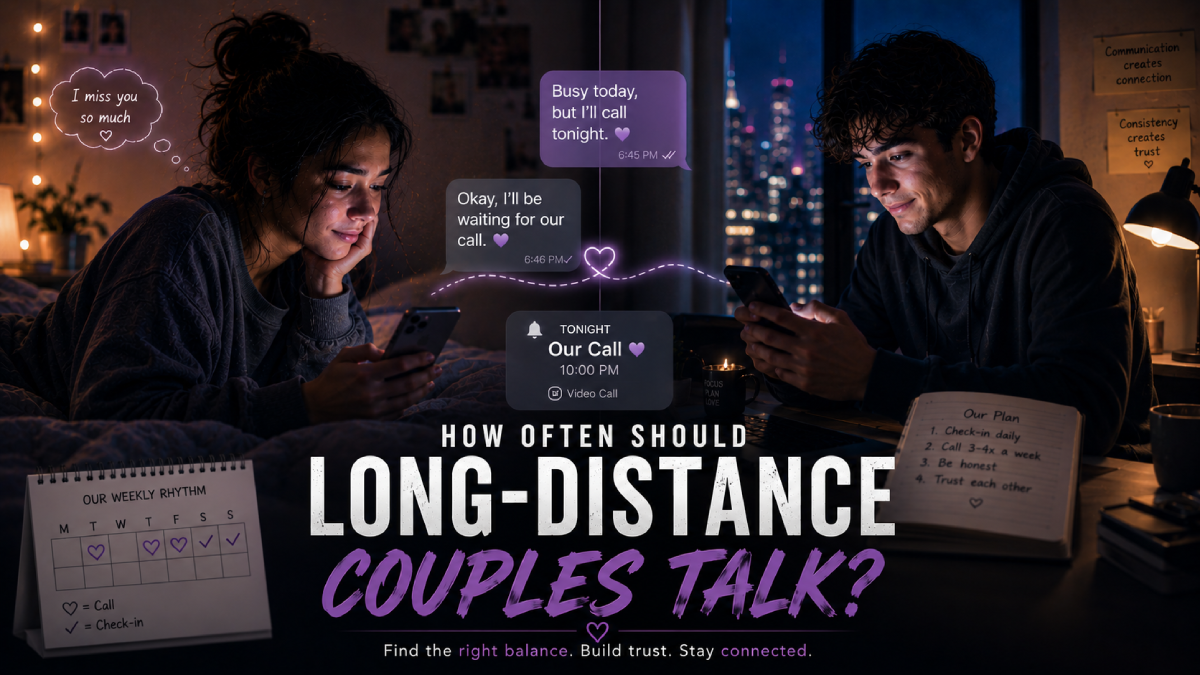
A healthy rhythm may include small daily updates, a few quality calls each week, and one deeper emotional check-in, depending on schedules, time zones, attachment needs, and relationship stage.
There is no perfect number that works for every couple.
But there is a healthy way to find your number.
This guide will help you understand how often long-distance couples should talk, whether daily texting is necessary, how often to call, and how to create a rhythm that feels close without becoming pressured.
How Often Should Long-Distance Couples Talk?
The honest answer is: long-distance couples should talk often enough to feel emotionally connected, but not so much that communication starts feeling forced, pressured, or exhausting.
That may sound simple, but it matters.
Because every couple has a different rhythm.
Some couples feel close with daily texts and two long calls a week.
Some need a short call every night.
Some are okay with fewer calls if the communication feels warm and reliable.
Some need more reassurance during stressful phases.
Some need more space during busy seasons.
So instead of asking, “What is the correct number?” ask:
“What rhythm makes both of us feel remembered, respected, and emotionally safe?”
That is the real answer.
The Honest Answer: Often Enough to Feel Connected, Not So Much That It Feels Forced
In a long-distance relationship, communication should feel like a bridge.
Not a test.
Not attendance.
Not emotional surveillance.
Not something one person has to perform just to avoid conflict.
If you are talking constantly but still feeling lonely, the issue may not be frequency.
It may be emotional presence.
And if you are talking less but both people feel secure, included, and loved, that may be healthier than forcing calls every night.
The goal is not maximum communication.
The goal is meaningful communication.
There Is No Universal Rule for Every Couple
Some people will tell you, “Long-distance couples should talk every day.”
Others will say, “You do not need to talk daily if the trust is strong.”
Both can be true for different couples.
A couple with similar schedules may enjoy daily calls.
A couple with different time zones may rely more on voice notes and planned weekend calls.
A newly long-distance couple may need more reassurance.
A couple that has been long-distance for years may have a more relaxed rhythm.
Your relationship does not need to copy anyone else.
It needs to work for both of you.
Emotional Impact Line
The real question is not “how many times did we talk?”
It is “did we feel emotionally connected when we did?”
Because you can talk all day and still feel unseen.
And sometimes one thoughtful message can make you feel more loved than twenty dry replies.
Micro Takeaway
Healthy long-distance communication is predictable, warm, and sustainable.
Not constant.
Not careless.
Not forced.
Predictable, warm, and sustainable.
A Healthy Baseline for Many Couples
If you need a starting point, here is a healthy baseline many long-distance couples can adapt:
Small daily updates.
Two to four quality calls per week.
One weekly emotional check-in.
This is not a rule.
It is a framework.
You can adjust it based on your schedules, emotional needs, time zones, and relationship stage.
Small Daily Updates
Small daily updates help your partner feel included in your life.
They do not need to be long.
They can be simple:
“Reached work.”
“Today is hectic, but I miss you.”
“Going out with friends, I’ll text you later.”
“I’m tired today, but we’re okay.”
“Saw this and thought of you.”
These messages are small, but in long-distance, they are emotional touchpoints.
They say:
“You are still part of my day.”
Two to Four Quality Calls Per Week
Calls matter because voice carries emotion that text often loses.
But not every couple needs long calls every day.
For many couples, two to four good-quality calls per week can feel healthier than forced daily calls where both people are tired, distracted, or irritated.
The key is quality.
A present 30-minute call can feel more intimate than a distracted two-hour call.
One Weekly Emotional Check-In
This is where many long-distance couples miss a big opportunity.
A weekly emotional check-in helps both people talk about the relationship before resentment builds.
Ask:
“Did we feel connected this week?”
“Did anything feel off?”
“Did communication feel enough?”
“Do we need to adjust anything?”
This prevents small disconnection from becoming a silent emotional gap.
Important Note
This is a starting point, not a rulebook.
If your relationship needs more, talk about it.
If it needs less, talk about it.
The point is not to follow a schedule perfectly.
The point is to create a rhythm both people trust.
Why Quality Matters More Than Constant Contact
Talking more does not always mean loving better.
Sometimes couples text all day but never say anything emotionally meaningful.
They exchange updates, but not feelings.
They send memes, but avoid difficult conversations.
They say goodnight, but do not repair hurt.
They are in contact, but not truly connected.
That is why quality matters more than constant contact.
Talking All Day Can Still Feel Empty If There Is No Emotional Presence
You may have experienced this.
You talked to them all day, but still felt lonely.
Or you had one honest call and suddenly felt close again.
That is because emotional presence matters more than communication quantity.
Emotional presence sounds like:
“I’m listening.”
“I remember what you said.”
“I care about how you felt.”
“I know I’ve been busy, but I’m still here.”
“You matter to me.”
This is what actually creates closeness.
Not just the number of messages.
Should Long-Distance Couples Talk Every Day?
Long-distance couples do not always have to talk deeply every day, but some form of daily contact often helps many couples feel secure.
That could be a text.
A voice note.
A short call.
A photo.
A goodnight message.
A small update.
Daily contact does not have to mean constant texting.
It can simply mean:
“I am still present in your life, even from far away.”
Daily Contact Helps Many Couples Feel Secure
Daily contact can be grounding in long-distance.
It reminds both people that the relationship is still active.
Not paused.
Not forgotten.
Not only alive during weekend calls.
Even a small message can help your partner feel emotionally included.
A Small Message Can Keep the Relationship Emotionally Present
A small text like:
“Busy day, but thinking of you.”
Can calm a lot.
A quick voice note like:
“I’m tired, but I wanted you to hear my voice.”
Can make someone feel loved.
A goodnight message like:
“Sleep well, I miss you.”
Can soften the distance.
These are not huge gestures.
But they keep emotional presence alive.
But Daily Deep Calls Are Not Always Realistic
Some people feel guilty because they cannot call every day.
But daily deep calls are not always realistic.
People have work, studies, family, exhaustion, different time zones, mental health dips, and responsibilities.
If you force a long call every night when both people are drained, communication can start feeling like an obligation.
And love should not always feel like an obligation.
Work, Studies, Family, Mental Health, and Time Zones Matter
A healthy long-distance relationship should fit real life.
Not fantasy life.
If one partner works late, studies long hours, lives in a different time zone, or has family responsibilities, the communication rhythm has to respect that.
But here is the important part:
Being busy is understandable.
Being emotionally careless is different.
A busy partner can still communicate with warmth.
They can still say:
“Today is packed, but I’m not ignoring you. I’ll call tomorrow.”
That one sentence can prevent so much overthinking.
When Not Talking Every Day Is Healthy
Not talking every day can be healthy if both people feel secure, updated, and emotionally considered.
Some couples do well with less frequent communication because their trust is strong and their lives are balanced.
They may not talk deeply every day, but they still feel connected.
They know when they will talk next.
They do not feel ignored.
They do not feel punished by silence.
They do not feel like they are guessing where they stand.
Both People Feel Secure, Updated, and Emotionally Considered
If both of you are comfortable with less daily contact, that is okay.
Your relationship does not need to look like someone else’s relationship.
The key is mutual comfort.
If both people feel safe, less contact may work.
If one person is quietly hurting, then the rhythm needs adjustment.
When Not Talking Every Day Becomes a Problem
Not talking every day becomes a problem when one person feels forgotten, avoided, or emotionally unsafe.
If your partner regularly disappears without explanation…
If you never know when you will talk…
If you are always waiting and guessing…
If they make you feel needy for wanting basic connection…
Then the issue may not be “daily talking.”
The issue may be emotional inconsistency.
One Person Feels Forgotten, Avoided, or Emotionally Unsafe
A long-distance relationship needs some form of emotional reliability.
If communication is random, cold, unclear, or one-sided, insecurity will naturally grow.
Not because you are weak.
Because the relationship does not feel emotionally held.
Emotional Clarity
Not talking every day is not automatically a red flag.
Feeling consistently ignored is.
That is the difference.
How Often Should Long-Distance Couples Call?
Long-distance couples should call often enough to feel emotionally connected, but not so often that calls become forced, rushed, or stressful.
For many couples, two to four quality calls per week can work well.
But some couples need short daily calls.
Some need fewer but deeper calls.
Some rely on video calls more than phone calls.
The right rhythm depends on what helps both people feel close without feeling pressured.
Calls Should Feel Like Connection, Not Attendance
A call should not feel like checking a box.
It should not feel like:
“If we do not call, we failed.”
It should feel like:
“This is our time to reconnect.”
When calls become attendance, both people can start feeling emotionally tired.
One person may feel they are being forced.
The other may feel the call is not genuine.
That can create resentment.
Forced Calls Can Create Pressure Instead of Closeness
A forced call can feel worse than no call sometimes.
Because the person is technically there, but emotionally absent.
They sound distracted.
They seem irritated.
They are half-listening.
They want to leave.
And then you feel even lonelier.
So instead of forcing daily long calls, create calls that both people can actually be present for.
Presence matters.
Suggested Calling Rhythm Based on Relationship Needs
There is no perfect calling schedule, but these frameworks can help.
Use them as starting points.
Adjust them based on your relationship.
For Busy Couples
Two to three quality calls per week.
This works when both people have demanding schedules.
The goal is not to talk constantly.
The goal is to protect intentional time.
For example:
One midweek call
One weekend call
One spontaneous short call when possible
This can feel stable without becoming overwhelming.
For Anxious or Newly Long-Distance Couples
Short daily calls or voice notes + planned longer calls.
When a relationship recently became long-distance, both people may need extra reassurance.
Short daily calls can help.
Even 5–10 minutes can make a difference.
But if daily calls are not possible, voice notes can help fill the gap.
A voice note feels more intimate than text because it carries warmth.
For Different Time Zones
Scheduled deep calls + asynchronous voice notes.
Different time zones can make real-time calling difficult.
So use a mix.
Send voice notes when one person is asleep.
Leave photos from your day.
Schedule one or two deeper calls when both are awake and emotionally available.
The goal is to stop making time zones feel like rejection.
Sometimes it is not lack of love.
It is lack of overlapping time.
When Video Calls Matter More
Video calls matter more when the conversation needs emotional context.
Text can hide tone.
Voice can help.
But video gives facial expression, eye contact, and presence.
It is especially useful when the relationship feels distant.
Emotional Topics, Conflict Repair, Missing Each Other, and Future Planning
Use video calls for:
Conflict repair
Future conversations
Emotional check-ins
Reassurance after disconnection
Missing each other deeply
Talking about trust issues
Planning visits
Feeling close after a dry phase
Video calls should not be only for serious talks, though.
They can also be used for virtual dates, dinner calls, watching shows, or just being together quietly.
How Often Should You Text in a Long-Distance Relationship?
You should text often enough to keep your partner emotionally included, but not so much that texting becomes monitoring.
Texting in long-distance works best when it feels warm, clear, and natural.
It should help both people feel remembered.
Not trapped.
Texting Should Create Inclusion, Not Constant Monitoring
Texting is not supposed to be a report system.
You do not need to update your partner every minute.
But small updates can make them feel part of your world.
There is a difference between:
“I want to include you.”
And:
“I have to prove where I am.”
The first builds closeness.
The second creates pressure.
Small Updates Help Your Partner Feel Part of Your Day
A simple message can say:
“You are still with me emotionally.”
Examples:
“This song reminded me of you.”
“Going into a meeting now, wish me luck.”
“Today feels heavy. I wish I could hug you.”
“I’m with friends, but I’ll text you when I’m back.”
These messages are not about control.
They are about connection.
Use “Busy But Connected” Texts
This is one of the best habits for long-distance couples.
When you are busy, do not disappear completely.
Send a message that gives context, reassurance, and a next connection point.
This prevents your partner from feeling ignored.
Context + Reassurance + Next Connection Point
The formula is simple:
Busy context + reassurance + next connection point.
For example:
“Work is hectic today, but I miss you. I’ll call after dinner.”
This tells your partner:
What is happening
That they still matter
When connection will happen again
That is emotional safety in one sentence.
Example
“Today is packed, but I’m not ignoring you. I’ll call after dinner.”
This is so much better than just disappearing.
It helps the other person feel considered.
Avoid Measuring Love Only by Reply Speed
Reply speed matters sometimes.
But it should not become the only measurement of love.
Someone can reply late and still love you.
Someone can reply fast and still be emotionally unavailable.
Do not measure the whole relationship by one response time.
Look at the pattern.
Responsiveness Matters, But Instant Replies Are Not Always Realistic
A healthy partner does not need to reply instantly every time.
But they should be emotionally responsive overall.
They should come back.
They should explain when needed.
They should care if you feel disconnected.
They should not regularly disappear and make you feel guilty for noticing.
There is a difference between being busy and being careless.
When Texting Frequency Feels Unbalanced
Texting can become painful when one person always initiates.
One person sends good morning texts.
One person asks questions.
One person checks in.
One person sends emotional messages.
The other only replies.
Over time, this feels one-sided.
One Person Initiates Everything While the Other Only Responds
If you are always initiating, you may start wondering:
“Would we even talk if I stopped?”
That thought hurts.
So instead of silently testing them, talk about it.
Say:
“I’ve noticed I initiate most of our conversations, and it’s starting to make me feel like I’m carrying the connection. Can we find a better balance?”
This is direct but not attacking.
Why One Partner May Want to Talk More Than the Other
Different communication needs are common in long-distance relationships.
One person may need frequent reassurance.
The other may need more space.
One person may feel loved through texts.
The other may feel connected through quality calls.
One person may feel anxious during silence.
The other may feel overwhelmed by constant contact.
This does not automatically mean the relationship is doomed.
But it does mean both people need to understand each other.
Attachment Needs Can Be Different
Attachment patterns can affect how much communication each person needs.
An anxious partner may need more closeness to feel safe.
An avoidant or overwhelmed partner may need more space to feel emotionally regulated.
These differences can create conflict if not understood.
Anxious Partners May Need More Reassurance
If you are more anxious, less communication may feel like danger.
You may think:
“They are losing interest.”
“They do not miss me.”
“I care more.”
You may need predictable communication and gentle reassurance to feel secure.
That need is not wrong.
But it should be expressed clearly, not through panic or testing.
Avoidant or Overwhelmed Partners May Need More Space
If your partner needs more space, it does not always mean they love you less.
They may feel drained by constant texting.
They may need quiet time.
They may prefer fewer but deeper conversations.
But they also need to understand that in long-distance, unexplained silence can hurt.
So space should come with reassurance.
For example:
“I need some quiet time today, but we’re okay. I’ll message you at night.”
That is space with care.
Lifestyle and Energy Levels Matter
Sometimes communication differences are not about attachment.
They are about real life.
Work.
Studies.
Family.
Mental health.
Time zones.
Social energy.
Some people have demanding routines.
Some people are bad at texting but good on calls.
Some people need time alone after a long day.
These things matter.
Busy Schedules Do Not Always Mean Lack of Love
A busy partner is not automatically an uninterested partner.
But a caring busy partner communicates.
They do not leave you confused for days.
They do not make you feel silly for needing connection.
They may not be available all the time, but they make effort visible.
That is the difference.
Communication Style Differences Can Feel Personal
One person may think texting is a love language.
The other may think texting is just practical.
One person may feel loved by goodnight messages.
The other may not understand why it matters.
One person may prefer voice notes.
The other may prefer calls.
If these differences are not discussed, they become emotional misunderstandings.
One Person Sees Texting as Love; the Other Sees Calls as Quality Time
This is why you need to ask:
“What kind of communication makes you feel loved?”
Do not assume.
Maybe your partner does not need constant texts but needs one meaningful call.
Maybe you do not need long calls but need affectionate messages.
Maybe both of you are trying, but in different languages.
Micro Insight
Different communication needs do not automatically mean incompatibility, but they do need honest negotiation.
Love does not mean needing the same thing.
It means caring enough to understand what the other person needs.
How to Create a Healthy Long-Distance Communication Routine
A healthy long-distance communication routine should feel supportive.
Not suffocating.
Not random.
Not one-sided.
Not forced.
The best routine is one both people can actually follow and emotionally trust.
Step 1: Talk About What “Enough Communication” Means to Each of You
The word “enough” is different for different people.
For one person, enough means texting throughout the day.
For another, enough means one good call at night.
For someone else, enough means a few messages and a long weekend call.
So ask each other directly.
Ask What Makes Each Person Feel Loved, Ignored, Pressured, or Safe
Ask:
What makes you feel loved from far away?
What makes you feel ignored?
What kind of communication feels pressuring?
What helps you feel safe?
Do you prefer texts, calls, voice notes, or video?
How should we handle busy days?
What should we do when communication feels off?
This conversation can save your relationship from many repeated fights.
Step 2: Build a Rhythm Around Real Life, Not Fantasy
Do not create a communication routine that only works in an ideal world.
Create one that works in your real life.
With real schedules.
Real tiredness.
Real responsibilities.
Real time zones.
Real emotional capacity.
Consider Time Zones, Work, Studies, Family, and Emotional Capacity
A realistic rhythm might look like:
Short daily messages
Voice notes when schedules do not match.
Planned calls twice a week
Weekend video date
Emotional check-in once a week
Do not make promises you cannot keep.
Broken communication promises damage trust.
It is better to promise less and show up consistently than promise more and keep failing.
Step 3: Combine Texts, Calls, Voice Notes, and Video
Different formats meet different emotional needs.
Texts are good for updates.
Voice notes add warmth.
Calls create emotional closeness.
Video helps with presence.
Photos make daily life feel shared.
Do not rely on one format for everything.
Different Formats Meet Different Emotional Needs
Use texting for:
Small updates
Affection
Quick reassurance
Use voice notes for:
Warmth
Missing each other
Soft emotional messages
Use calls for:
Real connection
Storytelling
Daily sharing
Use video for:
Emotional topics
Conflict repair
Virtual dates
Future planning
This gives your relationship more texture.
Step 4: Create a Weekly Emotional Check-In
A weekly check-in helps you adjust before resentment builds.
It can be simple.
It does not need to feel like a serious meeting.
Just one honest conversation.
Do Not Wait Until Resentment Builds
When communication needs are not discussed, they come out sideways.
As coldness.
Sarcasm.
Overthinking.
Arguments.
Silent disappointment.
A weekly check-in gives both people a safe place to say:
“This worked.”
“This hurt.”
“I need more of this.”
“Can we change this?”
Questions to Ask
Did you feel connected this week?
Did our communication feel enough?
Did anything make you feel ignored or pressured?
What should we adjust next week?
Did we have enough emotional quality, not just contact?
Is there anything we avoided talking about?
These questions help communication stay alive.
Step 5: Review the Routine Instead of Fighting About the Same Issue Again
Communication needs change over time.
A routine that worked in one season may not work in another.
Exams, jobs, family stress, health, time zones, and emotional needs can change.
So review the rhythm.
Do not keep fighting about the same issue without changing the system.
Communication Needs Change Over Time
Say:
“I think our communication rhythm worked before, but lately it’s not feeling enough for me. Can we adjust it?”
Or:
“I feel a bit overwhelmed by constant texting lately, but I still want us to feel close. Can we find a better balance?”
This is mature.
It treats the issue as something to solve together.
What to Do If You Want to Talk More Than Your Partner
Wanting to talk more does not make you needy.
It may mean you need more reassurance, closeness, predictability, or emotional presence.
But how you express that need matters.
The goal is to ask clearly without making your partner feel attacked.
First, Name What You Actually Need
Before saying, “We don’t talk enough,” ask yourself:
What am I actually missing?
Is it reassurance?
Attention?
Closeness?
Predictability?
Emotional warmth?
Future clarity?
Do I want more messages, or do I want more meaningful messages?
Do I want more calls, or do I want the calls to feel more present?
This matters.
Because the solution depends on the real need.
Is It Reassurance, Attention, Closeness, Predictability, or Future Clarity?
If you need reassurance, ask for reassurance.
If you need predictability, ask for a routine.
If you need closeness, ask for better quality time.
If you need future clarity, ask for a future conversation.
Do not reduce every need to “talk more.”
Sometimes the real need is deeper.
Ask Without Accusing
If you start with blame, your partner may become defensive.
Instead of:
“You never make time for me.”
Try:
“I’ve been feeling a little disconnected, and I think I need more intentional time with you.”
This is softer and more effective.
Use “I Feel” Instead of “You Never”
“I feel” language helps your partner hear your pain without immediately defending themselves.
It does not make your need weak.
It makes your communication clearer.
Script
“I know you are busy, but I feel more secure when we have a proper time to connect. Can we plan something realistic?”
This sentence respects both sides.
Your need for closeness.
Their real-life capacity.
Do Not Turn Communication Into a Test
When you feel hurt, you may want to test them.
Stop texting first.
Wait to see if they notice.
Reply coldly.
Act distant.
But testing usually creates more confusion.
It does not build closeness.
Testing Creates Confusion Instead of Closeness
If you want more communication, say it.
Do not make your partner guess through your silence.
That may feel vulnerable, but it is healthier.
A relationship should not become an emotional exam.
Notice Whether They Are Willing to Meet You Halfway
After you express your need, notice their response.
Do they care?
Do they try?
Do they adjust?
Do they offer alternatives?
Or do they dismiss you?
This tells you a lot.
Mutual Adjustment Is the Real Sign of Care
Your partner may not be able to give exactly what you want.
But if they care, they will try to find a middle ground.
That is love in action.
Not perfection.
Willingness.
What to Do If Your Partner Wants to Talk More Than You
Maybe you are the partner who needs more space.
Maybe you love them, but constant communication drains you.
Maybe you feel pressured by too many texts.
Maybe you do not understand why they get anxious when you are simply busy.
This does not make you bad.
But you still have emotional responsibility.
Especially in long-distance.
Do Not Shame Them for Needing Reassurance
If your partner needs more reassurance, do not immediately call them needy.
Try to understand what is underneath.
They may miss you.
They may feel far from you.
They may be adjusting to distance.
They may be triggered by silence.
They may need predictability to feel safe.
Their Need May Come From Missing You, Not Controlling You
Of course, you should not accept controlling behavior.
But not every need for connection is control.
Sometimes your partner is simply saying:
“I miss feeling close to you.”
Try to hear that before reacting defensively.
Explain Your Capacity With Warmth
If you cannot talk as much as they want, explain it with care.
Do not just disappear.
Do not say, “You’re too much.”
Do not make them feel ashamed.
Say what you can realistically give.
And reassure them that needing space does not mean you care less.
Space Feels Safer When It Comes With Reassurance
Space without reassurance can feel like rejection.
Space with reassurance feels healthier.
Say:
“I need some quiet time today, but we are okay.”
Or:
“I can’t text constantly during work, but I want to call properly tonight.”
This helps your partner feel safe.
Script
“I care about you, but I get drained by constant texting. Can we do fewer texts and more focused calls?”
This is honest.
It does not shame them.
It offers a solution.
Offer Predictability Instead of Disappearing
If you need space, give context.
Do not vanish and expect them to understand.
Predictability helps reduce anxiety.
Silence Without Context Can Feel Like Rejection
If you say:
“I’ll be offline for a few hours, but I’ll message you at night,”
That feels very different from disappearing with no explanation.
The first creates safety.
The second creates fear.
Make Your Effort Visible
If you are not naturally expressive, you may need to be more intentional in long-distance.
Your partner cannot read your mind.
They need visible care.
Small Reassurance Can Reduce Big Anxiety
A simple message like:
“I know I’ve been quiet today, but I’m not distant from you.”
Can calm a lot.
It takes ten seconds.
But emotionally, it can mean so much.
Common Mistakes Couples Make With Communication Frequency
Most long-distance couples do not struggle because they do not care.
They struggle because they never define what healthy communication means for them.
Then both people start measuring love by different rules.
One counts calls.
One counts freedom.
One counts effort.
One counts pressure.
And both feel misunderstood.
Mistake 1: Thinking More Talking Always Means More Love
More talking can help.
But it is not always more love.
Sometimes more talking becomes pressure.
Sometimes it becomes routine.
Sometimes it becomes dry.
Sometimes it becomes emotional dependency.
Why It Is Harmful
It can create pressure without real emotional closeness.
If you talk constantly but do not feel seen, the issue is not frequency.
It is emotional quality.
Emotional Consequence
You may talk constantly and still feel unseen.
That can feel deeply frustrating because technically, communication is happening.
But emotionally, connection is not.
Mistake 2: Using Busyness as an Excuse for Emotional Neglect
Being busy is real.
But busyness should not become a permanent excuse for emotional neglect.
A busy partner can still be thoughtful.
A busy partner can still send one message.
A busy partner can still reschedule with care.
A busy partner can still make effort visible.
Why It Is Harmful
One person starts feeling like an afterthought.
And feeling like an afterthought in long-distance can be very painful.
Because communication is already limited.
So when even that feels careless, the relationship starts feeling emotionally unsafe.
Mistake 3: Not Discussing Expectations Clearly
Many couples never talk about communication expectations.
They just assume.
Then they get hurt when their partner does not meet expectations they never explained.
Why It Is Harmful
Both people silently measure love by different rules.
One person thinks:
“If they loved me, they would call daily.”
The other thinks:
“If they trusted me, they wouldn’t need so much contact.”
Both are interpreting through their own emotional lens.
You need to name the rules before judging each other by them.
Mistake 4: Comparing Your Communication to Other Couples
Other couples may talk every night.
Some may barely text during the day.
Some may be constantly on FaceTime.
Some may send long paragraphs.
Some may be okay with short updates.
None of that means your relationship is wrong.
Why It Is Harmful
You may copy a rhythm that does not fit your relationship.
Comparison creates unnecessary pressure.
Your communication rhythm should be built around your actual lives and needs.
Not someone else’s aesthetic relationship online.
Mistake 5: Ignoring the Emotional Meaning Behind “We Don’t Talk Enough”
When someone says, “We don’t talk enough,” they may not only mean the number of messages.
They may mean:
“I feel unimportant.”
“I miss feeling close.”
“I do not feel included in your life.”
“I feel like I am carrying this relationship.”
“I need more emotional reassurance.”
So do not respond only to the surface sentence.
Listen for the emotion underneath.
Why It Is Harmful
The real issue may be feeling unimportant, not the number of messages.
If you solve only the number, but not the emotional need, the problem will come back.
When Communication Frequency Is a Red Flag
Less communication is not always a red flag.
But certain patterns are.
The difference matters.
Because sometimes people panic over normal busyness.
And sometimes people excuse emotional neglect by saying, “They’re just busy.”
You need clarity.
They Regularly Disappear Without Explanation
If your partner disappears often and gives no explanation, that can damage emotional safety.
Needing space is okay.
Vanishing without care is different.
They Only Talk When It Is Convenient for Them
If communication only happens on their terms, your needs may start feeling invisible.
A relationship cannot survive on one person’s convenience and the other person’s patience.
They Make You Feel Needy for Wanting Basic Connection
Wanting connection in a long-distance relationship is normal.
If they make you feel dramatic for wanting basic communication, that is not fair.
You are allowed to need emotional presence.
You Are Always Initiating, Planning, and Repairing
If you are always the one starting conversations, planning calls, asking for repair, and keeping the relationship alive, the communication is one-sided.
That deserves attention.
They Avoid Every Deeper Conversation
If they talk casually but avoid every emotional or future-oriented conversation, the relationship may lack depth.
Long-distance needs emotional honesty.
Not only updates.
You Feel More Lonely With Them Than Without Them
This is painful but important.
If being in the relationship makes you feel more alone than being single would, something is wrong.
Love should not make you feel permanently abandoned.
Emotional Clarity
Less talking is not always a problem.
Feeling emotionally abandoned is.
That is the line to remember.
When to Walk Away From a Long-Distance Relationship With Poor Communication
Walking away is not always about lack of love.
Sometimes it is about lack of emotional safety.
You may still love them.
You may still miss them.
You may still hope things improve.
But if communication stays one-sided, dismissive, and emotionally neglectful, the relationship can slowly drain you.
Walk Away When Communication Is One-Sided for Too Long
Uneven seasons happen.
But if communication has been one-sided for a long time, that matters.
If you are always reaching and they are only responding, you may eventually feel emotionally exhausted.
A relationship needs mutual effort.
Not perfect equality every day.
But mutual care overall.
Walk Away When Every Need Is Dismissed as “Too Much”
If every time you ask for more connection, they call you needy, clingy, dramatic, or difficult, that is not healthy communication.
A caring partner may not meet every need perfectly.
But they should not shame you for having needs.
Walk Away When There Is No Effort, No Repair, and No Future Direction
Long-distance can survive busy schedules.
It can survive missed calls.
It can survive hard phases.
But it cannot survive forever without effort, repair, and direction.
If there is no communication, no plan, and no willingness to improve, you may be holding onto the idea of the relationship more than the reality.
Walk Away When You Keep Shrinking Your Needs to Keep the Relationship Alive
If you have stopped asking for calls because you fear they will get annoyed…
If you pretend you are okay with less because you do not want to lose them…
If you convince yourself that basic communication is “too much”…
Pause.
You may not be adjusting.
You may be shrinking.
And love should not make you disappear.
Reality Check
A relationship can survive less communication, but not permanent emotional neglect.
Distance is hard.
But emotional absence is different.
Final Thoughts: The Right Amount of Talking Should Feel Safe, Not Forced
So, how often should long-distance couples talk?
Enough to feel connected.
Enough to feel remembered.
Enough to feel emotionally included.
But not so much that communication becomes pressure, control, or performance.
There is no perfect number.
But there is a healthy feeling.
You should feel like both people are trying.
You should feel like communication has warmth.
You should feel like silence is not always scary because the relationship has trust.
You should feel like your needs can be discussed without shame.
You should feel like your partner’s space does not mean emotional disappearance.
And your partner should feel like your need for connection is not a trap.
That is the balance.
Reassurance
Long-distance couples do not need to talk all day to be strong.
They need communication that feels warm, predictable, honest, and emotionally safe.
If you need more communication, you are not automatically needy.
If your partner needs space, they are not automatically careless.
The real question is whether both people are willing to build a rhythm where closeness and breathing room can exist together.
Emotional Closure
The healthiest rhythm is not the most intense one.
It is the one where both people feel remembered without feeling trapped.
It is the one where one person does not have to beg, and the other does not feel monitored.
It is the one where busy days come with reassurance.
Where silence comes with trust.
Where calls feel like connection, not attendance.
Where both people understand:
“We do not have to talk every second to love each other, but we do need to make each other feel emotionally present.”
That is what long-distance love needs.
Not perfect availability.
Presence.
Warmth.
Consistency.
And two people who care enough to adjust for each other.
If communication frequency is making you anxious, read next:
Long-Distance Relationship Communication Tips for When Texts Start Feeling Dry
Because sometimes the issue is not only how often you talk.
Sometimes it is whether your communication feels warm, clear, and emotionally safe enough to make distance feel less lonely.