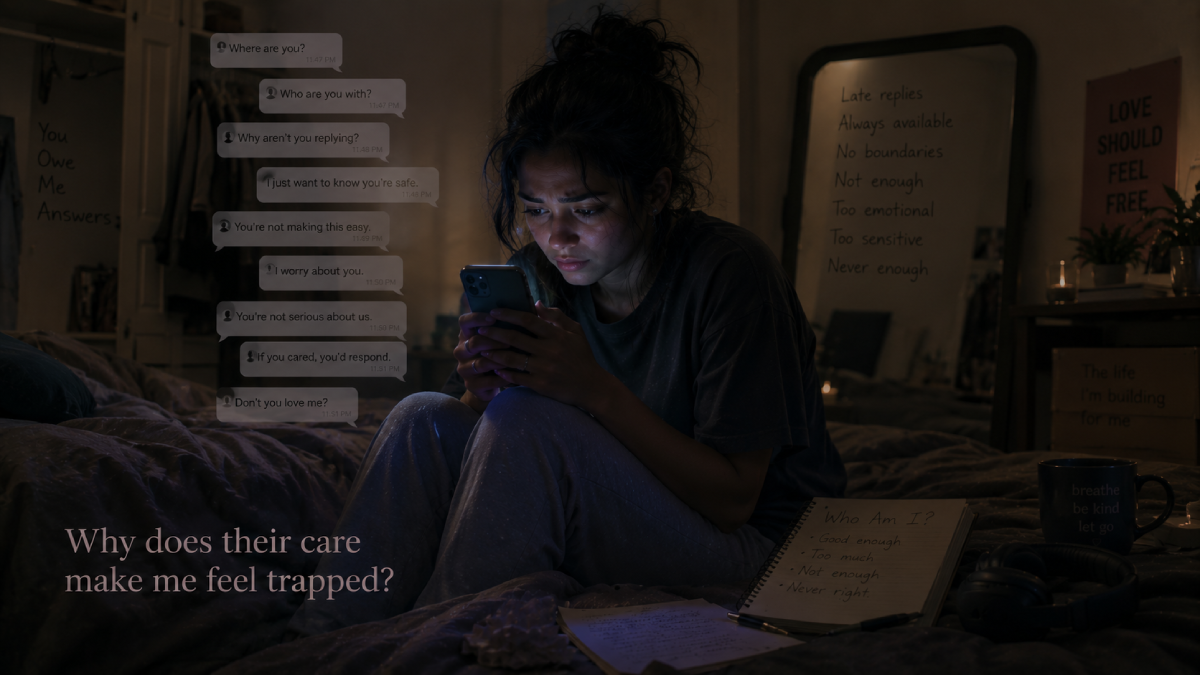
Love or Control? 12 Signs Their Care Is Starting to Own You
Love, Care, Protection, or Control?
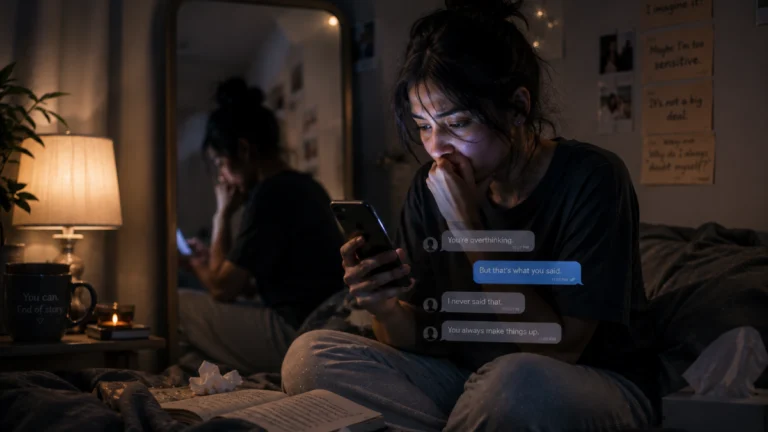
Have you ever felt confused because their care felt sweet at first, but now it feels like you are being watched, limited, or managed?
Maybe in the beginning, their attention felt romantic.
They wanted to know where you were.
They asked who you were with.
They noticed what you wore.
They replied fast.
They got jealous.
They said things like:
“I just care about you.”
“I’m only protective because I love you.”
“I don’t trust other people around you.”
“If you love me, why do you need privacy?”
At first, maybe it felt intense.
Maybe even special.
Like someone cared enough to notice every detail.
But slowly, something changed.
Their care started feeling heavy.
Their questions started feeling like checking.
Their jealousy started feeling like pressure.
Their “protection” started limiting your freedom.
And now you may be wondering:
“Is this love or control?”
It can be confusing because control does not always arrive loudly.
Sometimes control arrives wearing the clothes of love.
Concern.
Protection.
Jealousy.
Possessiveness.
“Care.”
“I’m doing this for you.”
“I just don’t want to lose you.”
And because you care about them, you may keep explaining their behavior.
Maybe they are insecure.
Maybe they have been hurt before.
Maybe they are just scared of losing you.
Maybe they love deeply.
Maybe you are overreacting.
But here is the quiet truth:
Love should not make you feel smaller.
Love should not make you feel watched.
Love should not make you feel guilty for having friends, privacy, clothes, opinions, space, or a life outside the relationship.
This blog will help you understand the difference between love and control, signs of controlling behavior in relationships, why control can feel like love at first, and what to do if someone’s care is slowly limiting your freedom.
Because real love does not need to own you to feel secure.
Is It Love or Control?
Love respects your freedom, boundaries, individuality, and emotional safety.
Control tries to manage your choices, friendships, clothes, phone, time, emotions, or behavior to reduce someone else’s insecurity.
Love cares about your well-being.
Control limits your independence.
That is the core difference.
Love may say:
“Text me when you reach safely.”
Control says:
“Send me your location the whole time or I’ll be upset.”
Love may say:
“I felt a little insecure. Can we talk?”
Control says:
“Stop talking to that person if you care about me.”
Love may say:
“I trust you, but I need reassurance.”
Control says:
“Give me your password if you have nothing to hide.”
The difference is not always in the words.
Sometimes it is in the pattern.
Does their care help you feel safe?
Or does it make you feel monitored?
Does their love make your world bigger?
Or does it slowly make your world smaller?
Answer-First Explanation
Love gives you room to be a full person.
Control tries to make you emotionally, socially, or physically available on someone else’s terms.
Love respects that you have your own friendships, privacy, body, dreams, time, and choices.
Control treats those things as threats.
When someone loves you healthily, they may have insecurities, but they do not turn those insecurities into rules for your life.
When someone controls you, they may say it is because they care, but the result is that you become less free.
That result matters.
The Emotional Difference
Love says:
“I care about your safety.”
Control says:
“I need access to your choices, so I feel safe.”
Love says:
“I want to understand you.”
Control says:
“I need to approve you.”
Love says:
“Your freedom does not threaten me.”
Control says:
“Your independence makes me uncomfortable, so I will limit it.”
Love supports your emotional safety.
Control protects someone else’s access to you.
And sometimes, that difference becomes clear only when you try to say no.
Micro Takeaway
Love makes you feel safe to be yourself.
Control makes you feel guilty for being yourself.
If someone’s “care” keeps making you shrink, pause.
Your discomfort may be telling you something your heart is still trying to explain away.
Love vs Control: What Is the Difference?
The difference between love and control is not always easy to see in the beginning.
Because control often starts softly.
A little jealousy.
A few extra questions.
A comment about your clothes.
A reaction to your friends.
A request for your password “just for reassurance.”
A problem whenever you do something without them.
At first, each thing may seem small.
But slowly, the small things become a pattern.
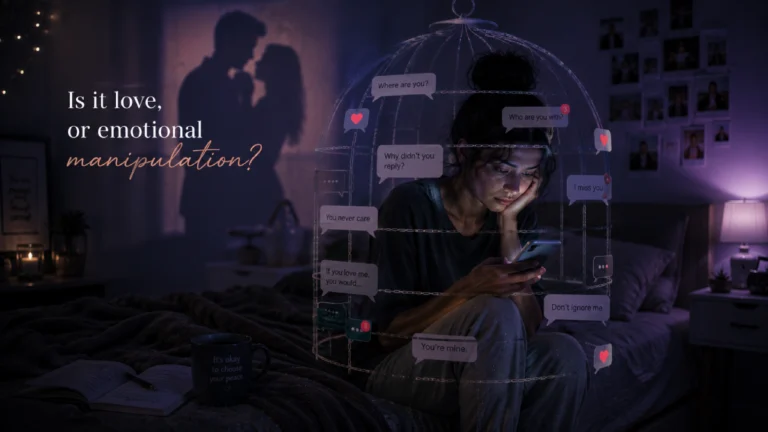
And the pattern becomes a cage.
Not always a visible cage.
Sometimes it is emotional.
You start asking before doing normal things.
You start editing yourself.
You start avoiding certain people.
You start dressing differently.
You start posting less.
You start explaining more.
You start choosing peace over honesty because their reaction feels too exhausting.
That is when love begins to feel like control.
Love vs Control Comparison Table
| Love | Control |
| Respects your choices | Manages your choices |
| Trusts you | Monitors you |
| Supports your friendships | Slowly isolates you |
| Communicates insecurity honestly | Uses insecurity to limit you |
| Respects privacy | Demands access |
| Encourages growth | Feels threatened by independence |
| Handles jealousy maturely | Uses jealousy as permission to control |
| Accepts boundaries | Punishes boundaries |
| Makes you feel free | Makes you feel watched |
| Protects your well-being | Protects their access to you |
| Lets you be yourself | Makes you edit yourself |
| Builds trust | Demands proof repeatedly |
| Talks through discomfort | Creates rules from discomfort |
| Makes space for individuality | Treats individuality as distance |
This table is not about making every insecurity a red flag.
Everyone can feel insecure sometimes.
Everyone can feel jealous sometimes.
Everyone can need reassurance sometimes.
But healthy love takes responsibility for insecurity.
Control makes you responsible for curing it by shrinking your life.
Protective vs Controlling Relationship
Protective love asks:
“Are you safe?”
Controlling love asks:
“Are you still under my influence?”
Protective love may care if you are traveling late at night.
Controlling love wants to know your every movement.
Protective love may worry if someone disrespects you.
Controlling love decides who you are allowed to speak to.
Protective love may say, “I’m concerned.”
Controlling love says, “You can’t.”
The emotional difference is simple but powerful:
Protection supports your safety.
Control reduces your freedom.
Emotional Clarity
Protection does not require ownership.
Care does not require control.
Someone can love you deeply without needing to monitor, manage, approve, or shrink you.
Pyaar mein care hoti hai.
Control mein permission system hota hai.
And you were not born to live inside someone else’s insecurity.
Signs of Controlling Behavior in Relationships
Signs of controlling behavior in relationships include monitoring your phone, checking your location, controlling who you talk to, criticizing your clothes, making you feel guilty for independence, isolating you from friends, using jealousy as proof of love, and punishing boundaries.
These signs may not all appear at once.
Control often grows slowly.
One rule becomes normal.
Then another.
Then another.
Until one day, you realize you are not choosing freely anymore.
You are choosing based on what will avoid a fight.
That is not emotional safety.
That is emotional management.
1. They Want to Know Where You Are All the Time
It may start as concern.
“Text me when you reach.”
That can be caring.
But then it becomes:
“Where are you?”
“Who are you with?”
“Send me a photo.”
“Why did your location turn off?”
“Why didn’t you reply immediately?”
What This Looks Like
They may ask for constant updates, location sharing, screenshots, or proof.
You may feel like you have to document your life to avoid suspicion.
You may start explaining normal things before they even ask.
“I’m with my friends.”
“There are girls and boys both.”
“I’ll send a picture.”
“I’m not doing anything wrong.”
Slowly, your normal freedom starts feeling like something you need to defend.
Emotional Impact
You may start feeling watched instead of cared for.
And that feeling matters.
Because love should not make you feel like you are constantly reporting to someone.
Concern asks if you are safe.
Control asks for evidence that you are still available to be monitored.
2. They Check Your Phone or Demand Passwords
This is one of the clearest lines.
Privacy is normal.
Secrecy and privacy are not the same thing.
You can love someone and still have personal messages, private thoughts, old photos, journal notes, passwords, and digital space.
But a controlling partner may treat privacy like betrayal.
What This Looks Like
They may say:
“If you have nothing to hide, why not show me?”
“Couples should not have secrets.”
“I only check because I’ve been hurt before.”
“If you love me, give me your password.”
“Why did you delete that chat?”
At first, you may give access to prove loyalty.
But proof rarely satisfies control.
After one password, they may want another.
After checking one chat, they may check more.
After one explanation, they may need ten.
Because the real issue is not your phone.
It is their need to manage uncertainty.
Micro Takeaway
Privacy is not betrayal.
You do not have to surrender your personal space to prove you are trustworthy.
Trust built through surveillance is not trust.
It is control wearing a security badge.
3. They Criticize What You Wear
A controlling partner may frame clothing comments as care.
“I don’t want people looking at you.”
“You look too available in that.”
“Why do you need to dress like that?”
“I’m just protecting you.”
But slowly, their discomfort becomes your dress code.
What This Looks Like
They may comment on:
- your clothes
- your makeup
- your photos
- your hairstyle
- your body
- what you post
- how you present yourself
- whether something is “too much”
You may start changing outfits to avoid conflict.
You may stop posting pictures.
You may feel guilty for liking how you look.
You may hear their voice in your head before you choose what to wear.
That is not care.
That is control over your expression.
Emotional Clarity
Someone can have feelings.
But your body is not their insecurity project.
Your clothes are not a loyalty test.
Your self-expression should not become a battlefield.
4. They Dislike Your Friends or Family “For Your Own Good”
Sometimes controlling behavior does not start by saying:
“Don’t meet them.”
It starts by planting doubt.
“Your friends don’t really care about you.”
“Your family controls you.”
“They are a bad influence.”
“They don’t understand our relationship.”
“Why do you tell them everything?”
At first, you may think they are being protective.
But slowly, you may start pulling away from people who care about you.
What This Looks Like
They create distance between you and people who support you.
Maybe they get upset when you spend time with friends.
Maybe they make you feel guilty for talking to family.
Maybe they insult people close to you.
Maybe they say your friends are jealous.
Maybe they say no one understands your love.
Maybe they only feel peaceful when your world revolves around them.
This kind of isolation can be subtle.
You may not notice it at first.
But one day, you realize you do not tell anyone the full truth anymore.
Emotional Impact
When someone separates you from support, the relationship becomes louder than reality.
That is dangerous emotionally.
Because safe people outside the relationship help you remember who you are.
5. They Use Jealousy as Proof of Love
Jealousy can happen in relationships.
But jealousy is not automatically proof of love.
Jealousy is a feeling.
What someone does with that feeling tells you whether it is love or control.
What This Looks Like
They may say:
“I only get jealous because I love you.”
“If I didn’t care, I wouldn’t react.”
“You should feel special that I’m possessive.”
“I don’t like sharing what’s mine.”
That last line may sound romantic in movies.
In real life, it can become suffocating.
You are not a possession.
You are a person.
Emotional Clarity
Jealousy is a feeling.
Control is a behavior.
A healthy partner can say:
“I felt insecure. Can we talk?”
A controlling partner says:
“Because I feel insecure, you need to stop doing normal things.”
One takes responsibility.
The other takes your freedom.
6. They Make You Feel Guilty for Having Independence
Independence should not feel like betrayal.
You should be able to spend time alone.
Meet friends.
Focus on work or studies.
Have hobbies.
Take rest.
Choose your clothes.
Have your own emotional world.
But in controlling dynamics, independence becomes suspicious.
What This Looks Like
They may act hurt when you spend time alone or with others.
They may say:
“You don’t need me anymore.”
“You have changed.”
“You care about everyone except me.”
“I guess I’m not important.”
Suddenly, normal independence becomes emotional injury.
So you shrink.
You cancel plans.
You reply faster.
You stop doing things that make them insecure.
Not because you want to.
Because guilt becomes too heavy.
Emotional Reassurance
Wanting your own life does not mean you love them less.
A healthy relationship should add love to your life, not replace your whole life.
7. They Decide What Is “Allowed” in the Relationship
Healthy relationships can have mutual agreements.
But control creates one-sided rules.
Rules that mostly limit you.
Rules that grow over time.
Rules that are framed as love, loyalty, or respect.
What This Looks Like
Rules may include:
- who you can talk to
- what you can wear
- what you can post
- when you can go out
- how fast you must reply
- whether you can have male/female friends
- what photos are “allowed”
- what topics you can discuss with friends
- how private your phone can be
The issue is not every agreement.
The issue is whether the rules are mutual, respectful, and freely chosen, or fear-based and one-sided.
Emotional Impact
Rules keep increasing, but your freedom keeps shrinking.
That is how control grows.
Not always through one big demand.
Sometimes through many small permissions.
8. They Punish Boundaries With Silence, Anger, or Coldness
A boundary shows you a lot about a relationship.
Because people reveal their emotional maturity when they hear “no.”
A healthy partner may feel disappointed, but they will try to respect your limit.
A controlling partner may punish it.
What This Looks Like
Every limit becomes an emotional consequence.
You say:
“I need space.”
They go cold.
You say:
“I’m not comfortable sharing my password.”
They accuse you.
You say:
“I’m meeting my friends.”
They sulk.
You say:
“Please don’t speak to me like that.”
They say you are dramatic.
Now the boundary becomes exhausting.
And eventually, you may stop setting boundaries to avoid their reaction.
That is not peace.
That is fear.
9. They Say They Trust You, But Act Like They Don’t
Words can sound loving.
Behavior tells the truth.
They may say:
“I trust you.”
But still check your phone.
Still question your friends.
Still monitor your online status.
Still ask for proof.
Still doubt your explanations.
Still make you feel guilty for privacy.
What This Looks Like
Their words say trust.
Their behavior says surveillance.
And that mismatch can make you feel confused.
You may think:
“Maybe they trust me, but they just have anxiety.”
Maybe they do have anxiety.
But anxiety does not permit someone to control you.
Their feelings are valid.
Their controlling behavior is not.
10. They Make You Responsible for Their Insecurity
This is where control often hides.
They feel insecure.
You become responsible.
They feel jealous.
You must change.
They feel anxious.
You must prove yourself.
They fear abandonment.
You must give up independence.
What This Looks Like
You must keep proving loyalty so they do not feel anxious.
You may constantly reassure them.
Explain yourself.
Avoid triggers.
Change your behavior.
Make your world smaller.
Walk on emotional eggshells.
At some point, your life becomes organized around preventing their insecurity.
That is too heavy for one person to carry.
Emotional Reassurance
You can support someone’s healing.
But you cannot become the cure for their insecurity.
Love can offer reassurance.
It should not require self-erasure.
11. You Feel Like You Need Permission to Be Yourself
This is a quiet but powerful sign.
You may not notice it immediately.
But slowly, you start asking internally:
“Will they be okay with this?”
Before posting.
Before dressing.
Before replying.
Before going out.
Before meeting someone.
Before making a plan.
Before saying what you really feel.
What This Looks Like
You ask before dressing, posting, going out, replying, or meeting people.
Maybe not directly.
Maybe only in your head.
But their reaction becomes part of every decision.
You stop moving freely.
You begin living through the filter of their approval.
That is not partnership.
That is permission-based living.
12. You Feel Smaller Than You Used to Feel
Control does not always announce itself.
Sometimes you notice it through your own disappearance.
You used to be more confident.
More expressive.
More social.
More relaxed.
More open.
More yourself.
Now you are careful.
Quiet.
Anxious.
Edited.
Always explaining.
Always proving.
Always avoiding emotional consequences.
Emotional Impact Line
Control does not always arrive as a cage.
Sometimes it arrives as care until you realize you cannot move freely.
If you feel smaller than you used to feel, listen to that.
Your shrinking is information.
Why Does Control Feel Like Love at First?
Control feels like love at first because it often begins with attention, concern, jealousy, intensity, and fear of losing you.
And when someone pays intense attention to you, it can feel romantic.
Especially if you have felt unseen before.
A person who wants to know everything about you may feel deeply invested.
A person who gets jealous may feel emotionally attached.
A person who wants constant updates may feel protective.
A person who says they cannot lose you may feel serious.
But intensity is not always intimacy.
Sometimes intensity is control, warming up its hands before it starts tightening its grip.
It Can Start as Intense Attention
At first, constant texting can feel romantic.
They want to know your day.
They reply immediately.
They ask where you are.
They want updates.
They miss you quickly.
They feel emotionally intense.
You may think:
“They care so much.”
But later, the same attention can become monitoring.
If you reply late, they get upset.
If you do not update them, they become suspicious.
If you are busy, they feel rejected.
If you want space, they accuse you of changing.
Attention becomes pressure.
And pressure slowly becomes control.
Jealousy Can Feel Like Being Wanted
Jealousy can feel flattering in the beginning.
It can make you feel chosen.
Wanted.
Important.
Like they care enough to fear losing you.
But jealousy becomes dangerous when it turns into rules.
Who you can talk to.
What you can wear.
Where you can go.
What you can post.
How much privacy you can have.
Emotional Recognition
At first, jealousy can feel like proof that you matter.
Later, it can become emotional pressure.
You may start avoiding normal things just to prevent their jealousy.
That is when jealousy stops being a feeling and becomes a system controlling your behavior.
Protection Can Become Possession Slowly
Protection sounds beautiful.
We all want to feel cared for.
But protection becomes possession when your freedom starts depending on their approval.
At first, they say:
“I’m worried about you.”
Later, they say:
“You can’t go.”
At first, they say:
“I don’t like that person.”
Later, they say:
“Stop talking to them.”
At first, they say:
“I just want to keep you safe.”
Later, they use safety as a reason to control your choices.
Protection supports your safety.
Possession limits your autonomy.
Your Empathy Makes You Explain Their Behavior
If you are emotionally aware, you may understand their insecurity.
You may think:
“They were hurt before.”
“They have abandonment issues.”
“They are scared.”
“They just love deeply.”
“They don’t mean to control me.”
Maybe some of that is true.
But understanding someone’s pain does not mean accepting their control.
Their wound may explain their behavior.
It does not excuse it.
Micro Takeaway
Control feels like love at first because it often begins with attention, concern, and fear of losing you.
But love does not need to reduce your freedom to feel secure.
Real care should make you feel held.
Not handled.
Is Jealousy Love or Control?
Jealousy is not automatically love.
Jealousy is not automatically control either.
Jealousy is a feeling.
Control is what someone does with that feeling.
A healthy person may feel jealous and still respect you.
A controlling person uses jealousy as a reason to limit you.
This distinction matters because many toxic relationship patterns hide behind jealousy.
They say:
“I only react because I love you.”
But love is not measured by how much someone restricts you.
Love is measured by how safely they handle their feelings around you.
Healthy Jealousy vs Controlling Jealousy
| Healthy Jealousy | Controlling Jealousy |
| Owns the feeling | Blames you for the feeling |
| Communicates honestly | Accuses and interrogates |
| Does not limit your freedom | Creates rules around your behavior |
| Builds trust through conversation | Demands proof repeatedly |
| Respects your privacy | Checks phone, location, or social media |
| Says “I felt insecure” | Says “You made me insecure” |
| Allows reassurance | Requires obedience |
| Wants connection | Wants control |
Healthy jealousy may sound like:
“I felt insecure earlier. Can we talk about it?”
Controlling jealousy sounds like:
“You need to stop talking to them because I don’t like it.”
One invites conversation.
The other creates restriction.
The Key Difference
Jealousy is a feeling.
Control is what someone does with that feeling.
Someone cannot always control the first feeling that rises inside them.
But they are responsible for how they act after it.
Feeling jealous does not give someone the right to check your phone, control your clothes, isolate you from friends, or punish your independence.
Emotional Reassurance
You are not responsible for shrinking your life so someone else never feels insecure.
You can reassure a partner.
You can be considerate.
You can talk through discomfort.
But you should not have to give up your freedom, privacy, identity, or support system to prove love.
Pyaar reassurance maang sakta hai.
Control surrender maangta hai.
And you do not have to surrender yourself to be loved.
What Should You Do If Their Love Feels Controlling?
If their love feels controlling, start by naming the behavior clearly, checking the pattern, setting a calm boundary, watching their response, telling someone safe, and seeking support if you feel unsafe.
This section matters because once you see control, you may feel scared.
Or guilty.
Or confused.
You may think:
“What if I’m overreacting?”
“What if they really do care?”
“What if setting a boundary makes them angry?”
So take this slowly.
You do not need to solve the entire relationship in one night.
Start with clarity.
Step 1: Name the Behavior Clearly
Control often survives through romantic language.
So the first step is to describe what is happening without dressing it up.
Instead of:
“They care too much.”
Write:
“They check my location and get angry when I do not respond quickly.”
Instead of:
“They are protective.”
Write:
“They tell me not to meet certain friends.”
Instead of:
“They are insecure.”
Write:
“They make me responsible for proving loyalty repeatedly.”
Clear Action
Write the behavior in plain words.
Not the excuse.
Not the intention.
The behavior.
This helps you see the pattern without emotional fog.
Step 2: Check the Pattern, Not One Incident
One insecure moment may be a conversation.
A repeated pattern is something else.
Ask yourself:
“Is this becoming a repeated limit on my freedom?”
Does this happen often?
Do the rules keep increasing?
Do you feel anxious before doing normal things?
Do you change your behavior to avoid their reaction?
Do you feel less free than before?
Do you feel watched?
Patterns matter more than isolated moments.
A controlling relationship is usually built through repetition.
Step 3: Set a Calm Boundary
If it feels safe to do so, set a clear boundary.
Keep it calm.
Short.
Direct.
Do not over-explain.
Do not defend your right to basic privacy like you are guilty.
Scripts
You can say:
“I care about you, but I am not comfortable sharing my passwords.”
“I understand you feel insecure, but I cannot stop seeing my friends.”
“I am willing to talk about trust, but I will not accept being monitored.”
“My privacy is not proof of disloyalty.”
“Jealousy does not give permission to control me.”
“I can reassure you, but I cannot give up my independence.”
“I am not okay with being questioned every time I go out.”
“I need a relationship where care does not feel like surveillance.”
A boundary is not an attack.
It is a line of emotional honesty.
Step 4: Watch Their Response
This is where clarity often arrives.
A healthy partner may feel uncomfortable, but they will try to understand.
A controlling partner may punish the boundary.
Watch what happens when you say no.
Do they listen?
Do they reflect?
Do they take responsibility?
Or do they accuse you, guilt-trip you, go silent, threaten to leave, or make you prove love again?
Clear Action
Ask:
“Do they respect the boundary, or punish it?”
Their response matters as much as the original behavior.
Because love may feel insecure sometimes.
But love does not punish your right to have limits.
Step 5: Tell Someone Safe
Control becomes stronger when you are isolated.
Tell someone outside the relationship.
Not necessarily everyone.
Just one safe person.
Someone calm.
Someone grounded.
Someone who will not shame you.
Clear Action
Share the pattern with someone outside the relationship.
You can say:
“I’m confused because some things feel caring, but I also feel controlled. Can I tell you what has been happening?”
Saying it out loud can help you hear the truth.
Sometimes the mind excuses what the voice cannot.
Step 6: Seek Support If You Feel Unsafe
If there are threats, stalking, intimidation, coercion, isolation, fear, violence, or pressure, prioritize safety.
Do not treat fear as a normal relationship problem.
Fear is information.
If you feel unsafe, you may need help from trusted people, local support services, or emergency resources depending on the situation.
You do not have to wait until things are “bad enough.”
If you feel afraid to be honest, that already matters.
Common Mistakes People Make When Confusing Love With Control
Confusing love with control does not mean you are foolish.
Control is often designed to feel like love in the beginning.
It may use romantic language.
Emotional intensity.
Jealousy.
Concern.
Promises.
Fear of losing you.
So if you missed the signs at first, please do not attack yourself.
Let’s name the common mistakes gently so you can see more clearly now.
Mistake 1: Calling Possessiveness Passion
Possessiveness can feel romantic when it is packaged as devotion.
“I don’t like sharing you.”
“You’re mine.”
“I get jealous because I love you.”
In songs and movies, this may look intense.
In real relationships, it can become suffocating.
Why It Is Harmful
It romanticizes behavior that limits your freedom.
Passion should not require ownership.
Someone can desire you deeply without treating you like property.
You are not a thing to possess.
You are a person to love.
Mistake 2: Believing Privacy Means Secrecy
Many people in controlling relationships start feeling guilty for wanting privacy.
They think:
“Maybe couples should share everything.”
“Maybe I’m wrong for wanting personal space.”
“Maybe privacy means I’m hiding something.”
But privacy is healthy.
Secrecy hides betrayal.
Privacy protects individuality.
Emotional Consequence
You may feel guilty for having a normal personal life.
Your phone, journal, friendships, thoughts, and alone time do not automatically become suspicious because you are in a relationship.
Love does not erase personhood.
Mistake 3: Letting Jealousy Write the Rules
If their jealousy becomes the reason for every rule, your life will keep shrinking.
At first, you may stop talking to one person.
Then another.
Then stop posting.
Then stop dressing a certain way.
Then stop going out.
Then stop sharing your thoughts.
All because jealousy keeps writing new rules.
Why It Is Harmful
Their insecurity becomes the boss of your behavior.
And if insecurity is never worked on, the rules will never be enough.
Because control does not heal insecurity.
It feeds it.
Mistake 4: Ignoring Isolation Because It Sounds Like Concern
Control often isolates slowly.
They may not say:
“Leave everyone.”
They may say:
“Your friends are not good for you.”
“Your family interferes too much.”
“Only I understand you.”
“Don’t tell people our problems.”
Some of this may sound intimate.
But if you slowly lose your support system, pay attention.
Emotional Consequence
You may slowly lose your support system.
And without support, it becomes harder to see clearly.
Healthy love does not need to separate you from people who care about you.
Mistake 5: Waiting Until It Gets “Bad Enough”
Many people wait.
They think:
“It’s not that bad.”
“They don’t hit me.”
“They just get jealous.”
“They only check because they care.”
“Maybe I’m overreacting.”
But control does not need to become extreme before it matters.
If you feel watched, limited, afraid, isolated, guilty, or smaller, that is enough to take seriously.
Reality Check
Control usually grows slowly.
You do not need to wait until you feel trapped.
Early discomfort is still valid.
You are allowed to name something before it destroys your peace completely.
When Should You Walk Away From Controlling Love?
You may need to walk away or seek support if someone’s love repeatedly makes you feel watched, limited, afraid, isolated, guilty for your independence, or smaller than you used to be.
This is not always easy.
Because controlling people can also be loving sometimes.
They may have good moments.
They may apologize.
They may say they are scared.
They may promise to change.
They may cry.
They may remind you of how much they need you.
And because you care, you may keep trying to understand.
But understanding someone’s insecurity should not require you to live inside it.
Clear Decision Signals
Consider walking away or seeking help if:
- They monitor your phone, location, or social media
- They isolate you from friends or family
- They punish you for boundaries
- They threaten you or themselves
- They control your clothes, money, movement, or choices
- You feel afraid to be honest
- You need permission to live normally
- Your self-worth is shrinking
- They use love as a reason to control you
- You feel watched more than loved
- They guilt-trip you for wanting privacy
- They say boundaries mean you do not love them
- They make you prove loyalty repeatedly
- They get angry when you spend time away from them
- You feel relief when they are not around
- You keep hiding normal things to avoid conflict
These signs are not small.
They show that the relationship may be affecting your emotional safety.
Reality Check
Love should not require you to become smaller to keep someone else secure.
If someone’s peace depends on controlling your freedom, that is not emotional safety.
That is dependence on power.
You are allowed to have a life.
Friends.
Privacy.
Clothes.
Thoughts.
Space.
A voice.
Boundaries.
A future that does not revolve entirely around managing someone’s insecurity.
Emotional Clarity
Pyaar mein care hoti hai.
Control mein ownership hoti hai.
Aur aap insaan ho, kisi ke insecurity ka project nahi.
You can love someone.
You can understand their fear.
You can care about their past.
But you cannot heal their insecurity by disappearing into their rules.
Final Thoughts: Love Should Not Feel Like Being Managed
If you are asking for love or control, it does not mean you are dramatic.
It may mean your emotional safety is noticing something your heart is still trying to explain away.
Maybe they do love you in some way.
Maybe they are scared.
Maybe they are insecure.
Maybe they have been hurt before.
Maybe they do not fully understand how controlling their behavior has become.
But love is not only what someone feels.
Love is also what someone does with those feelings.
If their love makes you smaller, watched, guilty, isolated, or afraid to be honest, that matters.
If their care keeps reducing your freedom, that matters.
If their jealousy becomes rules, that matters.
If their insecurity becomes your responsibility, that matters.
You are not overreacting for noticing the weight of it.
Reassurance
You are allowed to want love that does not monitor you.
You are allowed to want care that does not control you.
You are allowed to have privacy without being accused.
You are allowed to have friends without being punished.
You are allowed to dress for yourself.
You are allowed to say no.
You are allowed to be trusted without constantly proving your loyalty.
Healthy love does not make you feel like you are always on trial.
Emotional Closure
Healthy love gives you room to breathe.
Control asks you to shrink until someone else feels safe.
But if someone only feels safe when you are smaller, that is not love protecting you.
That is control protecting itself.
You deserve love that can hold your freedom without panicking.
Love that can talk about insecurity without turning it into rules.
Love that trusts you enough to let you be a whole person.
Love that does not make you choose between being loved and being yourself.
Soft CTA
If this felt familiar, you may want to read next:
- Emotional Manipulation in Relationships
- Guilt for Setting Boundaries
- Signs of a Toxic Relationship You Should Not Ignore
- Silent Treatment in Relationships
- Healing After a Toxic Relationship
Because once you understand the difference between love and control, the next step is learning how to protect your boundaries without letting guilt pull you back into old patterns.
FAQs About Love or Control
What is the difference between love and control?
Love respects freedom, boundaries, privacy, individuality, and emotional safety.
Control tries to manage your choices, behavior, friendships, clothes, phone, time, or emotions.
Love may care about your safety, but control limits your independence to reduce someone else’s insecurity.
If their care makes you feel watched, guilty, or smaller, it may be control disguised as love.
Is jealousy love or control?
Jealousy is a feeling.
It becomes control when someone uses jealousy to monitor, accuse, limit, isolate, or punish you.
A healthy partner may say:
“I felt insecure. Can we talk?”
A controlling partner may say:
“Because I feel jealous, you need to change your behavior.”
You can reassure someone without giving up your freedom.
Is checking my phone a sign of control?
Yes, demanding phone access or checking your phone can be a sign of controlling behavior, especially when it is framed as proof of love or loyalty.
Privacy is not betrayal.
Trust should not require surveillance.
If someone needs constant access to your phone to feel secure, the relationship may have a deeper trust or control issue.
Can control look like care?
Yes, control can look like care at first.
It may start as concern, protection, jealousy, intense attention, or fear of losing you.
But care supports your safety and freedom.
Control limits your independence.
A simple question to ask is:
“Does this care help me feel supported, or does it make me feel managed?”
What should I do if my partner is controlling?
Start by naming the behavior clearly.
Check whether it is a repeated pattern.
Set a calm boundary if it feels safe.
Watch whether they respect the boundary or punish it.
Tell someone safe outside the relationship.
If there are threats, stalking, isolation, coercion, violence, or fear, seek support and prioritize safety.
Is being protective the same as being controlling?
No.
Being protective means caring about your well-being while still respecting your freedom and choices.
Being controlling means limiting your behavior, relationships, privacy, clothes, movement, or independence to reduce someone else’s insecurity.
Protection asks, “Are you safe?”
Control asks, “Are you under my influence?”
Why does controlling behavior feel romantic at first?
Controlling behavior can feel romantic at first because it may begin as intense attention, jealousy, concern, or protectiveness.
If you have wanted to feel deeply chosen, that intensity can feel special.
But over time, healthy love should make you feel safer and freer.
If the intensity starts making you feel watched, guilty, isolated, or small, it may be control, not love.