How to Heal Anxious Attachment: Stop Overthinking Love
Why Does Healing Anxious Attachment Feel So Hard?
Have you ever promised yourself, “This time, I will not overthink”?
You decide you will stay calm.
You will not check their last seen.
You will not reread the chat.
You will not send one more message just to feel better.
You will not let one late reply ruin your whole mood.
And then it happens.
They reply differently.
They take longer than usual.
They ask for space.
Their tone feels a little dry.
They do not say goodnight the way they usually do.
And suddenly, your body does not care about the promise you made.
Your chest tightens.
Your mind starts creating stories.
Your hands want to pick up the phone.
Your heart starts asking, “Are they pulling away?”
Logically, you may know that nothing huge has happened.
But emotionally, it feels like love is about to disappear.
That is why learning how to heal anxious attachment can feel so hard.
Because anxious attachment is not only a thinking pattern.
It is an emotional safety pattern.
Your mind may understand that one late reply does not mean abandonment.
But your body may still feel unsafe.
Your logic may say, “They are probably busy.”
But your fear says, “Something is wrong. Fix it now.”
And when fear becomes loud, it can make you do things you later regret.
You text again.
You ask for reassurance.
You apologize when you did nothing wrong.
You over-explain.
You check their online status.
You try to act calm, but inside, you are shaking.
Then, when they finally reply, you feel relief.
For a moment, everything feels okay again.
But later, another trigger comes.
And the cycle starts again.
If this is you, please hear this softly:
You are not weak.
You are not dramatic.
You are not “too much.”
You are someone whose heart has learned to look for danger when love feels uncertain.
And healing does not begin by shaming that part of you.
Healing begins by understanding it.
The Painful Loop You May Be Stuck In
Anxious attachment often works like a loop.
At first, something triggers you.
Maybe they reply late.
Maybe they sound distant.
Maybe they need space.
Maybe they are warm one day and unavailable the next.
Then your body feels unsafe.
Not just sad.
Unsafe.
Like something important is slipping away.
Then your mind starts searching for proof.
“Did I say something wrong?”
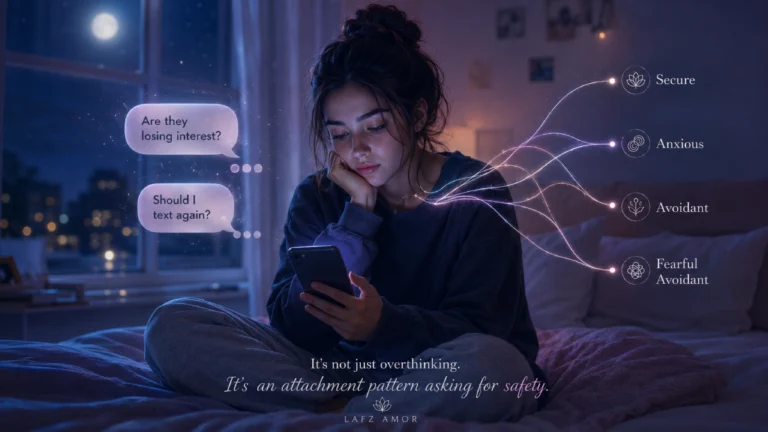
“Are they losing interest?”
“Are they mad at me?”
“Do they still want this?”
“Should I text again?”
Then you seek reassurance.
Maybe you ask directly.
“Are we okay?”
“Do you still love me?”
“Did I do something wrong?”
Or maybe you seek reassurance indirectly.
You send a casual message.
You post something hoping they will notice.
You become quiet to see if they will ask what happened.
You test the connection without fully saying what you need.
Then, if they reassure you, you feel relief.
Your body relaxes.
Your heart calms down.
You think, “Okay, maybe everything is fine.”
But after some time, the anxiety returns.
And when it returns, you may feel ashamed.
“Why do I need reassurance again?”
“Why can’t I be normal?”
“Why am I so affected by this?”
That shame becomes another layer of pain.
So now you are not only anxious.
You are anxious about being anxious.
And that is exhausting.
Why “Just Stop Overthinking” Does Not Work
People may tell you, “Just stop overthinking.”
As if you have not tried.
As if you enjoy lying awake at night imagining the worst.
As if checking your phone again and again feels good.
As if you want to feel emotionally controlled by someone’s reply.
But anxious attachment does not work like a light switch.
You cannot simply turn it off because someone gives you logical advice.
Because the real issue is not just thinking too much.
It is not just “being sensitive.”
It is not just “needing attention.”
Anxious attachment is often your emotional system trying to protect you from abandonment, rejection, or uncertainty.
Your mind may overthink because your body is trying to predict pain before it happens.
Your body may panic because distance feels dangerous.
Your heart may ask for reassurance because reassurance feels like proof that you are still safe.
So if you only tell yourself, “Stop overthinking,” you may end up feeling worse.
Because now you are anxious and blaming yourself for being anxious.
A better question is:
“What is my anxiety trying to protect me from?”
That question is kinder.
And it opens the door to healing.
Micro Takeaway
Healing anxious attachment is not about becoming cold.
It is about teaching your heart that safety does not have to be begged for.
You can still be soft.
You can still care deeply.
You can still want love, reassurance, and closeness.
But slowly, you learn how to stop abandoning yourself every time someone feels distant.
That is where healing begins.
Can Anxious Attachment Be Healed?
Yes, anxious attachment can be healed. It may not disappear overnight, but you can move toward secure attachment by understanding your triggers, learning self-soothing, communicating needs clearly, choosing emotionally consistent partners, and building trust in yourself. Healing means you can feel anxious without letting anxiety control your actions.
That last part matters.
Healing does not mean you never feel anxious again.
It means anxiety no longer gets to drive every decision.
You may still feel triggered by a late reply.
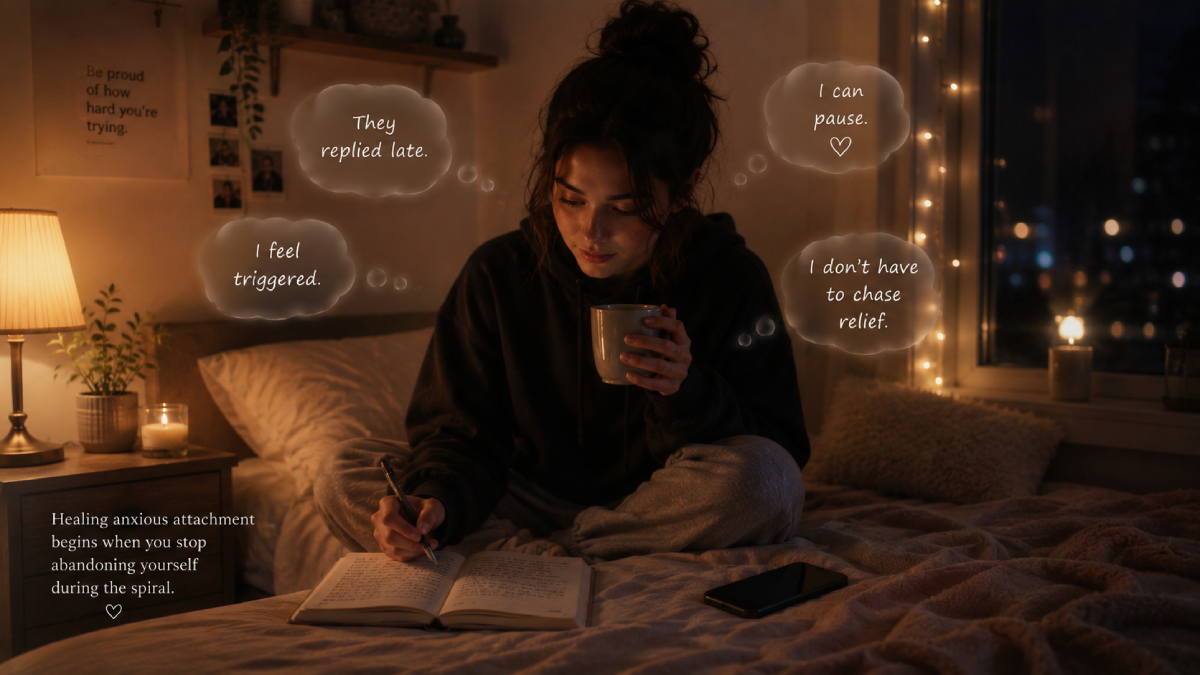
But instead of immediately texting from panic, you pause.
You may still feel hurt when someone needs space.
But instead of assuming abandonment, you ask for clarity.
You may still want reassurance.
But instead of begging for it from someone who keeps hurting you, you learn to ask clearly and also soothe yourself.
That is healing.
Not perfection.
Not emotional numbness.
Not becoming the “cool girl” or “cool guy” who never needs anything.
Healing anxious attachment means becoming emotionally safer with yourself and choosing relationships that do not keep reopening your deepest fears.
Healing Does Not Mean You Stop Needing Reassurance
Let’s remove one harmful idea right away.
Healing anxious attachment does not mean you stop needing reassurance.
Reassurance is normal in healthy relationships.
People who love each other comfort each other.
They check in.
They repair.
They clarify.
They say, “We are okay.”
They say, “I am not leaving.”
They say, “I need space, but I care about you.”
That is not weakness.
That is emotional care.
The problem is not reassurance itself.
The problem begins when reassurance becomes the only way you can feel safe.
If you cannot breathe until they reply, reassurance has become emotional oxygen.
If one kind message calms you but only for a few hours, the deeper fear still needs healing.
If you need the same reassurance again and again because the relationship keeps triggering uncertainty, there may be a pattern that needs attention.
So the goal is not:
“I should never need reassurance.”
The goal is:
“I can ask for reassurance clearly, receive it, and also build enough inner steadiness that I do not collapse without it.”
That is a much healthier goal.
Healing Means You Respond Differently to Triggers
You may not control the first wave of anxiety.
Sometimes your body reacts before your mind can catch up.
A message feels different, and your chest tightens.
They ask for space, and your stomach drops.
They seem distant, and your mind starts racing.
That first reaction may come automatically.
Healing begins with what you do next.
Do you chase?
Do you accuse?
Do you abandon yourself?
Do you send a paragraph from panic?
Do you pretend you do not care?
Or do you pause?
Name the fear?
Check the facts?
Ask what you actually need?
Choose a response that protects both your heart and your dignity?
That is where change happens.
Not in never being triggered.
But in slowly becoming less controlled by the trigger.
A secure person is not someone who never feels fear.
A secure person is someone who can feel fear and still choose wisely.
What Secure Attachment Actually Looks Like
Secure attachment may sound like some perfect emotional state where you never overthink, never need reassurance, never feel jealous, never get hurt.
That is not real.
Secure attachment is not emotional perfection.
It is emotional balance.
It looks like asking for clarity without panic.
It looks like tolerating space without assuming abandonment.
It looks like expressing needs without shame.
It looks like noticing inconsistency instead of romanticizing it.
It looks like leaving relationships that repeatedly make you feel unsafe.
It looks like trusting patterns, not only promises.
It looks like saying, “I feel anxious right now, but I do not have to act from fear.”
It looks like being soft without being self-abandoning.
That is the kind of healing Lafz Amor should always guide readers toward.
Not becoming cold.
Becoming clear.
Why Anxious Attachment Happens: The Psychology Layer
Before you try to heal anxious attachment, it helps to understand why it happens.
Not so you can blame your past forever.
Not so you can diagnose yourself harshly.
But because patterns become less scary when they make sense.
Anxious attachment often develops when emotional safety has felt uncertain.
Maybe love felt unpredictable.
Maybe people left without explanation.
Maybe affection came with conditions.
Maybe silence meant punishment.
Maybe you had to earn attention by being useful, impressive, quiet, agreeable, or easy.
Maybe past relationships taught you that people can be warm one day and distant the next.
So now, when love feels important, your emotional system becomes alert.
It scans.
It checks.
It worries.
It tries to protect you before you get hurt again.
That protection may have helped you survive emotionally before.
But now, it may be making love feel unsafe even when there is no immediate danger.
Reason 1: Love May Have Felt Inconsistent Before
Anxious attachment often grows when love has not felt stable.
Sometimes affection was available.
Sometimes it disappeared.
Sometimes people were warm.
Sometimes they were distant.
Sometimes you were praised.
Sometimes you were ignored.
Sometimes you felt chosen.
Sometimes you felt replaceable.
When care is inconsistent, your heart learns to monitor it.
You start noticing small changes.
Tone.
Timing.
Energy.
Attention.
Distance.
You may become sensitive to emotional shifts because, in the past, those shifts meant something painful was coming.
So now, even in a new relationship, your system may keep checking:
“Is this still safe?”
“Are they changing?”
“Are they leaving?”
“Did I do something wrong?”
This is not you being dramatic.
This is your heart trying to predict loss before it happens.
Emotional Impact
Your heart may have learned to monitor love because love did not always feel stable.
And when monitoring becomes a habit, peace can feel unfamiliar.
You may not know how to relax into love because a part of you keeps waiting for it to change.
Healing means slowly teaching that part of you:
“I can notice changes without assuming abandonment.”
“I can ask for clarity without panicking.”
“I can observe someone’s pattern before blaming myself.”
This is a new emotional language.
It takes time.
Reason 2: Distance Feels Like Abandonment
For anxious attachment, distance can feel dangerous.
A late reply may feel like rejection.
A quiet mood may feel like loss.
A need for space may feel like goodbye.
A dry message may feel like proof that they are losing interest.
And even if the other person does not mean it that way, your body may still react strongly.
This is one of the most painful parts of anxious attachment.
The situation may be small.
But the feeling is huge.
Someone else may say, “It is just a late reply.”
But inside you, it feels like something is slipping away.
That does not mean your fear is always accurate.
But it does mean your fear is real.
The work is learning to separate real danger from old emotional memory.
Sometimes someone is genuinely inconsistent.
Sometimes your fear is responding to the past.
Sometimes both are happening.
Healing requires enough honesty to know the difference.
Emotional Impact
Your body may react to emotional distance as if it is danger.
That is why “just relax” does not work.
Your body needs repeated evidence of safety, not just logical explanations.
And if the relationship keeps creating distance without clarity, your anxiety may not be irrational.
It may be responding to real instability.
That is why healing anxious attachment is not only inner work.
It is also relationship-choice work.
Reason 3: Reassurance Becomes Emotional Pain Relief
Reassurance can feel powerful when you have anxious attachment.
One message can calm you.
One “we are okay” can soften your chest.
One “I love you” can quiet the storm.
One explanation can make your body relax again.
So of course you seek reassurance.
You are not doing it to annoy someone.
You are trying to stop emotional pain.
But if reassurance becomes the only way you feel safe, the cycle continues.
You feel triggered.
You seek reassurance.
You feel relief.
The fear comes back.
You seek reassurance again.
Then you feel ashamed.
And sometimes your partner feels pressured.
This can become painful for both people.
The deeper healing is learning to receive reassurance, but not depend on it as your only source of safety.
You need two kinds of safety:
Safety from the relationship.
And safety from within yourself.
Both matter.
Emotional Impact
You are not asking again because you are weak.
You are trying to feel safe again.
But healing means slowly learning:
“I can want reassurance without chasing it from panic.”
“I can ask clearly instead of testing.”
“I can soothe myself before I reach outward.”
“I can notice whether this person actually offers consistency.”
That is how reassurance becomes supportive, not survival.
Reason 4: Inconsistent Relationships Keep the Wound Active
Sometimes people think their anxious attachment is only their personal issue.
But the relationship environment matters deeply.
If someone is hot and cold, your anxiety will likely increase.
If someone gives mixed signals, your mind will keep searching for clarity.
If someone disappears after intimacy, your fear of abandonment may become louder.
If someone says sweet things but does not show consistent effort, you may feel emotionally trapped between hope and hurt.
This matters because not every anxious feeling is irrational.
Sometimes your anxiety is a signal.
Sometimes your body is saying, “This person’s behavior is not emotionally safe for me.”
If you keep choosing emotionally unavailable people, healing becomes much harder.
Because the wound keeps getting touched.
Again and again.
A stable relationship can help your nervous system learn safety.
An unstable relationship can make you feel more anxious than you actually are.
Emotional Impact
Sometimes your anxiety is not only your attachment style.
Sometimes it is your relationship environment.
This is why healing anxious attachment does not mean tolerating inconsistency with a calmer face.
It means becoming clearer about what kind of love helps you feel secure and what kind of love keeps you in survival mode.
Reason 5: You Learned to Earn Love Instead of Receive It
This reason is quiet, but very deep.
Maybe somewhere along the way, you learned that love had to be earned.
By being good.
By being useful.
By being impressive.
By being low-maintenance.
By being beautiful.
By being funny.
By being available.
By never asking for too much.
By fixing the relationship before anyone left.
If you learned to earn love, then distance can feel terrifying because you think:
“What did I do wrong?”
“How do I fix this?”
“How do I become more lovable?”
“How do I make them stay?”
You may start performing for love instead of receiving it.
You may become hyper-aware of what someone wants from you.
You may hide your needs because needs feel risky.
You may become the person who gives too much, forgives too quickly, and asks for too little.
Not because you lack self-worth completely.
But because some part of you believes love is safer when you can control how lovable you appear.
Emotional Impact
Healing means learning that love should not require constant emotional performance.
You do not have to audition for consistency.
You do not have to be perfect to be respected.
You do not have to be easy to be loved.
You do not have to erase your needs to keep someone close.
The right love will not make you feel like you are always one mistake away from being abandoned.
How to Heal Anxious Attachment Step by Step
Healing anxious attachment is not a one-day transformation.
It is not one quote.
Not one journal prompt.
Not one “glow up.”
Not one decision to stop caring.
It is a repeated practice of coming back to yourself in moments where you would usually chase, panic, overthink, or self-abandon.
The steps below are practical, but they are also emotional.
Because healing anxious attachment needs both.
You need tools.
And you need tenderness.
Step 1: Notice Your Trigger Before You React
The first step is awareness.
Not perfect calm.
Not instant healing.
Just noticing.
When you feel triggered, try to catch the moment before you act.
Maybe your trigger is a late reply.
Maybe it is a dry tone.
Maybe it is them needing space.
Maybe it is seeing them online but not responding.
Maybe it is feeling like they are less affectionate than before.
Your trigger is the moment your emotional system says:
“Something is wrong.”
Before you text, accuse, explain, apologize, check, or spiral, pause and ask what happened.
You are not trying to suppress your fear.
You are trying to understand it before letting it make decisions for you.
Clear Action
Ask yourself:
- What happened?
- What did I feel?
- What story did my mind create?
- What do I want to do immediately?
- Will that action create safety or only temporary relief?
- Am I reacting to this person’s actual behavior or my fear of what it means?
- Have I seen this as a repeated pattern, or is this one moment?
These questions create space.
And space is powerful.
Because anxious attachment often acts fast.
Healing asks you to slow the reaction down.
Emotional Reassurance
You are not trying to ignore your fear.
You are learning to understand it before obeying it.
That is a major shift.
Instead of saying, “I should not feel this,” you say:
“I feel this. Now let me understand what it is asking for.”
That sentence is gentle.
And healing needs gentleness.
Step 2: Separate Feeling From Fact
Anxious attachment often turns feelings into facts.
You feel rejected, so it seems obvious that they are rejecting you.
You feel abandoned, so it seems obvious that they are leaving.
You feel unwanted, so it seems obvious that you are not enough.
But feelings, even real ones, are not always complete truth.
Your feeling deserves care.
But your decisions deserve evidence.
This step helps you slow down the story your mind creates.
It teaches you to say:
“I feel this, but what do I actually know?”
Clear Action
Use this structure:
| Feeling | Fact | Healthier Response |
| They are leaving me | They replied late once | Wait before reacting |
| I am too much | I asked for clarity | Needs are not shameful |
| They do not care | Their tone changed | Ask calmly or observe pattern |
| I must fix this now | I feel triggered | Pause before texting |
You can do this in your notes app.
Or in a journal.
Or even mentally.
The point is not to argue with your emotions.
The point is to give them context.
For example:
Feeling: “They are losing interest.”
Fact: “They have not replied for three hours.”
Missing information: “I do not know why yet.”
Secure response: “I can wait, take care of myself, and ask calmly if this becomes a pattern.”
That is not denial.
That is emotional clarity.
Emotional Reassurance
Your feeling is real, but it may not be the full truth.
You do not have to shame the feeling.
You can hold it gently and still say:
“Let me check the facts before I let fear write the whole story.”
That is how you protect yourself from unnecessary spirals.
Step 3: Learn Self-Soothing Before Seeking Reassurance
Self-soothing is one of the most important skills for healing anxious attachment.
But let’s define it properly.
Self-soothing does not mean pretending you do not need anyone.
It does not mean becoming emotionally independent in a cold way.
It does not mean never asking for comfort.
Self-soothing means you learn how to stay with yourself during emotional distress instead of immediately reaching for someone else to make the pain stop.
This matters because anxious attachment often seeks quick relief.
You feel panic, so you text.
You feel scared, so you ask for reassurance.
You feel uncertain, so you check.
But sometimes, before you reach outward, you need to come inward.
Not forever.
Just first.
Clear Action
When you feel triggered, try:
- Put your phone away for 20 minutes.
- Breathe slowly.
- Write the fear down.
- Name the trigger.
- Drink water.
- Walk outside.
- Repeat: “I can feel this without chasing relief.”
- Message a safe friend instead of immediately texting them.
- Place your hand on your chest and say, “This is fear, not proof.”
- Do one small routine that belongs to your life.
The goal is not to erase anxiety.
The goal is to show your body:
“I can survive this feeling without instantly chasing relief.”
That builds inner safety.
Slowly.
Repetition by repetition.
Emotional Reassurance
Self-soothing does not mean you stop needing people.
It means you stop abandoning yourself when someone feels distant.
You can still ask for reassurance.
You can still want closeness.
You can still love deeply.
But you also learn that you are not helpless inside your own emotions.
That is powerful.
Step 4: Ask for Reassurance Clearly, Not From Panic
You are allowed to ask for reassurance.
Let’s say that clearly.
You do not need to become someone who never asks, “Are we okay?”
You do not need to pretend you are fine when you feel hurt.
You do not need to hide every need to seem mature.
Healthy relationships include reassurance.
The healing part is learning how to ask for it in a way that is clear, calm, and honest.
Not from accusation.
Not from panic.
Not through testing.
Not by becoming silent and hoping they guess.
Not by sending five messages when one honest sentence would be enough.
Clear Action
Use scripts like:
“I feel triggered because communication changed suddenly. Can you reassure me that we are okay?”
Or:
“I am working on my anxious attachment, but clarity helps me feel safe. Can we talk about what consistency looks like for us?”
Or:
“I do not need constant texting, but I do need emotional honesty.”
Or:
“I know this may be my fear coming up, but I would appreciate a little reassurance right now.”
These scripts are direct.
They do not attack.
They name your feeling.
They ask for what you need.
That is much healthier than saying:
“You never care.”
“You are ignoring me.”
“You always make me feel like this.”
Even if those sentences come from pain, they can make the other person defensive.
The goal is to express the need beneath the fear.
Emotional Reassurance
You are allowed to ask for reassurance.
You just do not have to beg for it.
And remember this too:
A caring person may not always reassure perfectly.
But they will not shame you for needing emotional safety.
If someone repeatedly mocks your need for clarity, that is important information.
Healing anxious attachment does not mean staying with people who punish your vulnerability.
Step 5: Stop Chasing Emotionally Unavailable People
This step may hurt, but it is necessary.
You cannot heal anxious attachment by repeatedly choosing people who make love feel unsafe.
If someone is hot and cold, emotionally distant, vague, inconsistent, or unavailable, your anxious attachment will likely become stronger.
You may keep trying to win safety from someone who keeps creating uncertainty.
And because they give you small moments of warmth, you may stay attached.
One sweet message.
One good night.
One deep conversation.
One apology.
One “I miss you.”
One return after distance.
These moments can feel powerful.
But if the overall pattern is confusion, you need to pay attention.
Healing is not only calming your anxiety.
Healing is also choosing people who do not keep activating it unnecessarily.
Clear Action
Watch for:
- Hot-and-cold behavior
- Avoiding clarity
- Emotional crumbs
- Disappearing after intimacy
- Making you feel needy for basic needs
- Saying sweet things but showing little consistency
- Only being available when it suits them
- Refusing to talk about where things are going
- Returning when you pull away but not changing
- Making you feel anxious more often than safe
If you notice these patterns, do not immediately ask, “How do I become less anxious?”
Also ask:
“Is this person emotionally safe for me?”
Because sometimes your anxiety is not the problem.
Sometimes your anxiety is responding to a real lack of consistency.
Emotional Reassurance
You cannot heal anxious attachment by repeatedly choosing people who make love feel unsafe.
That does not mean you should only date perfect people.
No one is perfect.
But there is a difference between someone imperfect who is willing to grow and someone unavailable who keeps you starving for clarity.
Choose the first.
Stop romanticizing the second.
Step 6: Practice Slow Emotional Pacing
Anxious attachment often rushes emotionally.
Not because you are foolish.
Because waiting can feel unsafe.
You may want to know quickly where things are going.
You may want reassurance early.
You may want to attach fast because uncertainty feels uncomfortable.
But secure attachment needs pacing.
Pacing means you let time show you who someone is before giving them deep emotional access.
You do not give your whole heart to someone because they were sweet for a week.
You do not build a future around one intense conversation.
You do not confuse chemistry with safety.
You let consistency gather evidence.
This is not cold.
This is wise.
Clear Action
Before deeply investing, ask:
- Have they shown consistency?
- Do I know their pattern?
- Do I feel safe or just excited?
- Am I attached to them or the possibility?
- Are their actions matching their words?
- Do they respect clarity?
- Do they communicate when things get uncomfortable?
- Do I feel more peaceful or more anxious around them?
These questions slow down fantasy.
They bring you back to reality.
And reality is where secure love grows.
Emotional Reassurance
Moving slowly does not mean you care less.
It means you are protecting your peace while your heart learns trust.
You can feel something and still go slowly.
You can like someone and still observe them.
You can be open without being unprotected.
This is the middle path anxious attachment often needs.
Soft heart.
Clear eyes.
Step 7: Build a Secure Relationship With Yourself
This is the deepest part of healing.
Because anxious attachment often makes you leave yourself to keep someone else close.
You abandon your routine because you are waiting for their reply.
You abandon your needs because you do not want to seem difficult.
You abandon your peace because you are trying to decode their behavior.
You abandon your standards because you are afraid they will leave.
You abandon your voice because you want to be easy to love.
Healing means coming back.
To your body.
Your life.
Your values.
Your routines.
Your self-respect.
Your own emotional home.
Because when you have a secure relationship with yourself, another person’s distance may still hurt, but it does not erase you.
Clear Action
Practice:
- Keeping routines even when triggered
- Not cancelling your life for someone’s attention
- Speaking kindly to yourself after spiraling
- Honoring your needs without shame
- Choosing partners based on consistency
- Letting yourself leave confusing dynamics
- Eating, sleeping, working, creating, and living even when love feels uncertain
- Asking, “What do I need from myself right now?”
- Reminding yourself, “Their attention is not my worth.”
These are not small things.
They are the foundation of secure attachment.
Every time you choose not to abandon yourself, you teach your nervous system something new:
“I am safe with me.”
Emotional Reassurance
The safest love begins when you stop abandoning yourself to keep someone else close.
You deserve love from others.
Of course you do.
But you also deserve your own loyalty.
Especially in moments when fear tells you to leave yourself behind.
How to Self-Soothe Anxious Attachment in the Moment
This section is for the moment when you are actively triggered.
Not later.
Not after you have processed everything.
Right in the middle of the spiral.
When your heart is racing.
When your phone feels magnetic.
When your mind wants answers immediately.
When you feel like you cannot calm down until they respond.
This is where self-soothing becomes practical.
Not aesthetic.
Not theoretical.
A real emotional emergency kit.
The 20-Minute Pause Method
When anxiety hits, tell yourself:
“I only need to pause for 20 minutes.”
Not forever.
Just 20 minutes.
This makes the pause feel possible.
Because anxious attachment often hates open-ended waiting.
But 20 minutes feels more manageable.
During that time, your goal is not to solve the whole relationship.
Your goal is to bring your body down from emotional emergency.
Step-by-Step
- Put the phone away.
- Say: “I am triggered, not abandoned.”
- Breathe slowly for one minute.
- Write the fear in one sentence.
- Write the fact in one sentence.
- Decide whether you need reassurance, rest, clarity, or distance.
- Respond only after your body feels calmer.
This method helps you stop reacting from the sharpest part of fear.
You may still decide to text.
But now the text comes from clarity, not panic.
That difference matters.
Micro Takeaway
The goal is not to stop feeling.
The goal is to stop reacting from emotional emergency.
You are allowed to feel hurt.
You are allowed to want reassurance.
You are allowed to care.
But you do not have to let the first wave of fear choose your next move.
The Feeling vs Fact Check
This is one of the best tools for anxious attachment healing.
When anxiety speaks, it often sounds like certainty.
“They are leaving.”
“They do not care.”
“I am too much.”
“I ruined everything.”
But certainty is not always truth.
So you separate feeling from fact.
Example:
Feeling: “They are leaving me.”
Fact: “They have not replied for two hours.”
Missing information: “I do not know why.”
Secure response: “I can wait, care for myself, and ask calmly later if needed.”
This gives your mind a structure.
And anxious minds often need structure because fear creates emotional fog.
You are not denying the feeling.
You are grounding it.
You are saying:
“Yes, I feel scared. But what do I actually know?”
That question is a small anchor.
Use it often.
The Secure Self Question
When you feel triggered, ask:
“What would the secure version of me do right now?”
Not the cold version.
Not the careless version.
Not the version pretending not to care.
The secure version.
The version who loves deeply but does not self-abandon.
The version who wants reassurance but does not beg for crumbs.
The version who can feel fear without obeying every fear.
Examples of secure responses:
- Wait before texting again.
- Ask directly instead of assuming.
- Notice the pattern.
- Choose self-respect.
- Not chase someone who keeps creating confusion.
- Say, “I need clarity,” without apologizing for having needs.
- Let someone’s behavior reveal their capacity.
- Return to your own life while waiting.
This question helps you practice secure attachment before it feels natural.
At first, it may feel forced.
That is okay.
New patterns often feel unnatural before they feel safe.
Common Mistakes People Make While Healing Anxious Attachment
Healing anxious attachment is not a straight line.
You may understand the pattern and still repeat it.
You may pause one day and spiral the next.
You may ask clearly once and then send a panic paragraph another time.
That does not mean you are failing.
It means you are learning.
But some common mistakes can keep you stuck.
Let’s name them gently.
Mistake 1: Trying to Become Emotionless
After getting hurt, you may feel tempted to become cold.
You may think:
“I will never care this much again.”
“I will stop needing people.”
“I will become detached.”
“I will not show emotions.”
“I will act as nothing affects me.”
It makes sense.
Pain can make numbness look powerful.
But becoming emotionless is not healing anxious attachment.
It is protection.
Sometimes protection is necessary for a while.
But it is not the same as secure love.
Secure attachment does not mean you feel nothing.
It means you can feel without falling apart.
Why It Is Harmful
Coldness is not secure attachment.
It is often protection.
If you shut down your feelings completely, you may stop chasing, but you may also stop receiving healthy love.
You may push away people who are actually safe.
You may mistake emotional numbness for growth.
But numbness is not peace.
Peace still allows feeling.
Emotional Consequence
You may stop chasing, but also block healthy love.
And deep down, that is not what you want.
You do not want to become someone who feels nothing.
You want to become someone who feels deeply and chooses wisely.
That is very different.
Mistake 2: Blaming Yourself for Every Relationship Problem
When you know you have anxious attachment, you may start blaming yourself for everything.
“They pulled away because I was too anxious.”
“They are distant because I asked for reassurance.”
“They avoid me because I am too much.”
“The relationship is hard because of me.”
But not every relationship problem is your fault.
Yes, anxious attachment can create challenges.
Yes, you are responsible for how you respond to triggers.
But the other person’s behavior matters too.
If someone is inconsistent, vague, emotionally unavailable, or disrespectful, your anxiety may be responding to real instability.
Do not turn attachment healing into self-blame.
Why It Is Harmful
Not every anxious feeling is irrational.
Sometimes the relationship is genuinely inconsistent.
If you blame yourself for everything, you may ignore real red flags.
You may stay in relationships that keep hurting you because you think, “I just need to heal more.”
Healing should give you clarity.
Not make you easier to mistreat.
Emotional Consequence
You may stay too long in a dynamic that keeps hurting you.
And that can deepen the wound.
So ask both questions:
“What is my attachment trigger?”
And:
“What is their actual pattern?”
Both matter.
Mistake 3: Asking for Reassurance Again and Again Without Self-Soothing
Reassurance is healthy.
But reassurance without self-soothing can become a loop.
If every anxious feeling immediately goes to the other person for relief, your body never learns that you can survive the feeling too.
You may become dependent on their response to feel okay.
And if they are unavailable, your anxiety becomes even stronger.
This can put pressure on the relationship.
But more importantly, it keeps you feeling powerless.
Because your safety stays outside you.
Why It Is Harmful
It makes reassurance the only way you feel safe.
And if reassurance is delayed, absent, or not strong enough, the anxiety returns.
This does not mean you should stop asking for comfort.
It means you practice self-soothing first or alongside reassurance.
You learn:
“I can ask for support, but I am not completely helpless without it.”
Emotional Consequence
You feel calm only when someone else regulates your fear.
And that is a painful place to live.
You deserve support from love.
But you also deserve safety within yourself.
Mistake 4: Choosing the Same Unavailable Pattern Again
Sometimes people do healing work, but keep choosing the same type of person.
Emotionally unavailable.
Hot and cold.
Avoidant without accountability.
Vague about commitment.
Sweet in moments but inconsistent in pattern.
Then they wonder why their anxious attachment is not healing.
But the environment keeps reopening the wound.
You cannot heal a burn while touching the same flame again and again.
If the person keeps creating uncertainty, your body will keep reacting.
That is not failure.
That is information.
Why It Is Harmful
The wound cannot heal in the same emotional environment that keeps reopening it.
You may become better at explaining your anxiety, but still keep living in a dynamic that feeds it.
That is not healing.
That is becoming emotionally educated inside the same pain.
Emotional Consequence
You mistake repeated pain for deep connection.
You may think the relationship is intense because it is meaningful.
But sometimes it is intense because your nervous system is constantly activated.
Ask yourself:
“Does this connection help me feel safer over time?”
If the answer is no, listen.
Mistake 5: Using Attachment Labels Instead of Changing Behavior
Learning attachment language can feel relieving.
Finally, you have words.
Anxious attachment.
Avoidant attachment.
Triggers.
Reassurance seeking.
Self-soothing.
Secure attachment.
But words are not healing by themselves.
They are tools.
If you say, “I have anxious attachment,” but still text from panic every time, the label is only awareness.
If you say, “They are avoidant,” but keep chasing them without looking at the pattern, the label is only explanation.
If both people know the cycle but nothing changes, the relationship stays stuck.
Why It Is Harmful
Saying “I have anxious attachment” is awareness, not healing.
Healing happens when insight becomes behavior.
When you pause.
When you self-soothe.
When you ask clearly.
When you choose consistency.
When you stop romanticizing emotional unavailability.
When you leave dynamics that repeatedly harm you.
Emotional Consequence
You understand the pattern but keep living inside it.
And that can feel even more painful because now you know what is happening, but you still feel trapped.
So use labels as maps.
Not excuses.
Not identity prisons.
Maps.
And then take the next step.
When Should You Walk Away While Healing Anxious Attachment?
Healing anxious attachment does not mean staying in every relationship and trying harder.
This is important.
Sometimes your anxiety is an old wound asking for healing.
Sometimes your anxiety is your body responding to a genuinely unsafe relationship.
You need to learn the difference.
Because if you treat every anxious feeling as “my issue,” you may stay too long with people who keep hurting you.
And if you treat every trigger as a red flag, you may leave relationships that could have been repaired.
So how do you know when to walk away?
Look at the pattern.
Not one bad day.
Not one mistake.
The pattern.
Walk Away When Your Anxiety Is Constantly Triggered by Their Inconsistency
If someone is consistently inconsistent, your anxiety may be responding to something real.
Hot and cold behavior.
Disappearing.
Avoiding clarity.
Changing energy without explanation.
Giving affection, then withdrawing.
Saying one thing, doing another.
Keeping you emotionally unsure.
This kind of pattern can keep anxious attachment activated.
You may keep trying to calm yourself, but the relationship keeps creating new reasons to panic.
At some point, you have to ask:
“Am I healing my anxiety, or am I trying to survive their inconsistency?”
That question matters.
If their behavior keeps making you feel unsafe and they refuse to understand the impact, walking away may be self-protection.
Walk Away When They Shame Your Need for Reassurance
A caring partner may not always know what to say.
They may need to learn.
They may have their own limitations.
They may need space sometimes.
That is human.
But a caring partner will not mock your need for emotional safety.
They will not call you pathetic for needing reassurance.
They will not use your fear of abandonment against you.
They will not make you feel stupid for asking, “Are we okay?”
They may say, “I need a moment, but I care.”
They may say, “I cannot reassure you constantly, but I want to understand.”
They may say, “Let’s find a healthier way to handle this.”
That is different from shame.
If someone repeatedly shames your emotional needs, that relationship may not be a safe place to heal.
Walk Away When You Are the Only One Doing Emotional Work
A relationship cannot become secure if only one person is doing the work.
If you are the only one reading, reflecting, apologizing, changing, communicating, and trying to understand the pattern, you will become exhausted.
You cannot heal anxious attachment alone inside a relationship that requires two people to change.
Your work matters.
But their work matters too.
If they keep avoiding responsibility, dismissing your feelings, refusing repair, or making every issue your fault, then your healing becomes unpaid emotional labor.
Love should not feel like you are carrying the entire relationship on your nervous system.
Walk Away When Healing Means Silencing Yourself
This is a dangerous misunderstanding.
Some people think healing anxious attachment means asking for less.
Needing less.
Feeling less.
Speaking less.
Expecting less.
But that is not healing.
That is self-erasure.
If you are trying to heal by pretending you are fine, the relationship is not making you secure.
It is making you silent.
Healing anxious attachment does not mean accepting emotional crumbs with a calm face.
It does not mean lowering your needs until someone else feels comfortable.
It does not mean becoming “low maintenance,” so they do not leave.
You are allowed to have needs.
You are allowed to ask for clarity.
You are allowed to want consistency.
You are allowed to walk away from love that requires you to abandon yourself.
Reality Check
Healing anxious attachment should make you clearer, not easier to mistreat.
It should help you take responsibility for your reactions.
But it should also help you recognize when someone is not treating you with care.
Healing should make you less controlled by fear.
But more connected to truth.
And the truth may sometimes be:
“This is my trigger.”
Other times, the truth may be:
“This relationship is not safe for me.”
Both forms of honesty are part of healing.
Final Thoughts: Healing Does Not Mean Becoming Cold
Healing anxious attachment is not about becoming detached, emotionless, or “low maintenance.”
It is not about becoming the person who never asks for reassurance.
It is not about pretending you do not care.
It is not about acting unavailable so nobody can hurt you.
It is not about turning your softness into stone.
Healing is softer than that.
Braver too.
Healing anxious attachment means becoming safe enough inside yourself that love does not feel like something you must chase.
You can still be soft.
You can still love deeply.
You can still want reassurance.
You can still care.
You can still miss someone.
You can still feel fear.
But slowly, you learn not to abandon yourself every time someone feels distant.
You learn to pause before reacting.
You learn to ask clearly instead of testing.
You learn to separate feeling from fact.
You learn to choose consistency over intensity.
You learn to stop calling emotional crumbs a meal.
You learn to walk away when love keeps feeling like panic.
And most importantly, you learn that your needs are not shameful.
Tum zyada nahi ho.
Tumhara dil bas safety dhoondh raha hai.
And now, you can learn to give that safety to yourself too.
Not because you do not need anyone.
But because you deserve to meet love as a whole person, not as someone begging to be chosen.
The right love will not make you feel ashamed for needing emotional safety.
And the healing version of you will not keep choosing people who make safety feel impossible.
You are not broken.
You are learning a new way to love.
One where you can stay soft without losing yourself.
One where closeness does not require panic.
One where reassurance is welcome, but self-abandonment is no longer the price.
That is healing.
Not becoming cold.
Becoming home.
Read Next
If this blog helped you understand your healing journey, read these next:
- Anxious Attachment in Relationships
- Why Do I Get Attached So Easily?
- How to Become Secure in Relationships
Start with the one that feels closest to your current pattern.
If you are still trying to understand why you overthink in love, read about anxious attachment.
If you get attached quickly to people who show you attention, read why you get attached so easily.
If you are ready to build a calmer and safer way to love, read about becoming secure in relationships.
Healing does not happen all at once.
It happens one clear, kind, self-respecting choice at a time.