Why Long-Distance Relationships Are Hard When You Love Them So Much
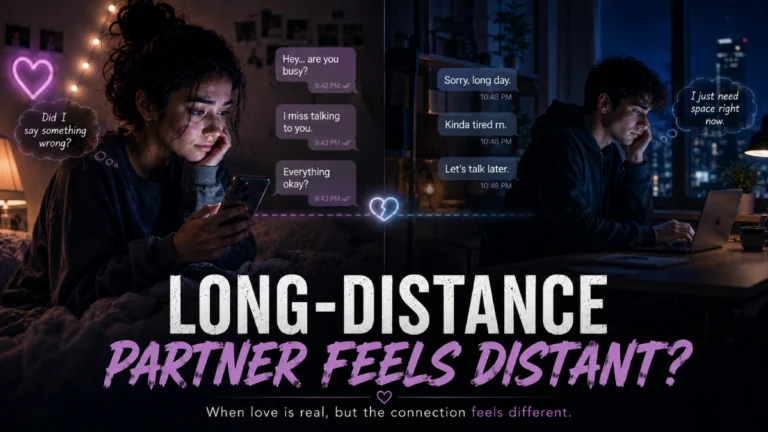
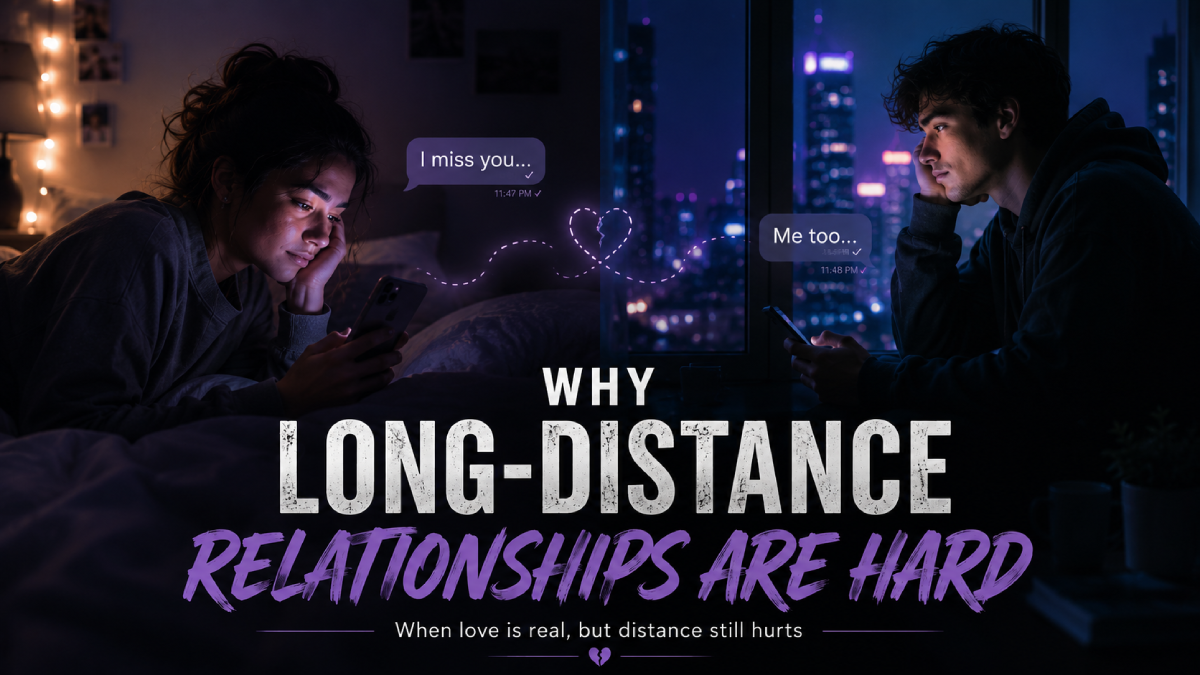
Why does a long-distance relationship feel so hard when you genuinely love each other?
Maybe you are not doubting your love.
Maybe you are doubting the distance.
The silence.
The waiting.
The time zones.
The missed calls.
The dry replies.
The way one late message can change your whole mood.
You may know they care about you, but sometimes your heart still asks, “Then why do I feel so alone?”
And that is the confusing part.
Because when you love someone from far away, the relationship can feel both beautiful and painful at the same time.
You feel lucky to have them.
But you also miss them in a way that words cannot fully fix.
Kabhi-kabhi lagta hai relationship hai bhi aur nahi bhi. They are yours, but they are not there. You can talk to them, but you cannot always reach them emotionally.
That is why long-distance relationships are hard.
Not because love is weak.
Not because you are too sensitive.
Not because you are asking for too much.
Long-distance relationships are hard because love is present, but physical closeness, daily reassurance, and immediate emotional support are limited. This creates loneliness, overthinking, communication pressure, trust challenges, and uncertainty about the future.
And when you are emotionally attached to someone, distance does not feel like geography.
It feels personal.
It feels like waiting.
It feels like trying to keep love alive through a screen.
This article will help you understand why long-distance hurts so much, what is normal, what needs attention, and when the pain may be pointing to a deeper relationship problem.
Why Are Long-Distance Relationships So Hard?
Long-distance relationships are hard because they ask two people to feel close without having normal access to each other.
You have love.
You commit.
You have memories.
You have future hopes.
But you do not have daily physical presence.
And that absence changes the emotional experience of the relationship.
You cannot hug after a fight.
You cannot sit together after a bad day.
You cannot randomly meet for coffee.
You cannot always see their mood with your own eyes.
So everything starts depending on messages, calls, effort, tone, timing, and trust.
And honestly, that can feel exhausting.
Because Love Is There, But Access Is Missing
This is one of the biggest reasons why long-distance relationships feel so painful.
You love them.
They may love you too.
But you cannot always access them in the way your heart wants.
You cannot just go to them when you miss them.
You cannot hold their hand when you feel insecure.
You cannot look at their face and feel, “Okay, we are fine.”
Instead, you wait.
You wait for a reply.
You wait for a call.
You wait for the next visit.
You wait for life to finally bring you closer.
And waiting becomes emotionally heavy when your heart wants certainty now.
You Can Love Someone Deeply and Still Feel Lonely
This is something many people in long-distance relationships feel guilty about.
They think:
“I am in a relationship, so why do I still feel lonely?”
But loneliness in a long-distance relationship does not always mean your relationship is failing.
Sometimes it means your emotional need for presence is not fully met.
You may have someone who loves you, but they are not physically beside you.
You may have someone to call, but not someone to come home to.
You may have someone who says, “I miss you,” but not someone who can hold you when missing them becomes too much.
That kind of loneliness is real.
And you do not need to shame yourself for feeling it.
Emotional Impact Line
Missing someone is painful because your heart feels connected, but your life still feels physically separate.
That separation creates a strange emotional ache.
You are not single.
But you are not fully together either.
Micro Takeaway
Long-distance hurts because emotional closeness and physical presence are not always available at the same time.
And that gap can make even a strong relationship feel emotionally difficult.
Because Small Gaps Start Feeling Emotionally Bigger
In a long-distance relationship, small things can feel huge.
A late reply may not be just a late reply.
A cancelled call may not feel like just a scheduling issue.
A short text may not feel like just tiredness.
Because when someone is far away, you do not have enough daily evidence to calm your mind.
So your brain starts treating small signs as emotional clues.
“They replied late. Are they losing interest?”
“They did not sound excited. Did something change?”
“They cancelled again. Am I not important anymore?”
Sometimes your fear may be wrong.
Sometimes they really are just busy.
But when you already miss someone, even small emotional gaps can feel like distance growing.
A Late Reply Can Feel Like Distance Growing
A late reply is not always a red flag.
But in long-distance, it can trigger a lot.
Because your relationship already depends heavily on digital connection.
So when that connection pauses, your mind feels the absence more deeply.
You may tell yourself, “Relax, they must be busy.”
But another part of you may still feel restless.
That does not make you dramatic.
It means your heart is looking for closeness in the only place available: communication.
A Cancelled Call Can Feel Like Rejection
If you were waiting all day to hear their voice, a cancelled call can hurt badly.
Not because you do not understand that life happens.
But because that call may have been your emotional anchor.
Maybe you saved things to tell them.
Maybe you were excited.
Maybe you were having a hard day and just wanted to feel close.
So when the call gets cancelled casually, it can feel like your need did not matter.
And that is where hurt begins.
Emotional Impact Line
In long-distance, your mind often turns small moments into emotional evidence.
And unless both people understand this, they may accidentally hurt each other without meaning to.
Because You Cannot Easily Read Their Energy
When someone is physically with you, you can read so much without words.
Their face.
Their body language.
Their eyes.
Their silence.
Their mood.
Their energy.
But in long-distance, you often get only texts, emojis, voice notes, or short calls.
And those are easy to misunderstand.
A simple “okay” can feel cold.
A busy tone can feel like disinterest.
A delayed response can feel like distance.
This is why long-distance relationship communication problems are so common.
Not always because people do not care.
But because screens remove emotional context.
Texts Hide Tone, Body Language, and Context
Texting is useful, but it is emotionally limited.
It does not always show warmth.
It does not always show tiredness.
It does not always show stress.
It does not always show love properly.
Your partner may type a short reply because they are exhausted.
But you may read it as emotional distance.
You may send a serious message because you are hurt.
But they may read it as an attack.
So both people start reacting to interpretations, not reality.
You May Start Guessing What They Really Mean
When tone is unclear, your mind starts guessing.
And if you are already anxious, tired, or emotionally sensitive that day, your guesses may become painful.
You may read between the lines so much that the actual line disappears.
That is why long-distance relationships need more clarity than normal relationships.
Not more drama.
More clarity.
A simple “I’m tired today, but we’re okay” can prevent hours of overthinking.
The Psychology Behind Why Long Distance Hurts So Much
Long distance hurts because it activates emotional needs that are very human.
The need to feel safe.
The need to feel chosen.
The need to feel remembered.
The need to feel close.
The need to know that love is still alive even when the person is not physically present.
When those needs feel uncertain, your mind does not stay quiet.
It starts searching for proof.
Proof that they love you.
Proof that they miss you.
Proof that you still matter.
Proof that the relationship is not fading.
This is why long-distance relationship overthinking can feel so intense.
Your Brain Looks for Proof of Safety
In close-distance relationships, safety often comes through everyday presence.
You see each other.
You share routines.
You spend time together.
You notice their care in small physical ways.
But in long-distance, your brain has fewer signals.
So it starts depending on digital signals.
Their reply speed.
Their tone.
Their effort.
Their consistency.
Their willingness to call.
Their excitement when talking to you.
This is why small changes can feel so emotionally loud.
When Physical Reassurance Is Missing, Texts and Calls Become Emotional Signals
A text is not just a text anymore.
A call is not just a call.
A goodnight message is not just a habit.
These things become proof of emotional presence.
You may not consciously think this way, but your heart may feel it.
When they text warmly, you feel secure.
When they seem distant, you feel unsettled.
When they make time, you feel loved.
When they keep postponing, you feel unwanted.
This is not weakness.
This is your emotional system trying to understand whether the bond is safe.
Example
A simple “busy today” text can feel fine in a secure moment, but painful when you already feel disconnected.
Because the same message can land differently depending on your emotional state.
If you feel secure, you may think:
“Okay, they’re busy. We’ll talk later.”
If you feel anxious, you may think:
“They don’t want to talk to me.”
That is why emotional consistency matters so much in long-distance.
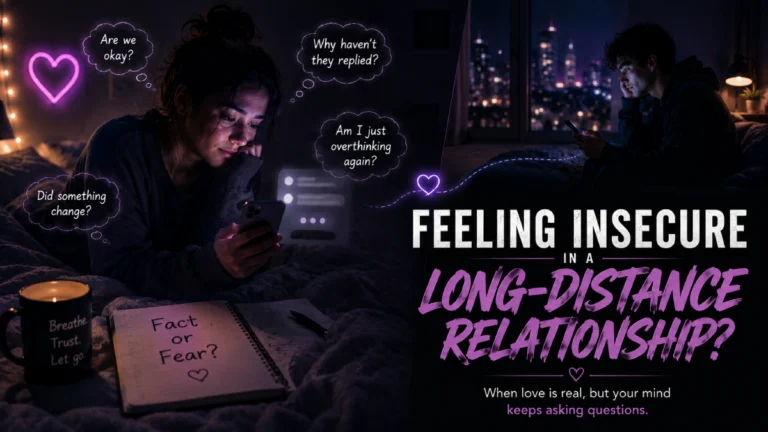
Uncertainty Triggers Overthinking
The less clarity you have, the more your mind fills in the blanks.
And in long-distance relationships, there are many blanks.
You do not always know what their day looked like.
You do not always know why their energy changed.
You do not always know why they replied late.
You do not always know whether they miss you as much as you miss them.
So your mind tries to protect you by preparing for possible pain.
It starts imagining problems before they happen.
Not because you want drama.
But because uncertainty feels unsafe.
The Less You Know, the More Your Mind Fills In
When communication is unclear, your mind becomes a storyteller.
And usually, it does not write peaceful stories.
It writes painful ones.
It turns silence into rejection.
Busyness into disinterest.
Tiredness into emotional distance.
A dry reply into the beginning of the end.
This is why overthinking feels so convincing.
It uses small real details and builds a scary emotional story around them.
Common Thoughts
- “Are they losing feelings?”
- “Are they bored of me?”
- “Are they talking to someone else?”
- “Am I being too needy?”
- “Is this still working?”
- “Why do I care more?”
- “Would they make more effort if they really loved me?”
- “Are we slowly becoming strangers?”
If these thoughts sound familiar, you are not alone.
Long distance can make even emotionally aware people feel confused.
Because the relationship is real, but the reassurance is not always immediate.
Attachment Patterns Can Become Louder in Long Distance
Long distance does not create every insecurity.
But it can amplify the emotional patterns that are already inside us.
If you have anxious attachment, distance may make you crave more reassurance.
If you have avoidant tendencies, distance may make emotional demands feel overwhelming.
If one person needs closeness and the other needs space, the relationship can enter a painful push-pull cycle.
One reaches.
The other withdraws.
One asks for more.
The other feels pressured.
One feels ignored.
The other feels controlled.
And both people end up feeling misunderstood.
Anxious Attachment May Seek More Reassurance
If you are more anxious in love, distance can feel like emotional danger.
You may need frequent reassurance.
You may overthink tone changes.
You may feel deeply affected by late replies.
You may need to hear, “We are okay,” more often than your partner realizes.
This does not make you needy.
But it does mean you need to learn how to ask for reassurance clearly, not through panic, testing, or emotional pressure.
Avoidant Attachment May Need More Space
If your partner is more avoidant, they may love you but feel overwhelmed by constant emotional intensity.
They may pull away when conversations feel too heavy.
They may need alone time to regulate.
They may struggle to express emotions often.
This does not always mean they do not care.
But if they use distance to avoid emotional responsibility, that becomes a problem.
Space is healthy.
Emotional disappearance is not.
The Push-Pull Cycle Can Become Stronger
In long-distance relationships, the anxious-avoidant push-pull cycle can become more intense.
The anxious partner may think:
“If they loved me, they would make more effort.”
The avoidant partner may think:
“No matter what I do, it is never enough.”
And slowly, the relationship becomes less about love and more about emotional survival.
The solution is not blaming one person.
The solution is understanding the pattern and creating safer communication.
Your Nervous System Misses Predictability
Your nervous system likes predictability.
It feels safer when it knows what to expect.
But long distance can feel unpredictable.
Will they call today?
Will they reply warmly?
Will they be emotionally available?
Will they cancel again?
Will the plan happen?
When too many things feel uncertain, your body stays alert.
That alertness can feel like anxiety, sadness, irritability, or emotional exhaustion.
Consistency Helps the Relationship Feel Emotionally Safer
Consistency does not mean talking all day.
It means showing up in ways your partner can trust.
It means saying what you mean.
Doing what you said.
Explaining when plans change.
Reassuring before distance becomes fear.
Returning after conflict.
Making effort visible.
Consistency tells the heart:
“You do not have to panic. This connection is still here.”
Micro Takeaway
Sometimes you are not “too sensitive.”
Your body is reacting to uncertainty, distance, and emotional unpredictability.
And instead of shaming that reaction, the relationship needs more clarity, rhythm, and reassurance.
Common Long-Distance Relationship Problems That Make It Feel Harder
Every relationship has problems.
But long-distance relationship problems can feel sharper because you cannot always repair them through physical closeness.
A small misunderstanding can last longer.
A small silence can feel heavier.
A small emotional gap can become a big question.
Here are the common problems that make long-distance feel especially hard.
1. Loneliness Even When You Are Technically Together
This is one of the most painful parts.
You have someone.
But sometimes you still feel alone.
You may see other couples spending weekends together, going on dates, taking photos, meeting casually, and doing normal couple things.
And suddenly your relationship feels unfairly difficult.
You may think:
“I love them, but why does this feel so lonely?”
That thought can make you feel guilty.
But it should not.
Why It Happens
You have someone, but you cannot always access their presence.
Your partner may be emotionally important to you, but they are not physically part of your daily life.
So your relationship exists strongly in your heart, but not always in your routine.
That gap creates loneliness.
Emotional Consequence
You may feel guilty for feeling lonely because you think, “But I am in a relationship.”
But loneliness does not mean you do not value your partner.
It means you miss the lived experience of being with them.
2. Communication Starts Feeling Like Pressure
Communication is important in long-distance relationships.
But sometimes it becomes pressured.
Every text starts carrying meaning.
Every call starts feeling like proof.
Every delay starts becoming a possible issue.
One person may want more contact.
The other may feel overwhelmed.
And suddenly, communication stops feeling romantic.
It starts feeling like responsibility.
Why It Happens
Texts and calls become the main proof of love.
When you cannot meet, communication becomes the relationship’s main emotional channel.
So naturally, it starts carrying more weight.
But if communication becomes the only way someone feels secure, it can become stressful for both people.
Emotional Consequence
One person may feel monitored, while the other feels ignored.
And this is where both people need compassion.
The person asking for connection may not be trying to control.
They may be trying to feel safe.
The person needing space may not be trying to reject.
They may be trying to breathe.
Both experiences need to be understood.
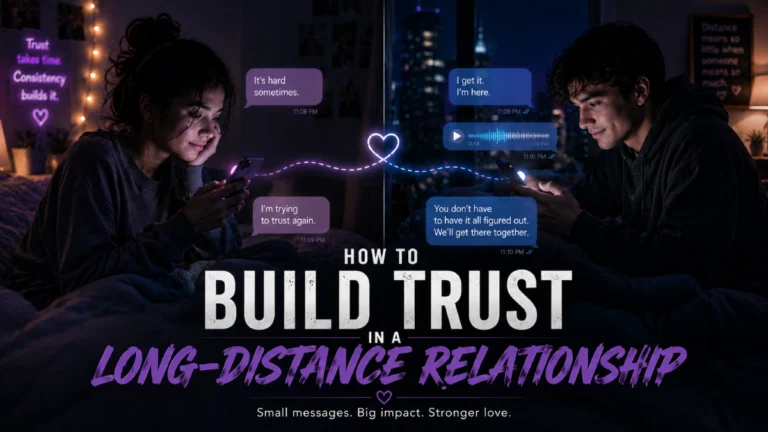
3. Trust Has to Work Without Physical Visibility
Trust is harder in long-distance because you cannot see each other’s daily life fully.
You do not always know who they are with.
You do not always know their mood.
You do not always know what they are not saying.
And if communication is already inconsistent, trust can become fragile.
Trust is not only about cheating.
It is also about emotional reliability.
Can I trust that you will tell me the truth?
Can I trust that you will show up?
Can I trust that you will not disappear when things get hard?
Can I trust that your love is still active, not just spoken?
Why It Happens
You do not always know where they are, who they are with, or what their day feels like.
That unknown space can become emotionally uncomfortable.
Especially if you have been hurt before.
Or if your partner has broken trust before.
Or if they are vague, defensive, or inconsistent.
Emotional Consequence
Even small unknowns can become big fears.
A healthy long-distance relationship does not demand blind trust.
It builds trust through honesty, consistency, and transparency.
4. Time Zones and Busy Schedules Create Emotional Gaps
Sometimes love is there, but timing is cruel.
When you are free, they are busy.
When you want to talk, they are tired.
When you are emotional, they are unavailable.
When they finally call, you may already feel hurt.
Time zones and schedules can create emotional distance even between two people who care deeply.
Why It Happens
One person may be free when the other is tired, working, studying, or sleeping.
This creates uneven emotional availability.
And if not handled gently, both people can start feeling disappointed.
One feels ignored.
The other feels pressured.
One wants closeness.
The other needs rest.
Emotional Consequence
You may start feeling like love needs too much planning.
And that can be heartbreaking.
Because love is supposed to feel natural.
But long distance often makes love feel scheduled.
The way forward is not expecting perfect availability.
It is creating a realistic rhythm that respects both people’s lives.
5. Physical Intimacy Is Missing
This part matters more than people admit.
Physical closeness is not just about romance.
It is also about comfort.
A hug after a bad day.
A hand on your shoulder.
Sitting beside each other.
Resting your head on them.
Laughing in the same room.
Sharing ordinary silence.
These things regulate emotions in ways texts cannot.
Why It Happens
Touch, hugs, shared space, and everyday warmth are limited.
So the relationship may feel emotionally strong but physically incomplete.
And that can create frustration, sadness, and longing.
Emotional Consequence
You may miss them in a way words cannot fully fix.
Sometimes you do not want another text.
You want them.
Their actual presence.
And that need is human.
6. Goodbyes After Visits Feel Emotionally Brutal
If you have met after a long time, you may know this feeling.
The visit feels magical.
Everything feels real again.
You remember why you are doing this.
You feel close, alive, connected.
And then comes goodbye.
Suddenly, you have to go back to screens.
Back to waiting.
Back to missing.
Back to counting days.
And the emotional drop can feel brutal.
Why It Happens
Meeting reminds your body what it has been missing.
Your body gets used to their presence again.
Their voice in the room.
Their touch.
Their routine.
Their warmth.
Then separation feels like losing access all over again.
Emotional Consequence
The return to distance can feel like emotional withdrawal.
You may cry more.
You may feel empty.
You may feel irritated.
You may even wonder if meeting made it harder.
But this does not mean the relationship is wrong.
It means the goodbye reopened the missing.
7. No Clear Future Plan Makes Everything Feel Heavier
Long distance becomes much harder when there is no direction.
If you do not know when you will meet…
If you do not know whether the distance will close…
If you do not know if both people are serious…
Then love starts feeling like emotional waiting.
And waiting without clarity can hurt deeply.
Why It Happens
Without direction, distance starts feeling endless.
The heart can handle difficulty better when it knows there is a purpose.
But when there is no timeline, no plan, and no honest conversation, the relationship can start feeling uncertain.
Emotional Consequence
You may wonder if you are building a future or just waiting.
That question is painful.
But it is important.
Because love needs hope.
And hope needs some kind of direction.
Why Long-Distance Relationships Can Make You Overthink Everything
Long-distance relationships can make you overthink because they create emotional gaps.
And your mind does not like gaps.
It wants answers.
It wants certainty.
It wants proof.
So when proof is missing, it starts creating possibilities.
Some are realistic.
Some are fear-based.
But all of them feel intense when your heart is attached.
Overthinking Often Starts When Reassurance Feels Inconsistent
Overthinking does not always mean you do not trust your partner.
Sometimes it means reassurance has become unpredictable.
One day they are warm.
The next day they feel distant.
One week they call often.
Next week they disappear into busyness.
One moment they say they miss you.
Next moment they act emotionally unavailable.
This inconsistency confuses the heart.
And confusion creates overthinking.
It Is Not Always Lack of Trust
You can trust someone and still feel anxious.
You can believe they love you and still need reassurance.
You can be mature and still feel hurt by distance.
Trust is not a switch you turn on once.
In long-distance, trust often needs maintenance.
Not because love is weak.
But because the situation is emotionally demanding.
Sometimes it is a lack of Emotional Clarity
A lot of overthinking reduces when clarity improves.
For example:
Instead of disappearing for hours, they say:
“Today is hectic. I’ll be slow with replies, but we’re okay. I’ll call you at night.”
That one message can calm so much anxiety.
Not because it is grand.
But because it removes uncertainty.
Your Mind Tries to Protect You From Being Hurt
Overthinking is painful, but it often has a protective intention.
Your mind thinks:
“If I notice the signs early, maybe I can protect myself.”
So it scans.
It checks.
It compares.
It remembers.
It predicts.
It prepares.
But sometimes, in trying to protect you from future pain, your mind creates pain in the present.
It Searches for Signs Before Pain Arrives
This is why you may replay messages.
Check online status.
Read tone too deeply.
Compare their current effort with their old effort.
Look for emotional changes.
Wonder if they are pulling away.
Your mind is trying to avoid being blindsided.
But it may also be exhausting you.
Emotional Insight
Overthinking is often fear trying to feel prepared.
So instead of hating yourself for overthinking, ask:
“What am I afraid will happen?”
That question is gentler.
And more useful.
Social Media Can Make the Anxiety Worse
Modern long-distance relationships are not just affected by calls and texts.
They are affected by online behavior too.
They watched your story but did not reply.
They were active but did not text.
They liked someone’s post.
They posted but did not message.
They replied dryly but seemed happy online.
These things can trigger deep insecurity.
Even if nothing wrong is happening, social media can make your brain feel like it has evidence.
Online Status, Stories, Likes, and Delayed Replies Can Become Triggers
The problem is not always social media itself.
The problem is emotional interpretation.
You may see “active now” and think:
“So they have time for the app, but not for me?”
You may see them posting and think:
“They seem fine without me.”
You may see them watching your story and think:
“They know I am there, but they still are not talking.”
These thoughts can feel very real.
But they are not always the complete truth.
That is why long-distance couples need clear conversations around digital behavior, not silent assumptions.
What Helps
What helps is not telling yourself, “Stop overthinking.”
That rarely works.
What helps is creating more emotional clarity.
More predictable communication.
More direct reassurance.
More honest conversations.
More grounding in your own life.
Ask for Specific Reassurance Instead of Testing Them
Instead of testing their love through silence, ask for what you need.
Instead of acting cold, explain the feeling.
Instead of waiting for them to read your mind, offer them a real sentence they can respond to.
Better Script
“I know you are busy, but I have been feeling a little disconnected lately. Can we talk properly tonight?”
This is clear.
Soft.
Honest.
Not blaming.
It gives the relationship a chance to repair.
Micro Takeaway
Overthinking reduces when the relationship becomes more predictable, not when you shame yourself for needing reassurance.
And if your partner cares, they should be willing to understand that reassurance is not always a burden.
Sometimes it is love maintenance.
Why Long-Distance Relationships Fail Sometimes
Long-distance relationships do not fail only because of distance.
They often fail because distance exposes the weak parts of the relationship.
Weak communication.
Uneven effort.
Avoidance.
No plan.
Unrepaired conflict.
Emotional immaturity.
Lack of trust.
Distance does not always create these problems.
Sometimes it simply makes them impossible to ignore.
They Fail When Effort Becomes One-Sided
One-sided effort is one of the biggest reasons long-distance relationships break down.
When one person is always calling, planning, adjusting, forgiving, waiting, and carrying the emotional weight, love starts feeling unfair.
At first, the person may try harder.
Then they may feel hurt.
Then they may feel tired.
Then they may slowly emotionally detach.
One Person Keeps Carrying the Connection
A relationship cannot survive if only one person keeps it alive.
Long-distance needs mutual effort.
Not identical effort every day.
But visible effort from both sides.
If one person is always reaching and the other only responds, the relationship becomes emotionally imbalanced.
They Fail When Communication Becomes Dry or Defensive
Communication is not just about frequency.
It is about emotional quality.
Some couples talk every day but still feel disconnected.
Because their conversations become dry.
Only updates.
Only complaints.
Only fights.
Only surface-level messages.
No emotional sharing.
No warmth.
No curiosity.
No repair.
Conversations Become Updates, Not Emotional Connection
There is a difference between:
“What did you eat?”
And:
“How did your heart feel today?”
Both matter.
But if your relationship has only updates and no emotional depth, closeness may slowly fade.
Long-distance relationships need conversations that make both people feel emotionally seen.
They Fail When There Is No Trust Repair
Trust issues happen.
Misunderstandings happen.
Insecurity happens.
But if doubts are never addressed properly, they grow.
One person may keep asking.
The other may keep getting defensive.
One person may need reassurance.
The other may say, “Why don’t you trust me?”
And nothing gets repaired.
Doubt Keeps Building Without Honest Conversation
Trust repair needs honesty.
It needs patience.
It needs accountability.
It needs changed behavior.
If someone keeps hurting you and then expects you to trust them without repair, that is not fair.
Trust is not rebuilt through pressure.
It is rebuilt through proof.
They Fail When There Is No Plan to Close the Distance
Not every long-distance couple can close the distance quickly.
That is understandable.
But if there is no conversation, no intention, and no direction, the relationship can start feeling emotionally stuck.
At some point, one or both people may start asking:
“Where is this going?”
And if there is no answer, love starts feeling uncertain.
Hope Needs Direction
Hope is powerful.
But hope without direction can become painful.
You do not need a perfect plan.
But you do need honest conversations.
What are we working toward?
When might we meet?
What would need to change?
Are we both serious about closing this distance someday?
These questions matter.
They Fail When Distance Reveals Existing Relationship Problems
Sometimes people blame distance for everything.
But distance is not always the real problem.
If someone is emotionally unavailable, distance will make it more obvious.
If someone avoids conflict, distance will make it harder to repair.
If someone is inconsistent, distance will make you feel more anxious.
If someone is not serious, distance will expose it.
Physical Distance Does Not Create Every Problem; Sometimes It Exposes What Was Already Weak
This is an important reality check.
Long distance can be difficult even in a healthy relationship.
But if the relationship already lacks respect, trust, care, and effort, distance may make it feel unbearable.
Reality Check
Long distance does not automatically ruin a relationship.
But it can expose weak communication, unclear commitment, emotional avoidance, inconsistent effort, or lack of future planning.
And once those things are visible, both people have to decide:
Are we willing to repair this?
Or are we only hoping love will fix what effort refuses to touch?
What You Should Do When Long Distance Feels Too Hard
When long distance feels too hard, do not immediately jump to, “Maybe we should break up.”
Also, do not force yourself to pretend everything is fine.
Start by understanding what kind of pain you are feeling.
Because different pains need different care.
Missing them needs comfort.
Insecurity needs reassurance.
Confusion needs clarity.
Loneliness needs emotional connection.
One-sided effort needs a serious conversation.
Repeated neglect needs a reality check.
Step 1: Name the Real Pain
Before you react, pause and ask:
What exactly is hurting me?
Is it that I miss them?
Is it that they are not making an effort?
Is it that I feel insecure?
Is it that we have no plan?
Is it that I feel emotionally ignored?
Is it that I am scared they are changing?
This question matters.
Because if you do not name the real pain, you may ask for the wrong solution.
Are You Missing Them, Feeling Ignored, Feeling Insecure, or Feeling Unsure About the Future?
These are different experiences.
If you miss them, you may need connection rituals.
If you feel ignored, you may need clearer effort.
If you feel insecure, you may need reassurance and trust-building.
If you feel unsure about the future, you may need an honest planning conversation.
Do not put every feeling under “long distance is hard.”
Get specific.
That is where clarity starts.
Why This Helps
Different pain needs different solutions.
And when you understand the real pain, you can communicate better.
Instead of saying:
“You never care.”
You can say:
“I think I have been feeling insecure because we do not have a clear time to talk, and I miss feeling emotionally close to you.”
That is much easier to repair.
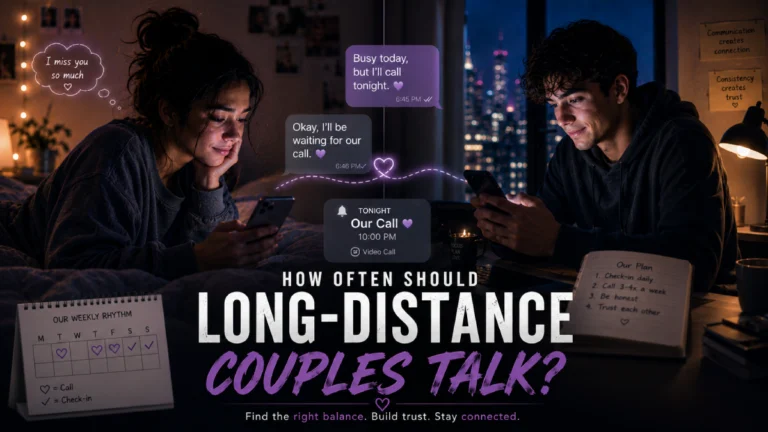
Step 2: Create a Communication Rhythm
Long-distance couples need rhythm.
Not strict rules.
Not pressure.
Rhythm.
A rhythm tells both people:
“We have a way to stay connected.”
It reduces guessing.
It lowers anxiety.
It makes the relationship feel more stable.
Decide What Daily and Weekly Connection Should Look Like
Talk about what feels realistic.
Maybe daily texting matters.
Maybe calls three times a week work better.
Maybe one deep weekend call is necessary.
Maybe goodnight texts are emotionally important.
Maybe both of you need flexible space during workdays.
There is no one perfect formula.
The right rhythm is the one that makes both people feel connected without feeling trapped.
Practical Example
Daily small updates + two proper calls per week + one weekly emotional check-in.
This can look like:
- Small messages during the day
- Voice notes when busy
- Proper calls when both are free
- One deeper conversation every week
- One fun shared activity, like a movie, game, or virtual dinner
Simple.
Sustainable.
Emotionally grounding.
Step 3: Ask for Reassurance Without Blaming
Reassurance is not wrong.
But the way you ask for it matters.
If you ask through accusation, your partner may become defensive.
If you hide the need, you may become resentful.
The healthiest way is to be honest and soft.
Use Clear, Soft, Direct Language
Instead of:
“You don’t care anymore.”
Try:
“I have been feeling a little disconnected, and I need to feel close to you again.”
Instead of:
“You never make time.”
Try:
“I miss having proper time with you. Can we plan a call that we both protect?”
This does not make you weak.
It makes you emotionally clear.
Example Script
“I am not blaming you. I just miss feeling close to you, and I need a little reassurance right now.”
This sentence gives your partner a chance to love you better.
Not by guessing.
But by understanding.
Step 4: Build Emotional Rituals
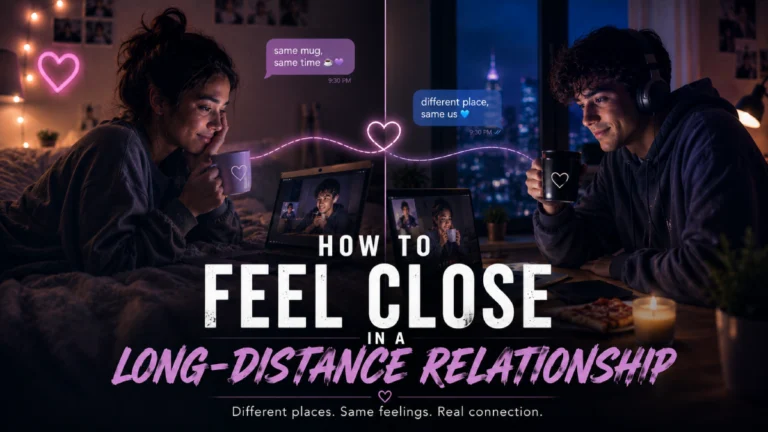
Rituals help long-distance love feel alive.
They give you something to look forward to.
They create shared meaning.
They make the relationship feel less like waiting and more like building.
Voice Notes, Virtual Dates, Shared Playlists, Open When Letters, and Photo Updates
Try rituals like:
- Sending a morning voice note
- Watching one show together
- Sharing one photo from your day
- Creating a shared playlist
- Writing “open when you miss me” letters
- Having a weekly virtual dinner
- Sending random reassurance texts
- Making a countdown to the next visit
These may sound small.
But in long-distance, small intentional actions carry emotional weight.
Lafz Amor Bridge
This is where emotional gifting and relationship psychology can connect naturally.
A love note, scrapbook, handmade gift, or open-when letter is not just a cute idea.
It becomes emotional proof.
It says:
“Even when I am far away, I am still thinking about you.”
And sometimes that is exactly what the heart needs.
Step 5: Talk About the Future Honestly
Future conversations can feel scary.
But avoiding them is scarier in the long run.
A long-distance relationship needs some kind of direction.
Not a perfect plan.
But honesty.
Even If the Plan Is Not Perfect, the Conversation Matters
Talk about questions like:
- When can we meet next?
- What are we both hoping for?
- How long can we realistically do long distance?
- What would closing the distance require?
- Are we both serious about this future?
- What needs to change for this to feel healthier?
These conversations may bring up difficult truths.
But they also bring relief.
Because clarity is kinder than endless guessing.
Step 6: Protect Your Own Emotional Life
This is the part many people forget.
You cannot make your whole life wait for one person’s message.
You cannot pause your growth until the distance ends.
You cannot let your entire mood depend on whether they called today.
That is too much pressure for you.
And too much pressure for the relationship.
Do Not Make Your Whole Life Wait for One Notification
Keep living.
Meet friends.
Focus on your goals.
Build your career.
Take care of your body.
Create routines.
Have hobbies.
Enjoy your city.
Laugh without guilt.
You can miss someone and still have a life.
You can love someone deeply and still belong to yourself.
Emotional Reassurance
You can love them deeply and still keep living fully.
In fact, that may help the relationship.
Because when you are emotionally grounded, you do not come to the relationship only from panic.
You come from love.
And that changes everything.
Common Mistakes That Make Long Distance Feel Even Harder
Long distance is already difficult.
But some patterns make it harder than it needs to be.
These mistakes are common, and they do not mean you are a bad partner.
They mean you are human.
But noticing them can protect your relationship from unnecessary pain.
Mistake 1: Expecting Constant Communication
Wanting connection is normal.
But expecting constant communication can create pressure.
If your partner has to reply all the time to prove love, the relationship may start feeling stressful.
And if you need constant replies to feel okay, your emotional peace becomes dependent on their availability.
That is exhausting.
Why It Is Harmful
It turns connection into pressure.
Instead of feeling loved, one person may feel monitored.
Instead of feeling secure, the other may feel anxious all day.
Emotional Consequence
One person feels controlled, and the other feels constantly anxious.
A better goal is not constant communication.
It is reliable communication.
Mistake 2: Pretending You Are Okay When You Are Not
Many people do this because they do not want to seem needy.
They say:
“It’s fine.”
But it is not fine.
They say:
“Do whatever you want.”
But inside, they feel hurt.
They act normal, but emotionally they are pulling away.
Why It Is Harmful
Unspoken hurt becomes resentment.
And resentment slowly changes the relationship.
You may become colder.
More sarcastic.
Less excited.
Less affectionate.
Not because love is gone, but because hurt has nowhere to go.
It is better to express pain early and gently than to let it harden inside you.
Mistake 3: Using Silence to Test Their Love
Sometimes when you feel hurt, you may stop texting first.
Not because you truly want space.
But because you want to see if they notice.
You want proof.
You want them to choose you without being told.
This is understandable.
But it can become damaging.
Why It Is Harmful
It creates confusion instead of closeness.
Testing someone rarely gives stable reassurance.
If they do not respond how you hoped, you feel worse.
If they do respond, you may still wonder if they did it because they care or because they noticed something was wrong.
Direct communication is safer than emotional testing.
Mistake 4: Comparing Your Relationship to Couples Who Live Near Each Other
This one hurts quietly.
You see couples going out.
Celebrating small things.
Posting pictures.
Meeting after work.
Spending birthdays together.
And you start feeling like your relationship is missing something.
Maybe it is.
But that does not mean it is less real.
Why It Is Harmful
It makes your relationship feel “less real” when it may simply need a different kind of effort.
Long-distance love is not fake love.
It is love under different conditions.
But if you keep comparing your relationship to close-distance couples, you may miss the ways your relationship is still meaningful.
Mistake 5: Ignoring Red Flags Because “Distance Is Hard”
This is very important.
Long-distance is hard.
But not every painful behavior should be excused because of distance.
Repeated lying is not just distance.
Emotional neglect is not just distance.
Disappearing during conflict is not just distance.
Making you feel guilty for normal needs is not just distance.
Never making an effort is not just distance.
Why It Is Harmful
You may excuse emotional neglect, lying, avoidance, or one-sided effort.
And slowly, you may start accepting less than what your heart actually needs.
Be patient with distance.
But do not use distance as a reason to abandon yourself.
When Is Long Distance Hard But Still Healthy?
Not every hard long-distance relationship is unhealthy.
Sometimes it is hard because the situation is genuinely difficult.
But the love is still safe.
The effort is still mutual.
The communication is still repairable.
The future is still being discussed.
The relationship still gives you more emotional security than confusion.
So how do you know the difference?
You Both Still Try to Repair After Conflict
Healthy couples do not avoid every fight.
They repair after it.
They come back.
They apologize.
They explain.
They try to understand.
They do not let one disagreement become emotional abandonment.
In long-distance, repair matters even more because you cannot rely on physical closeness to soften the hurt.
You Can Talk About Emotional Needs Without Being Shamed
This is a big sign.
If you can say:
“I miss you.”
“I need reassurance.”
“I feel disconnected.”
“Can we talk more intentionally?”
And your partner listens instead of mocking, dismissing, or guilt-tripping you, that is emotional safety.
They may not always understand perfectly.
But they care enough to try.
There Is Consistent Effort, Even If Life Gets Busy
Healthy effort does not mean someone is available 24/7.
It means they show care in realistic, repeated ways.
They communicate when busy.
They reschedule when plans change.
They remember what matters to you.
They make time when they can.
They do not leave you constantly guessing where you stand.
You Both Want a Future Together
A healthy long-distance relationship has some kind of shared direction.
Even if the plan is not immediate.
Even if life is complicated.
Both people should be willing to talk about the future.
Because without future hope, distance can become emotionally draining.
You Feel Loved Overall, Even When You Miss Them
This is the emotional difference.
In a healthy long-distance relationship, you may miss them.
You may feel sad.
You may have hard days.
But overall, you still feel loved.
You still feel chosen.
You still feel respected.
You still feel like both of you are trying.
Missing someone is painful.
But feeling unwanted is different.
Learn to notice the difference.
Emotional Clarity
Hard does not always mean unhealthy.
Sometimes hard means you need better systems, more reassurance, and clearer expectations.
But if the relationship is making you feel constantly invisible, anxious, and alone, then the issue may be deeper than distance.
When to Walk Away From a Long-Distance Relationship
This is not an easy section.
Because sometimes you can love someone and still realize the relationship is hurting you too much.
And that truth can feel unfair.
You may think:
“But we have history.”
“But they love me in their own way.”
“But maybe things will change.”
“But what if I regret leaving?”
These thoughts are normal.
But love should not require you to keep breaking yourself to prove patience.
Walk Away When You Are Always Begging for Basic Effort
If you have to beg for every call, every reply, every plan, every reassurance, every repair — something is wrong.
Basic effort should not feel like a luxury.
You are not asking for too much when you ask to feel considered.
You are asking for the minimum emotional respect a relationship needs.
Walk Away When They Avoid Every Future Conversation
If someone wants the comfort of your loyalty but avoids every serious conversation about the future, pay attention.
Long-distance cannot survive forever on vague hope.
At some point, love needs direction.
If they never want to talk about what comes next, you may be investing in uncertainty while they enjoy emotional convenience.
Walk Away When Trust Is Repeatedly Broken
Trust can be rebuilt.
But only when there is honesty, accountability, and changed behavior.
If someone keeps breaking trust and then makes you feel guilty for being hurt, that is not repair.
That is emotional unfairness.
You cannot heal in the same pattern that keeps hurting you.
Walk Away When You Feel More Lonely With Them Than Without Them
This one is painful.
But sometimes a relationship makes you feel lonelier than being alone would.
Because when you are single, loneliness is honest.
But when you are in a relationship and still feel emotionally abandoned, the loneliness becomes confusing.
You keep expecting comfort from the same place that keeps creating pain.
That can break you slowly.
Walk Away When You Keep Shrinking Your Needs to Keep the Relationship Alive
If you have stopped asking for what you need because you are afraid they will leave…
If you pretend you are okay with less because you do not want to seem difficult…
If you keep lowering your expectations just to keep them close…
Then you are not just adjusting.
You are shrinking.
And love should not make you disappear.
Reality Check
Distance can be difficult, but love should not make you feel permanently invisible.
A long-distance relationship can ask for patience.
But it should not ask you to abandon your self-respect.
Final Thoughts: Long Distance Is Hard Because Love Needs Presence
Long-distance relationships are hard because you are trying to keep love emotionally alive without the comfort of everyday presence.
You are trying to trust without always seeing.
You are trying to feel close without touch.
You are trying to communicate love through screens.
You are trying to build a future while missing the present.
Of course it feels hard.
Of course some days feel heavy.
Of course silence hurts more when you already miss them.
You are not weak for struggling.
You are human.
Reassurance
Long-distance relationships are hard because love needs presence.
And when presence is missing, both people have to become more intentional with reassurance, effort, communication, trust, and emotional care.
If both people are willing to show up, repair, plan, and understand each other, distance can be managed.
It may still hurt sometimes.
But it does not have to destroy the relationship.
Emotional Closure
If both people are willing to communicate, reassure, repair, plan, and stay emotionally consistent, distance can be managed.
But if the relationship only survives because one person keeps carrying it, the problem is not just distance.
It is imbalance.
And you deserve to know the difference.
Long distance is hard.
But healthy long-distance love should still make you feel chosen.
Maybe not every second.
Maybe not perfectly.
But deeply enough that your heart does not feel like it is begging for proof all the time.
If this made you realize you still want to make the relationship work, read next:
How to Make a Long-Distance Relationship Work When You Miss Them So Much
Once you understand why long-distance feels hard, the next step is learning to build emotional closeness, trust, and reassurance in a way that feels healthy for both of you.