Anxious vs Avoidant Attachment: Why one Pulls Away
Why Does This Relationship Feel Like a Push-Pull Cycle?
Have you ever felt like the more you try to get close, the more they pull away?
You ask for clarity.
They say you are pressuring them.
They go quiet.
You panic.
You text again.
They withdraw more.
Now you feel abandoned, and they feel trapped.
And somehow, both people end up feeling hurt by the same relationship, but for completely different reasons.
This is the painful heart of anxious vs avoidant attachment.
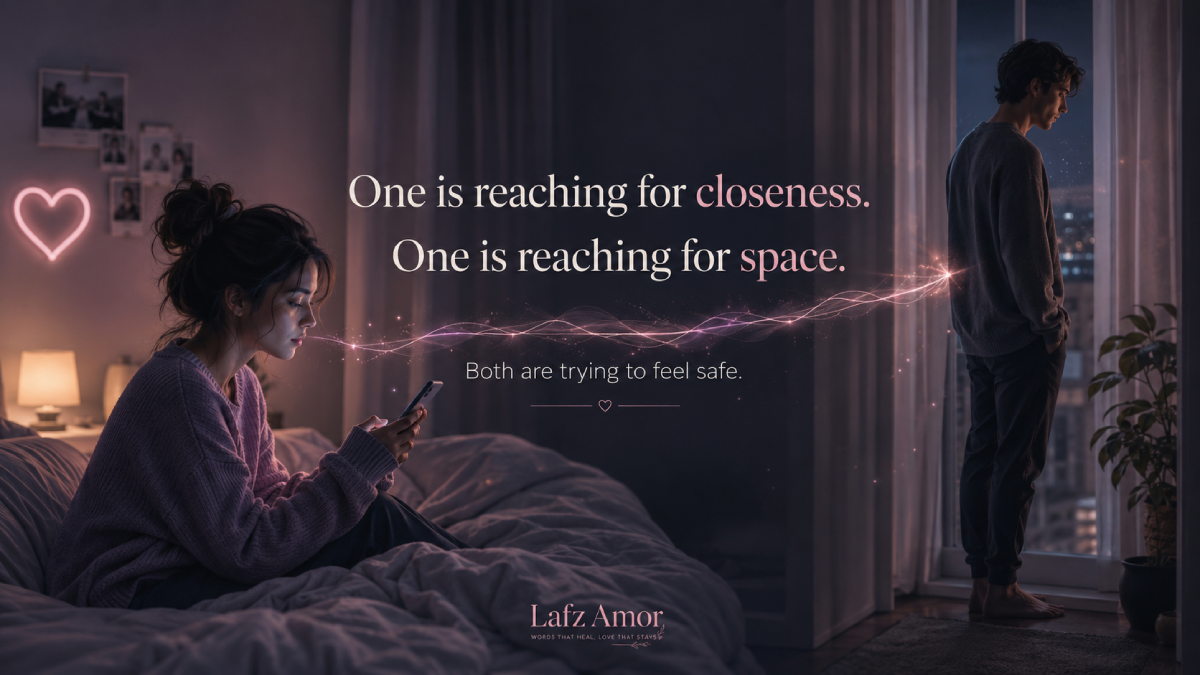
One person seeks safety through closeness.
The other seeks safety through distance.
One thinks, “Please come closer so I know we are okay.”
The other thinks, “Please give me space so I can breathe.”
And when these two patterns meet, love can start feeling like a loop.
Not because there is no love.
Not always.
Sometimes there is a lot of love.
But love alone does not automatically create emotional safety.
You might have noticed this in your own relationship.
When things are good, they feel really good.
Warm.
Deep.
Intense.
Almost impossible to let go of.
But when things get triggered, everything changes.
One person becomes anxious, emotional, and desperate to fix things.
The other becomes quiet, distant, and emotionally unavailable.
Then the anxious person feels rejected.
The avoidant person feels overwhelmed.
The anxious person reaches harder.
The avoidant person pulls further.
And both silently think, “Why don’t they understand me?”
That is why this dynamic feels so confusing.
Because both people are trying to protect themselves.
But their protection styles hurt each other.
The Moment the Cycle Usually Starts
The anxious-avoidant cycle does not always begin with a huge fight.
Sometimes it starts with something small.
A late reply.
A shorter message.
A serious conversation.
A need for reassurance.
A request for commitment.
A partner needing space.
A change in tone.
A moment of emotional vulnerability.
For the anxious partner, the moment may feel like danger.
“They are pulling away.”
“They are losing feelings.”
“They are going to leave.”
“I need to fix this now.”
For the avoidant partner, the same moment may feel like pressure.
“This is becoming too much.”
“They need too much from me.”
“I am losing my freedom.”
“I need to get some space.”
And from there, the cycle begins quietly.
The anxious partner tries to close the distance.
The avoidant partner tries to create distance.
Neither person feels safe.
The anxious partner feels abandoned.
The avoidant partner feels trapped.
And the original issue becomes buried under emotional reactions.
Maybe the actual issue was just a late reply.
But now the real fight is about safety.
Who gets it?
Who loses it?
Who has to change first?
Why It Feels So Addictive
The anxious-avoidant relationship can feel strangely addictive because it does not hurt all the time.
That is what makes it hard to leave or understand.
There are beautiful moments too.
The avoidant partner comes close.
The anxious partner feels chosen.
There is warmth, chemistry, affection, laughter, intimacy.
Then distance comes again.
The anxious partner panics.
The avoidant partner withdraws.
Pain returns.
Then, after some silence or tension, they reconnect.
And the reunion feels powerful.
It feels like relief.
It feels like love coming back.
It may even feel more intense because you almost lost it.
But this is where emotional clarity is needed.
Relief can feel like love when you have been in pain.
A reply feels magical when you have been waiting for hours.
A hug feels deeper when you have been scared they were leaving.
A small moment of affection feels huge when your heart has been starving.
That does not mean the connection is healthy.
It means the contrast is intense.
Pain, then relief.
Distance, then closeness.
Fear, then comfort.
This emotional high-low pattern can make the relationship feel deeper than it actually is.
And that is why people stay stuck.
Not because they are foolish.
Because the nervous system starts craving the next moment of relief.
Micro Takeaway
The anxious-avoidant dynamic often hurts because both people are trying to feel safe in opposite ways.
The anxious partner moves closer to feel safe.
The avoidant partner moves away to feel safe.
And unless both people understand the cycle, each person’s safety strategy becomes the other person’s trigger.
What Is the Difference Between Anxious and Avoidant Attachment?
Anxious attachment seeks safety through closeness, reassurance, and emotional certainty. Avoidant attachment seeks safety through distance, independence, and emotional control. In relationships, anxious partners may pursue when they feel insecure, while avoidant partners may withdraw when they feel overwhelmed. This creates the anxious-avoidant push-pull cycle.
That is the simple explanation.
But emotionally, it feels much more complicated.
Because the anxious person is not just “needy.”
And the avoidant person is not just “cold.”
Those labels are too lazy for something this emotionally layered.
The anxious partner often feels fear when distance appears.
The avoidant partner often feels fear when closeness becomes intense.
One fears being left.
The other fears being consumed.
One says, “Why won’t you come closer?”
The other says, “Why won’t you give me space?”
And both may genuinely feel misunderstood.
So before we talk about what to do, we need to understand both sides with honesty.
Not to excuse harmful behavior.
Not to blame one person.
But to see the pattern clearly.
Because you cannot heal a cycle you only keep judging.
Anxious Attachment: “Please Come Closer So I Can Feel Safe”
Anxious attachment often shows up as a deep need for closeness, reassurance, emotional consistency, and clarity.
If you are the anxious partner, you may feel love very intensely.
You may care deeply.
You may notice small emotional shifts quickly.
You may want to talk things out immediately.
You may feel unsettled when your partner becomes distant or unclear.
And when someone you love pulls away, your whole body may react.
Not just your mind.
Your chest tightens.
Your stomach drops.
Your thoughts race.
You may know logically that they need space, but emotionally it feels like the beginning of abandonment.
You may tell yourself, “Stay calm.”
But your fear says, “Do something now before you lose them.”
That is the anxious attachment alarm.
It is not always rational.
But it is real.
Core Fear
The core fear of anxious attachment is usually:
“They will leave me.”
“They will stop loving me.”
“I am not enough to stay for.”
“I will be replaced.”
“I care more than they do.”
At the center of anxious attachment, there is often a deep fear of abandonment, rejection, emotional distance, or being forgotten.
This is why uncertainty feels so painful.
The anxious partner does not just want a text.
They want proof that the bond is still safe.
Common Behaviors
Anxious attachment may show up as:
- Seeking reassurance again and again
- Overthinking replies
- Asking for clarity
- Feeling anxious when the partner needs space
- Chasing after withdrawal
- Sending long emotional messages
- Apologizing even when not fully wrong
- Blaming yourself when your partner pulls away
- Feeling addicted to small signs of affection
- Feeling calm only when the other person becomes warm again
From the outside, this may look like “too much.”
But inside, it often feels like survival.
The anxious partner is not thinking, “Let me create drama.”
They are thinking, “I need to know we are okay.”
Emotional Need
The emotional need underneath anxious attachment is safety through consistency.
The anxious partner needs:
- Reassurance
- Emotional clarity
- Predictability
- Warmth
- Follow-through
- Repair after conflict
- A sense of being chosen
But here is the important part.
These needs are not wrong.
The way they are expressed can become unhealthy when fear takes over.
But needing clarity, effort, and consistency does not make someone weak.
It makes them human.
Avoidant Attachment: “Please Give Me Space So I Can Feel Safe”
Avoidant attachment often shows up as a strong need for space, independence, emotional control, and autonomy.
If you are the avoidant partner, you may care about someone but still feel overwhelmed when emotional closeness becomes intense.
At first, connection may feel good.
You may enjoy the chemistry.
You may like spending time together.
You may even feel deeply attached.
But when the relationship starts asking for more vulnerability, reassurance, consistency, or emotional openness, something inside you may start pulling back.
Not always because you do not care.
Sometimes because closeness begins to feel like pressure.
You may feel responsible for someone else’s emotions.
You may feel like your freedom is shrinking.
You may feel like every conversation is becoming too heavy.
So you create distance.
You go quiet.
You delay replying.
You avoid the serious talk.
You tell yourself, “I just need space.”
And maybe you do.
But when space has no explanation, no return point, and no emotional reassurance, it can deeply hurt the other person.
Core Fear
The core fear of avoidant attachment is usually:
“I will lose myself.”
“I will be trapped.”
“They will need too much from me.”
“I cannot handle this emotional pressure.”
“If I get too close, I will lose control.”
Avoidant attachment often fears engulfment, dependence, emotional overwhelm, and loss of freedom.
Where the anxious person fears distance, the avoidant person may fear too much closeness.
And this is why the dynamic becomes painful.
The thing one person needs is the thing the other person fears.
Common Behaviors
Avoidant attachment may show up as:
- Pulling away when things get serious
- Shutting down during conflict
- Avoiding emotional conversations
- Needing space after closeness
- Downplaying emotional needs
- Feeling pressured by intensity
- Delaying replies when overwhelmed
- Acting distant after intimacy
- Avoiding commitment conversations
- Feeling irritated when asked for reassurance
From the outside, this may look like not caring.
But inside, it may feel like emotional flooding.
The avoidant partner may think, “I need space before I say something wrong.”
Or, “I do not know how to handle this.”
Or, “This is too much for me.”
But if they never communicate that clearly, their silence becomes painful.
Emotional Need
The emotional need underneath avoidant attachment is safety through space.
The avoidant partner needs:
- Autonomy
- Low-pressure connection
- Time to process
- Emotional pacing
- Respect for independence
- Space that does not become guilt
- Closeness that does not feel controlling
Again, these needs are not wrong.
Space is healthy.
Autonomy is healthy.
Independence is healthy.
But disappearing, dismissing, stonewalling, or making someone feel foolish for needing connection is not healthy.
The goal is not for avoidant partners to give up space.
The goal is to learn how to take space without abandoning the relationship.
Quick Comparison Table
| Pattern | Anxious Attachment | Avoidant Attachment |
| Core fear | “They will leave me” | “They will trap me” |
| Safety strategy | Closeness | Distance |
| Conflict response | Pursues, explains, protests | Withdraws, shuts down, avoids |
| Trigger | Silence, distance, uncertainty | Pressure, intensity, dependence |
| Emotional need | Reassurance and clarity | Space and autonomy |
| Shadow side | Chasing, overthinking, self-blame | Emotional withdrawal, dismissal, avoidance |
This table can help, but remember something important.
You are not just a type.
You are a person with history, fears, needs, wounds, and choices.
Your attachment style may explain your pattern.
It does not remove your responsibility.
And it does not decide your future.
What Is the Anxious-Avoidant Trap?
The anxious-avoidant trap is a relationship pattern where one partner seeks closeness to feel safe, while the other creates distance to feel safe. The more the anxious partner pursues, the more the avoidant partner withdraws. The more the avoidant partner withdraws, the more abandoned the anxious partner feels.
This is also called the anxious-avoidant cycle, anxious-avoidant relationship cycle, or push-pull relationship pattern.
And if you have been inside it, you know how emotionally tiring it can be.
It can make both people feel like they are loving someone who does not understand their pain.
The anxious person thinks:
“If they loved me, they would reassure me.”
The avoidant person thinks:
“If they loved me, they would stop pressuring me.”
Both are asking for safety.
But neither feels safe enough to give the other person what they need.
Let’s break down how the trap usually works.
Step 1: The Avoidant Partner Pulls Back
At some point, the avoidant partner feels overwhelmed.
Maybe the relationship is getting serious.
Maybe there was conflict.
Maybe the anxious partner asked for reassurance.
Maybe emotional expectations increased.
Maybe closeness started feeling too intense.
So the avoidant partner creates distance.
They may not always say, “I am overwhelmed.”
They may simply become less available.
What It Looks Like
This may look like:
- Less texting
- More emotional distance
- Avoiding serious talks
- Saying “I need space.”
- Acting cold after intimacy
- Becoming vague about commitment
- Taking longer to reply
- Changing the topic during emotional conversations
- Saying “You are overthinking.”
- Becoming irritated when asked for clarity
The avoidant partner may feel like they are protecting their peace.
But to the anxious partner, it feels like rejection.
Emotional Impact on the Anxious Partner
The anxious partner feels:
“They are leaving.”
“I need to fix this now.”
“If I do not do something, I will lose them.”
This is where the anxious alarm turns on.
And once that alarm turns on, waiting calmly becomes very hard.
Step 2: The Anxious Partner Chases Closeness
When the avoidant partner pulls back, the anxious partner often moves closer.
Not because they want to suffocate the other person.
But because distance feels unbearable.
They want clarity.
They want reassurance.
They want to know what changed.
They want to feel chosen again.
So they pursue.
They ask.
They text.
They explain.
They try to repair immediately.
They may send a long paragraph because silence feels too painful.
What It Looks Like
This may look like:
- Asking for reassurance
- Sending long messages
- Trying to talk immediately
- Seeking clarity again and again
- Apologizing even when not wrong
- Becoming hyper-aware of tone
- Asking, “Are we okay?”
- Asking, “Do you still want this?”
- Checking online status
- Feeling unable to focus until the issue is resolved
The anxious partner may believe they are trying to save the relationship.
But to the avoidant partner, it may feel like pressure.
Emotional Impact on the Avoidant Partner
The avoidant partner feels:
“This is too much.”
“I cannot breathe.”
“They need too much from me.”
“I need to get away.”
So they pull back more.
Not necessarily because they do not care.
But because they feel emotionally flooded.
Step 3: The Avoidant Partner Withdraws More
Now the avoidant partner feels even more overwhelmed.
The anxious partner’s pursuit confirms their fear that closeness will become demanding.
So they withdraw more.
They may stop replying.
They may become colder.
They may avoid emotional conversations completely.
They may say they need space but not explain when they will return.
This makes the anxious partner feel even more unsafe.
And the cycle deepens.
What It Looks Like
This may look like:
- Silence
- Delayed replies
- Emotional shutdown
- Avoiding conflict
- Changing the topic
- Acting irritated by needs
- Saying “I don’t want to talk about this”
- Saying “You are making this too big.”
- Leaving the conversation unresolved
- Acting normal later without repair
This is where the anxious partner may start feeling desperate.
Because now the distance feels like proof.
Emotional Impact on the Anxious Partner
The anxious partner thinks:
“Now I am sure something is wrong.”
“They are really leaving.”
“I knew it.”
“I need to try harder.”
And then they may chase more.
Which makes the avoidant partner withdraw more.
This is the trap.
Not one single moment.
A repeated loop.
Step 4: The Reunion Feels Like Relief, Not Real Repair
Eventually, the avoidant partner may come back.
They reply.
They act warm again.
They say they were busy.
They say they needed space.
They may even become affectionate.
The anxious partner feels relief.
The avoidant partner feels less pressured.
Things feel okay again.
For a while.
But if the deeper pattern is not discussed, nothing has actually changed.
The same trigger will return.
The same fear will return.
The same cycle will return.
What It Looks Like
This may look like:
- They finally reply
- Things feel warm again
- The anxious partner feels calm
- The avoidant partner feels less pressured
- Nobody deeply addresses the pattern
- The relationship feels good for a few days
- Then the same issue repeats later
This is why anxious-avoidant relationships can feel so addictive.
Because every reunion feels like healing.
But not every reunion is repair.
Sometimes it is just relief.
Micro Takeaway
Relief is not the same as security.
Security means the pattern is changing.
Relief means the pain stopped for now.
And if you are trying to understand your relationship honestly, this difference matters.
Why Do Anxious and Avoidant Partners Attract Each Other?
It can feel strange, even unfair.
Why would someone who fears abandonment feel drawn to someone who pulls away?
Why would someone who fears emotional pressure feel drawn to someone who needs closeness?
But anxious and avoidant partners often attract each other because their patterns fit together painfully.
Not a healthy fit.
But a familiar one.
One person brings emotional intensity.
The other brings distance.
One person seeks closeness.
The other creates uncertainty.
And uncertainty can feel strangely powerful when your attachment system is activated.
Reason 1: Familiar Pain Can Feel Like Chemistry
Sometimes the spark you feel with someone is not only attraction.
Sometimes it is familiar pain waking up.
An anxious person may feel drawn to someone slightly unavailable because uncertainty activates their attachment system.
The avoidant person may feel drawn to someone emotionally expressive because it feels warm, admiring, and connecting at first.
In the beginning, the anxious person may make the avoidant person feel deeply wanted.
The avoidant person may make the anxious person feel like they have found someone mysterious, exciting, and emotionally important.
But as expectations grow, the same qualities that attracted them may start triggering them.
The anxious person’s emotional need becomes “too much.”
The avoidant person’s space becomes “rejection.”
The spark becomes stress.
Emotional Impact
Sometimes the spark is not safety.
Sometimes it is your wound recognizing a familiar pattern.
That does not mean every intense connection is unhealthy.
But it does mean intensity needs to be questioned gently.
Ask yourself:
“Do I feel safe with this person?”
Or:
“Do I feel activated by trying to earn their closeness?”
Those are very different experiences.
Reason 2: Each Person Confirms the Other’s Core Fear
This is the cruel little machinery of the anxious-avoidant cycle.
Each person unintentionally confirms the other person’s deepest fear.
The anxious person fears being abandoned.
Then the avoidant partner withdraws.
So the anxious person thinks, “See, people always leave.”
The avoidant person fears being pressured or trapped.
Then the anxious partner pursues.
So the avoidant person thinks, “See, closeness always becomes too much.”
Both people feel proven right.
Both feel hurt.
Both feel misunderstood.
And because both feel emotionally threatened, both become more protective.
The anxious partner protects through closeness.
The avoidant partner protects through distance.
The protection becomes the problem.
Emotional Impact
Both people start thinking, “See, this is exactly what always happens to me.”
The anxious partner sees abandonment.
The avoidant partner sees pressure.
But underneath both reactions is fear.
And if that fear is not named, the relationship keeps fighting symptoms instead of healing the pattern.
Reason 3: Early Connection Can Feel Deep and Fast
Many anxious-avoidant relationships begin beautifully.
That is why they are so hard to understand later.
In the beginning, the anxious partner may feel chosen.
The avoidant partner may feel admired and desired.
There may be chemistry, attention, mystery, excitement, late-night conversations, emotional intensity, and a sense of “this feels different.”
The avoidant partner may be more available at first because the relationship has not yet become too emotionally demanding.
The anxious partner may feel secure at first because there is enough attention and closeness.
But as the relationship becomes real, expectations increase.
Now there are conversations about commitment.
Consistency.
Needs.
Future.
Conflict.
Emotional responsibility.
And that is where the avoidant partner may start feeling pressure.
The anxious partner notices the shift and starts feeling afraid.
The cycle begins.
Emotional Impact
The relationship often starts with closeness, then becomes a cycle of hope, distance, panic, and relief.
That is what makes it so difficult to let go.
You keep remembering how it was in the beginning.
You keep thinking, “That version of us is real.”
Maybe it was.
But the question is not only whether the beginning was real.
The question is whether the relationship can become emotionally safe now.
Reason 4: Both People Mistake Activation for Love
Activation can feel like love.
The anxious partner feels intensely focused on the avoidant partner.
They cannot stop thinking about them.
They feel desperate for connection.
They feel deeply affected by every small sign.
That intensity may feel like proof of love.
But sometimes it is anxiety.
The avoidant partner may feel calm when they create distance.
They may think, “I feel better when I am away, so maybe I do not love them.”
But sometimes that calm is not lack of love.
Sometimes it is relief from emotional overwhelm.
Both people may misread their nervous system.
The anxious partner thinks anxiety means love.
The avoidant partner thinks distance means peace.
And neither realizes the body is reacting to safety, not just love.
Emotional Impact
One person feels alive when chasing.
The other feels safe when escaping.
But a relationship cannot become secure if love only feels possible through pursuit and distance.
At some point, both people have to ask:
“What would safety look like for both of us?”
Not just closeness.
Not just space.
Safety.
How This Cycle Hurts Both Partners
It is easy to blame one side.
Many anxious people say avoidants are cold.
Many avoidant people say anxious partners are too needy.
But the truth is more layered.
Both people can be hurt in this dynamic.
Both can also hurt each other.
Understanding both sides does not mean excusing harmful behavior.
It means seeing the full emotional picture.
Because if you only blame, you may feel right.
But you may not heal.
How the Anxious Partner Gets Hurt
The anxious partner often feels like they are always reaching for someone who keeps moving away.
They may feel unwanted, rejected, too emotional, too demanding, or hard to love.
They may start questioning their worth.
They may become obsessed with small signs.
They may feel like the relationship is always on the edge of ending.
And because the avoidant partner may come close sometimes, the anxious partner keeps hoping.
“If I explain better, they will understand.”
“If I love harder, they will stay.”
“If I become calmer, they will choose me.”
“If I wait longer, they will open up.”
This hope can become heavy.
Because the anxious partner may start carrying the whole emotional weight of the relationship.
Emotional Experience
The anxious partner may experience:
- Feeling abandoned
- Feeling too much
- Feeling desperate for clarity
- Feeling rejected by space
- Feeling responsible for fixing everything
- Feeling ashamed of their needs
- Feeling calm only when the avoidant partner returns
- Feeling emotionally hungry between moments of affection
This can slowly damage self-worth.
Because when love keeps feeling uncertain, the anxious partner may start thinking they are the problem.
Hidden Wound
The hidden wound is often:
“I am not enough to stay for.”
This wound can make every withdrawal feel personal.
Even when the avoidant partner’s distance is about their own fear, the anxious partner may experience it as proof of being unlovable.
That is why this dynamic hurts so deeply.
It touches the place where the anxious partner already feels afraid.
Micro Takeaway
Anxious partners often need reassurance, but repeated uncertainty can make the need feel endless.
The need itself is not wrong.
But when reassurance comes from an inconsistent person, it may never fully settle.
How the Avoidant Partner Gets Hurt
The avoidant partner also gets hurt, though they may not show it as openly.
They may feel misunderstood.
They may feel like their need for space is treated as cruelty.
They may feel guilty for not being able to respond the way their partner wants.
They may feel emotionally flooded during conflict.
They may care, but feel unable to express it in the way the anxious partner needs.
They may feel like no matter what they do, it is never enough.
And when the anxious partner pursues, asks, explains, cries, or demands clarity, the avoidant partner may feel trapped.
Their system says, “Escape.”
So they withdraw.
But then they may feel guilty.
Or lonely.
Or confused.
Or relieved and sad at the same time.
Avoidant attachment can be emotionally isolating because the person often protects themselves by disconnecting from their own needs too.
Emotional Experience
The avoidant partner may experience:
- Feeling pressured
- Feeling controlled
- Feeling emotionally flooded
- Feeling like needs are demands
- Feeling guilty but unable to open up
- Feeling responsible for someone else’s emotions
- Feeling safer alone
- Feeling confused by their own distance
This does not mean their withdrawal does not hurt others.
It does.
But it helps explain why they may pull away even when they care.
Hidden Wound
The hidden wound is often:
“I will lose myself if I get too close.”
The avoidant partner may associate intimacy with pressure, control, criticism, dependence, or emotional overwhelm.
So when the relationship asks for closeness, their body may interpret it as danger.
Not because love is absent.
But because safety feels tied to distance.
Micro Takeaway
Avoidant partners often need space, but repeated withdrawal can make love feel emotionally lonely.
Space is not the problem.
Uncommunicated disappearance is.
Why Both People Feel Misunderstood
The anxious partner thinks:
“If they loved me, they would come closer.”
The avoidant partner thinks:
“If they loved me, they would give me space.”
Both are asking for love in the language of their wound.
The anxious partner’s language is closeness.
The avoidant partner’s language is distance.
So both people feel unloved when the other person tries to feel safe.
That is the tragedy of anxious vs avoidant attachment.
It is not always that one person loves and the other does not.
Sometimes both people care.
But they do not know how to protect the relationship while protecting themselves.
And that is the skill they must learn if the relationship is going to become healthier.
Can Anxious and Avoidant Relationships Work?
Yes, anxious and avoidant relationships can work, but only when both partners recognize the cycle, take responsibility for their part, and build safer ways to handle closeness, space, conflict, and reassurance. If only one person is trying, the relationship often becomes emotionally exhausting.
This is the honest answer.
Can it work?
Yes.
Will it work automatically because you love each other?
No.
Love may create the desire to stay.
But emotional safety creates the ability to stay well.
An anxious-avoidant relationship needs more than chemistry.
It needs awareness.
Repair.
Patience.
Accountability.
New patterns.
And most importantly, both people must be willing.
Not just one.
One person cannot heal the entire relationship alone.
It Can Work If Both People Are Self-Aware
Self-awareness means both partners can notice their own part in the cycle.
The anxious partner can say:
“When I feel scared, I chase and ask for reassurance in a panicked way.”
The avoidant partner can say:
“When I feel overwhelmed, I shut down and disappear emotionally.”
This kind of honesty changes the conversation.
Now it is not:
“You are too needy.”
“You are too cold.”
It becomes:
“We are getting stuck in a cycle.”
That shift matters.
Because a cycle can be changed more easily than a person can be attacked into becoming different.
What This Looks Like
A self-aware anxious-avoidant couple may practice:
- The anxious partner pausing before chasing
- The avoidant partner communicating before withdrawing
- Both naming triggers
- Both validating impact
- Both repairing after conflict
- Both learning each other’s safety needs
- Both noticing when the pattern starts
- Both choosing a different response
This does not mean they never get triggered.
They will.
But they begin to recover faster.
And recovery matters more than perfection.
It Can Work If Space Has a Return Point
Avoidant partners often need space.
That is not automatically unhealthy.
The problem is space without clarity.
When space has no return point, the anxious partner feels abandoned.
When someone says, “I need space,” but does not say when they will come back, what they need, or whether the relationship is okay, the anxious partner’s nervous system fills in the blanks with fear.
So space needs structure.
Not control.
Structure.
A healthier version of space sounds like:
“I need 30 minutes to calm down, but I will come back and talk.”
Or:
“I am overwhelmed right now. I am not leaving. I need some time, and we can speak tonight.”
This changes everything.
Because now space does not feel like disappearance.
It feels like regulation.
It Can Work If Reassurance Is Given Without Shame
Anxious partners often need reassurance.
That is not automatically unhealthy.
The problem is reassurance asked from panic or reassurance mocked by the other person.
A healthier version of reassurance sounds like:
“I feel triggered right now. Can you reassure me that we are okay?”
Or:
“When communication suddenly changes, I start overthinking. I am working on it, but clarity helps me.”
This is not begging.
This is emotional honesty.
And if the avoidant partner can respond with kindness instead of shame, the anxious partner may slowly feel safer.
A simple “We are okay, I just needed a little time” can prevent hours of spiraling.
But the anxious partner also has work to do.
They must learn to receive reassurance without needing the same reassurance every five minutes.
Both sides grow.
One learns to offer safety.
The other learns to hold safety.
It Cannot Work If Only One Person Is Doing the Work.
This is the part many emotionally aware people need to hear.
You cannot become secure for two people.
You cannot read enough psychology to compensate for someone else’s refusal to reflect.
You cannot love someone into emotional availability if they are committed to avoiding themselves.
You cannot heal anxious attachment while staying in a dynamic that keeps making you feel unwanted.
You cannot heal avoidant attachment if you keep calling every emotional need “pressure.”
If only one person is doing the work, the relationship becomes a one-sided emotional project.
And one-sided healing is exhausting.
It can make the anxious partner feel like a therapist.
It can make the avoidant partner feel constantly judged.
It can turn love into labor.
A relationship can work when both people are imperfect but willing.
But if one person is aware and the other is avoidant of all responsibility, the cycle will likely keep repeating.
What Should You Do If You Are in an Anxious-Avoidant Relationship?
If you are in an anxious-avoidant relationship, the first step is not to panic.
Do not immediately label it doomed.
But also do not romanticize the pain.
The goal is to see the pattern clearly.
Then decide whether both people are willing to change it.
Because some anxious-avoidant relationships can become healthier.
And some are simply hurting both people again and again.
The difference is not how intense the love feels.
The difference is whether the pattern is changing.
Step 1: Name the Cycle, Not Just the Person
When you are hurt, it is natural to blame the other person.
The anxious partner may say:
“You are avoidant.”
“You do not care.”
“You always run away.”
The avoidant partner may say:
“You are too needy.”
“You always make things heavy.”
“You never give me space.”
But these statements usually make the other person defensive.
They do not create repair.
A better approach is to name the cycle.
Clear Action
Instead of saying:
“You are avoidant.”
“You are too needy.”
Say:
“I think we are getting stuck in a cycle where I pursue and you withdraw.”
Or:
“When I feel scared, I ask for more closeness. When you feel overwhelmed, you pull away. Then both of us feel unsafe.”
This reduces blame.
It gives both people a shared problem to work on.
The enemy becomes the cycle, not each other.
Emotional Reassurance
Naming the cycle does not mean your pain is not valid.
It means you are choosing a language that makes repair more possible.
Sometimes the most healing sentence is not, “You hurt me because you are avoidant.”
It is:
“We are stuck in something painful, and I want us to understand it before it breaks us.”
Step 2: Identify Your Trigger Pattern
Every anxious-avoidant cycle has triggers.
The anxious partner may be triggered by distance.
The avoidant partner may be triggered by intensity.
But each relationship has its own details.
Maybe the anxious person panics when replies slow down.
Maybe the avoidant person shuts down when conversations become emotional at night.
Maybe conflict triggers both.
Maybe commitment talks create fear.
Maybe silence creates panic.
You need to know your pattern clearly.
Not vaguely.
Specifically.
Clear Action
Ask yourself:
- What makes me chase?
- What makes me shut down?
- What makes them pull away?
- What makes me panic?
- What makes them feel pressured?
- What do I do when I feel unsafe?
- What do they do when they feel overwhelmed?
- What keeps repeating after every conflict?
Write it down if needed.
Patterns become less powerful when they are visible.
Micro Takeaway
You cannot change a cycle you cannot see.
And sometimes seeing it clearly is the first moment you stop feeling crazy.
You realize, “This is not random. This is a pattern.”
That realization can feel like someone finally turned on a small lamp in a very dark room.
Step 3: Create a Safe Space Agreement
Space is often the biggest trigger in anxious-avoidant relationships.
The avoidant partner needs it.
The anxious partner fears it.
So the solution is “no space.”
That will make the avoidant partner feel trapped.
The solution is also not “unlimited space without explanation.”
That will make the anxious partner feel abandoned.
The healthier solution is safe space.
Space with clarity.
Space with a return point.
Space that says, “I need time, but I am not disappearing from the relationship.”
Clear Action
Use this structure:
“When one of us needs space, we will say how much time we need and when we will return.”
This creates emotional predictability.
It does not remove all discomfort.
But it reduces panic.
Example Script
“I need space, but I am not leaving. I need one hour to calm down, and then we can talk.”
Or:
“I am overwhelmed right now. I care about this conversation, but I need time to process. Can we come back to it at 8 PM?”
This gives the avoidant partner breathing room.
And it gives the anxious partner reassurance that space is not abandonment.
Emotional Reassurance
Space feels less scary when it does not feel like abandonment.
And for the avoidant partner, closeness feels less controlling when they know they are allowed to regulate.
This is how both needs can exist together.
Not perfectly.
But respectfully.
Step 4: Create a Reassurance Agreement
Reassurance is another big trigger.
The anxious partner needs it.
The avoidant partner may feel pressured by it.
So reassurance needs to become clear, direct, and less panic-driven.
The anxious partner can learn to ask without attacking.
The avoidant partner can learn to respond without shaming.
Both parts matter.
Because reassurance given with resentment does not feel safe.
And reassurance demanded through panic can feel heavy.
Clear Action
Use this structure:
“When one of us feels anxious, we can ask for reassurance directly without shame or attack.”
This sounds simple.
But it can change the whole emotional tone.
Example Script
“I am feeling triggered, and I do not want to assume the worst. Can you reassure me that we are okay?”
Or:
“I know this may be my fear coming up, but clarity would help me. Are we okay?”
Or:
“I am not asking you to fix everything. I just need a little reassurance before we continue.”
This is emotionally honest without blame.
Emotional Reassurance
Reassurance feels less heavy when it is asked clearly and received kindly.
And the anxious partner slowly learns:
“I can ask without begging.”
The avoidant partner slowly learns:
“I can reassure without losing myself.”
That is how security begins to grow between two imperfect people.
Step 5: Stop Solving Conflict at Peak Trigger
This one is important.
Do not try to solve serious relationship conflict when one person is panicking, and the other is shutting down.
At peak trigger, both people are usually protecting themselves.
The anxious partner may talk too much because silence feels dangerous.
The avoidant partner may go quiet because emotion feels overwhelming.
Neither person is fully available for repair.
So the conversation becomes more painful.
The anxious person feels unheard.
The avoidant person feels attacked.
And the conflict becomes bigger than it needed to be.
Clear Action
Do not force serious conversations when one person is panicking and the other is shutting down.
Instead:
- Pause
- Regulate
- Set a return time
- Talk when both people can stay present
- Keep the first conversation shorter
- Focus on one issue, not the entire relationship history
- Ask, “What are we both needing right now?”
This does not mean avoiding the conversation.
It means choosing a better time for it.
Avoidance says, “We will never talk about this.”
Regulation says, “We will talk when we can actually hear each other.”
There is a big difference.
Emotional Reassurance
Repair works better when both nervous systems are not fighting for survival.
You do not have to fix the entire relationship at midnight through a three-hour emotional argument.
Sometimes the secure thing is:
“I care about this. I want to talk. But we need to calm down first.”
That is not emotional distance.
That is emotional wisdom.
Step 6: Watch for Pattern Change, Not Promises
Words matter.
But patterns matter more.
In anxious-avoidant relationships, promises can feel very comforting.
“I will change.”
“I will not disappear again.”
“I will be less anxious.”
“I will communicate better.”
“I will make more effort.”
These words can create hope.
But hope without pattern change becomes another loop.
So watch behavior.
Not one good day.
Not one emotional apology.
Not one intense reunion.
Repeated behavior.
That is where the truth lives.
Clear Action
Track:
- Do they return after space?
- Do you pause before chasing?
- Do conflicts repair faster?
- Are needs respected more?
- Is the relationship becoming safer over time?
- Is space communicated better?
- Is reassurance given with less shame?
- Are both people taking responsibility?
- Do apologies lead to changed behavior?
This is not about keeping a scorecard.
It is about protecting yourself from confusing emotional intensity with growth.
Emotional Reassurance
Love is not proven by intense apologies.
It is proven by repeated emotional responsibility.
If the pattern is changing, you will feel it.
Not every day.
Not perfectly.
But gradually, the relationship will become less chaotic.
If the pattern is not changing, you will feel that too.
Your body knows the difference between temporary relief and real safety.
Listen to it.
Common Mistakes in Anxious-Avoidant Relationships
Even when both people care, this dynamic can become painful if the same mistakes keep repeating.
These mistakes are not listed to shame anyone.
They are here to help you notice what keeps feeding the cycle.
Because sometimes people think love is failing when actually the pattern is being repeated without awareness.
Mistake 1: The Anxious Partner Tries to Love Harder
The anxious partner often believes that if they love harder, explain better, wait longer, or prove themselves more, the avoidant partner will finally feel safe enough to stay close.
So they give more.
They forgive more.
They explain more.
They try to become easier.
They try to be less emotional.
They try to earn consistency.
But love cannot be earned from someone who is avoiding closeness.
You can be patient.
You can be kind.
You can be understanding.
But you cannot love someone into doing inner work they refuse to do.
Why It Is Harmful
More love does not fix someone’s fear of closeness.
Sometimes the more you give, the more pressure they feel.
And the more they pull away, the more you feel you must give.
This becomes exhausting.
You start losing yourself in the effort to keep someone emotionally present.
Emotional Consequence
The anxious partner becomes exhausted trying to earn consistency.
And slowly, love starts feeling like auditioning.
You keep trying to prove that you are worth staying for.
But the right kind of love should not require you to bleed emotionally just to be chosen.
Mistake 2: The Avoidant Partner Uses Space as Disappearance
Space is valid.
Disappearance is not.
An avoidant partner may genuinely need time to process.
That is okay.
But if space means silence for days, ignoring messages, refusing all repair, or returning as if nothing happened, then space becomes abandonment for the anxious partner.
The avoidant person may think, “I was just taking care of myself.”
But the impact may be:
“You left me alone in emotional uncertainty.”
Both intent and impact matter.
Why It Is Harmful
Space without communication feels like abandonment.
It makes the anxious partner more activated.
Then they chase harder.
Then the avoidant partner feels more pressured.
The cycle gets worse.
Emotional Consequence
The anxious partner becomes more activated, and the relationship becomes less safe for both people.
A healthier avoidant response is not “I must never take space.”
It is:
“I can take space responsibly.”
That means saying when you need it, why you need it, and when you will return.
Mistake 3: Both Partners Blame Each Other’s Needs
This is very common.
The anxious partner sees space as rejection.
The avoidant partner sees reassurance as control.
So both people start judging the other person’s needs instead of understanding them.
The anxious partner says:
“You do not care.”
The avoidant partner says:
“You are too needy.”
The anxious partner says:
“You always leave.”
The avoidant partner says:
“You always make things heavy.”
And beneath the blame, both are saying:
“I do not feel safe.”
But because they use blame, the other person cannot hear the need.
Why It Is Harmful
The anxious partner sees space as rejection.
The avoidant partner sees reassurance as control.
Neither person feels respected.
And when needs become enemies, love becomes a battlefield.
Emotional Consequence
Both people feel unloved in the exact place they need safety.
The anxious person needs closeness but receives distance.
The avoidant person needs space but receives pursuit.
Both feel unseen.
Both become more defensive.
The cycle tightens.
Mistake 4: Confusing Relief With Healing
This mistake keeps many anxious-avoidant relationships alive longer than they are healthy.
The couple fights.
One withdraws.
One panics.
There is silence.
Then reconnection.
The relief feels amazing.
The anxious partner feels calm again.
The avoidant partner feels less pressured.
They may feel close again.
They may even believe, “We are okay now.”
But if nothing changed, they are not healed.
They are just between cycles.
Why It Is Harmful
Making up after distance may feel good, but if the pattern does not change, the same pain returns.
Relief can become addictive.
You start craving the reunion instead of building real security.
And the relationship becomes a loop of rupture and temporary repair.
Emotional Consequence
The relationship becomes addicted to reunion instead of building security.
And when that happens, the good moments become harder to trust.
Because somewhere inside, you know the next emotional drop is coming.
Mistake 5: Over-Explaining Attachment Styles Instead of Changing Behavior
This is a modern relationship trap.
People learn attachment language and start explaining everything.
“I am anxious.”
“They are avoidant.”
“This is our anxious-avoidant cycle.”
“This is my trigger.”
“This is their wound.”
Understanding is valuable.
But if nothing changes, psychological language becomes decoration.
A beautiful label on the same painful pattern.
You can understand the cycle perfectly and still keep repeating it.
That is why insight must become behavior.
Why It Is Harmful
Psychology language can become a way to avoid responsibility.
The anxious partner may say, “I chase because I am anxious,” but never learns to pause.
The avoidant partner may say, “I withdraw because I am avoidant,” but never learns to communicate.
Both explanations may be true.
But truth without responsibility does not heal the relationship.
Emotional Consequence
Both people understand the cycle but still keep repeating it.
And that can feel even more painful.
Because now you know what is happening, but you are still living inside it.
Awareness is the door.
Action is the step through it.
When Should You Walk Away?
This is the part that needs honesty.
Not every anxious-avoidant relationship should be saved.
Some can grow.
Some cannot.
Some are two wounded people learning safety together.
Some are one person doing all the work while the other uses attachment language to avoid accountability.
Some are painful but repairable.
Some are damaging.
You do not decide this based on how much you love them.
You decide based on patterns, effort, respect, and emotional safety.
Walk Away When Space Becomes Punishment
If someone needs space and communicates it respectfully, that can be healthy.
But if someone disappears, stonewalls, blocks, ignores, or gives silent treatment to control you, that is not healthy avoidant attachment.
That is emotional harm.
Space should not feel like a weapon.
It should not be used to make you panic.
It should not be used to punish you for having needs.
It should not leave you begging for basic acknowledgment.
A person can need distance without being cruel.
If their space repeatedly leaves you emotionally shattered and they refuse to take responsibility for the impact, pay attention.
Walk Away When Reassurance Is Constantly Mocked
If your need for clarity is repeatedly called “drama,” “neediness,” or “too much,” the relationship may not be emotionally safe.
A partner does not have to reassure you perfectly.
They are human too.
But they should not humiliate you for needing emotional safety.
There is a difference between saying:
“I care about you, but I am overwhelmed and need a moment.”
And saying:
“You are so needy. This is why I pull away.”
One is honest.
The other is shaming.
If someone keeps making you feel foolish for wanting clarity, you may start shrinking yourself to keep the relationship.
That is not healing.
That is self-abandonment.
Walk Away When Only One Person Is Self-Aware
If one person is reading, reflecting, apologizing, changing, and carrying the whole emotional system, the relationship becomes one-sided.
You cannot be the only person naming the cycle.
You cannot be the only person calming the conflict.
You cannot be the only person learning attachment styles.
You cannot be the only person trying to repair.
A relationship requires two emotional adults, or at least two people willing to become more emotionally responsible.
If only one person is willing, the relationship becomes heavy.
One person becomes the healer.
The other becomes the pattern.
And eventually, love starts feeling like unpaid emotional labor.
Walk Away When the Cycle Keeps Getting Worse
Some cycles soften with awareness.
Others intensify.
If every conflict leads to more panic, more withdrawal, more shame, and less repair, the relationship may be damaging both people.
Ask yourself:
“Are we recovering faster, or hurting deeper?”
“Are we learning, or repeating?”
“Do I feel safer over time, or more anxious?”
“Do they take responsibility, or only explain?”
“Do I recognize myself in this relationship?”
These questions matter.
Because sometimes staying is not loyalty.
Sometimes staying is fear wearing loyalty’s clothes.
And sometimes walking away is not giving up.
Sometimes it is choosing peace when the pattern refuses to change.
Reality Check
Attachment style explains behavior.
It does not excuse emotional neglect, manipulation, disrespect, or repeated avoidance of responsibility.
Anxious attachment does not justify controlling someone.
Avoidant attachment does not justify abandoning someone emotionally.
Fear explains the pattern.
It does not erase the impact.
You can have compassion for someone’s wounds and still protect yourself from the way those wounds hurt you.
That is not cruelty.
That is emotional maturity.
Final Thoughts: The Goal Is Not Chasing or Escaping, It Is Safety
Anxious vs avoidant attachment is not about deciding who the villain is.
It is about understanding why one person reaches for closeness when scared, while the other reaches for distance when overwhelmed.
Dono safety dhoondh rahe hote hain, bas opposite directions mein.
One says, “Come closer, I am scared.”
The other says, “Give me space, I am overwhelmed.”
And both may be telling the truth.
But love cannot grow if one person keeps chasing and the other keeps disappearing.
Love cannot feel safe if closeness feels like pressure and space feels like abandonment.
Love cannot become secure if both people only protect themselves and no one protects the relationship.
The goal is not for the anxious partner to become silent.
Your need for reassurance is not shameful.
Your longing for closeness is not wrong.
Your desire for clarity does not make you weak.
But your healing may ask you to stop chasing people who only give you safety after making you panic.
The goal is not for the avoidant partner to feel trapped.
Your need for space is not wrong.
Your independence matters.
Your overwhelm is real.
But your healing may ask you to stop disappearing from people who are trying to love you.
The real goal is safety.
A relationship where closeness does not feel dangerous.
Where space does not feel like abandonment.
Where reassurance is not mocked.
Where independence is not punished.
Where conflict does not become a chase scene.
Where both people can say:
“I am scared, but I want to understand.”
“I am overwhelmed, but I will come back.”
“I need closeness.”
“I need space.”
“And we can find a way to protect both.”
That is secure love.
Not perfect love.
Not painless love.
But love where both people are willing to stop making their wound the other person’s prison.
And if you are reading this while feeling confused about your relationship, pause here.
Ask yourself gently:
“Are we both trying to build safety?”
Not just love.
Not just chemistry.
Not just memories.
Safety.
Because without safety, love becomes survival.
And you deserve more than survival.
Read Next
If this blog helped you understand your relationship pattern, read these next:
- Anxious Attachment in Relationships
- Avoidant Attachment in Relationships
- How to Become Secure in Relationships
Start with the one that feels closest to your current pain.
If you are the one chasing, read about anxious attachment.
If you are the one pulling away, read about avoidant attachment.
If you are tired of the cycle and want a healthier way to love, read about becoming secure.
Because healing does not begin by blaming yourself.
It begins by understanding the pattern clearly enough to choose differently.