
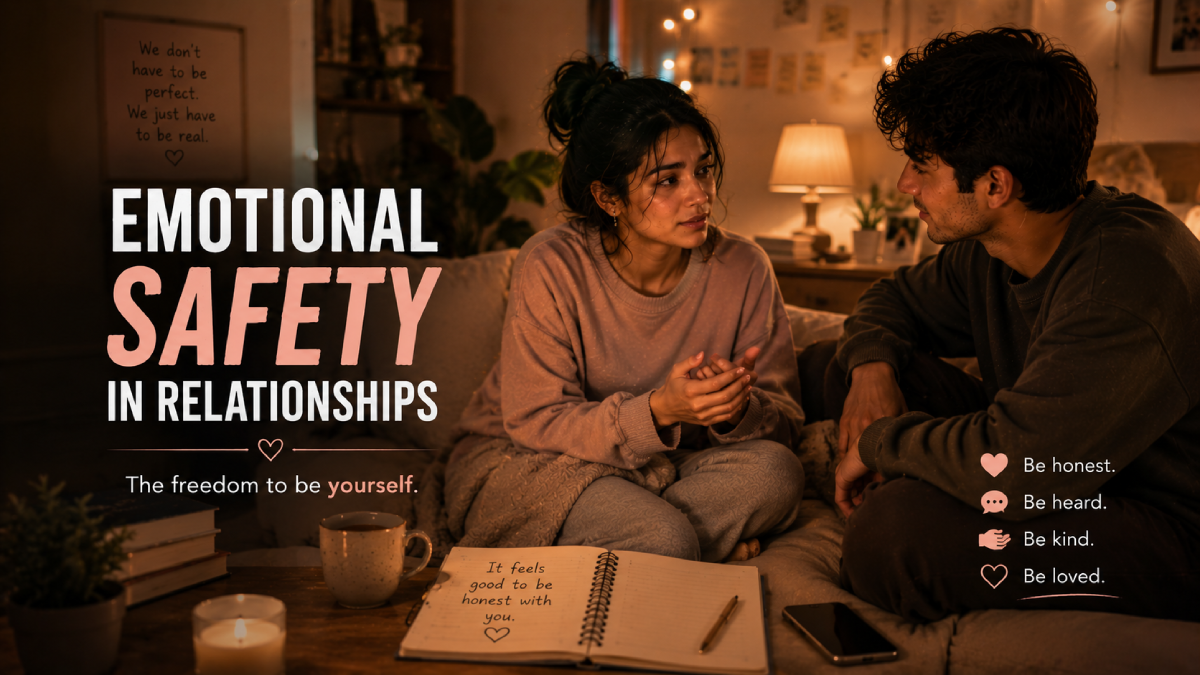
Emotional Safety in Relationships: What Is It
What Is Emotional Safety in Relationships?
Emotional safety in relationships means you feel safe enough to be honest, vulnerable, imperfect, and emotionally real without fearing punishment, rejection, judgment, mockery, or abandonment.
It is the feeling of knowing, “If I tell them how I really feel, they may not agree with everything, but they will not make me regret opening my heart.”
And maybe that sentence already touched something inside you.
Because sometimes love exists, but safety does not.
Sometimes someone says they love you, but you still feel scared to bring up what hurts. You rehearse your words. You wait for the “right mood.” You make your feelings smaller so the conversation does not become too much.
You may think:
“Maybe I am overreacting.”
“Maybe I should not say anything.”
“What if they get angry?”
“What if they leave?”
“What if I ruin everything by being honest?”
That fear is not random.
It usually comes from a place inside you that has learned honesty can be risky.
Maybe in this relationship, or maybe in an older one, your emotions were dismissed, punished, misunderstood, or used against you.
So now, even when you want closeness, your body prepares for danger.
That is why emotional safety matters so much.
Because love is not only about being together.
It is about whether your heart feels safe while being together.
Emotional safety means you can be honest without fearing punishment
In an emotionally safe relationship, honesty does not feel like a threat to the relationship.
You can say, “This hurt me,” without feeling like you are starting a war.
You can say, “I need reassurance,” without feeling weak.
You can say, “I do not feel okay,” without being treated like a problem.
This does not mean every conversation will be easy.
Sometimes honesty is uncomfortable. Sometimes your partner may need time to understand. Sometimes both of you may feel emotional.
But emotional safety means the conversation does not turn into punishment.
You are not insulted.
You are not mocked.
You are not ignored for days.
You are not made to feel guilty for having feelings.
You are allowed to be honest without love being withdrawn as a consequence.
That is a very different kind of love.
It means your feelings are treated with care, not shame
One of the clearest signs of emotional safety in relationships is how your feelings are handled.
Not when you are happy and easy.
But when you are hurt, anxious, insecure, disappointed, or overwhelmed.
Do they make space for your emotions?
Or do they make you feel embarrassed for having them?
Emotional safety feels like someone saying, “I may not fully understand yet, but I care enough to listen.”
It does not feel like:
“You are too sensitive.”
“Why are you always like this?”
“You are making a big deal out of nothing.”
“Here we go again.”
These sentences may look small, but they can slowly teach a person to hide.
And once you start hiding your feelings to protect the relationship, the relationship may continue from outside, but emotionally, you begin disappearing inside it.
Healthy love does not shame your emotional reality.
It may challenge you gently.
It may help you reflect.
But it does not humiliate you for feeling.
It means love feels safe enough for vulnerability
Vulnerability is not just crying in front of someone.
It is telling the truth when your voice shakes.
It is admitting, “I got scared.”
It is saying, “I need you.”
It is sharing the part of yourself you usually protect.
In an emotionally safe relationship, vulnerability is protected.
Your partner does not later use your fears against you.
They do not bring up your insecurities during arguments.
They do not laugh at your pain.
They do not make you feel foolish for trusting them.
Instead, your vulnerability is treated with softness.
This is what makes emotional intimacy possible.
Because nobody can stay deeply open in a place where honesty becomes a weapon.
Quick answer for featured snippet
Emotional safety in relationships means feeling safe to express your feelings, needs, fears, boundaries, and honest thoughts without fear of rejection, judgment, punishment, mockery, or abandonment.
Micro takeaway
Emotional safety is not about never feeling hurt.
It is about knowing your feelings will be handled with care.
Why Emotional Safety Matters So Much in Love
You can have attraction without emotional safety.
You can have history without emotional safety.
You can have attachment without emotional safety.
You can even have love without emotional safety.
But without emotional safety, love starts feeling scary.
Because the relationship may be close physically, but emotionally, you still feel alone.
You may be talking every day, but not saying what you really feel.
You may be together, but carefully managing your emotions so nothing “goes wrong.”
You may be loved, but still afraid to be fully known.
That is why emotional safety in relationships is not a small thing.
It is the foundation that makes love feel secure instead of exhausting.
Without emotional safety, people start hiding their real feelings
When emotional safety is missing, people do not always leave immediately.
Often, they stay.
But they start hiding.
They stop saying when something hurts.
They stop asking for reassurance.
They stop bringing up difficult topics.
They stop explaining what they need.
They become “fine.”
But inside, they are not fine.
They are just tired of the reaction.
Maybe you have done this too.
Maybe you have typed a message, deleted it, typed it again, then decided not to send it.
Maybe you have cried alone because saying it out loud felt too risky.
Maybe you have convinced yourself, “It is not that big of a deal,” even though it kept hurting.
That is what lack of emotional safety does.
It turns honest people into quiet people.
Emotional impact
You may stay in the relationship, but emotionally, you start disappearing.
Aur jab aap apni feelings ko baar-baar chupate ho, relationship bach sakta hai, par aapka andar ka connection dheere-dheere kamzor ho jata hai.
Emotional safety makes honesty possible
Honesty needs safety.
Not perfect safety.
Not a guarantee that the conversation will be smooth.
But enough safety to believe your truth will not be punished.
When you feel emotionally safe, you can say what you actually mean.
You do not need to turn your pain into anger to be taken seriously.
You do not need to make your needs look smaller.
You do not need to pretend something does not matter when it does.
You can be clear.
“I felt hurt.”
“I need more consistency.”
“I do not feel heard.”
“I want us to talk without blaming each other.”
That kind of honesty helps a relationship grow.
But when emotional safety is missing, honesty starts feeling dangerous.
So people choose silence.
And silence may avoid one fight, but it often creates long-term distance.
Behavior explanation
People open up more when they trust that vulnerability will not be used against them.
That trust is not built by one sweet conversation.
It is built by repeated moments where honesty is met with care.
Emotional safety helps conflict feel repairable, not dangerous
Conflict is not automatically unhealthy.
Two people can love each other and still disagree.
They can misunderstand each other.
They can hurt each other unintentionally.
They can have emotional reactions.
The real question is:
Does conflict feel repairable?
Or does conflict feel like emotional danger?
In an emotionally safe relationship, conflict may feel uncomfortable, but it does not make you feel unsafe.
You may feel upset, but not terrified.
You may need space, but not fear abandonment.
You may disagree, but not feel disrespected.
There is still an emotional thread connecting both people.
But when emotional safety is missing, even small disagreements can feel huge.
A simple conversation can feel like a test of whether the relationship will survive.
Psychology layer
When conflict feels unsafe, the body may respond with panic, shutdown, defensiveness, or over-explaining.
You may start talking too much because you are scared of being misunderstood.
Or you may go silent because speaking has not felt safe before.
Neither response means you are “too much.”
It means your system is trying to protect you.
Emotional safety creates the foundation for trust, intimacy, and secure love
Trust is not only about loyalty.
It is also about emotional reliability.
Can I trust you with my feelings?
Can I trust you with my fears?
Can I trust you when I am not at my best?
Can I trust that you will not use my soft parts against me?
That is emotional trust.
And without it, intimacy stays limited.
You may share time, attraction, memories, and routines, but the deeper parts of you remain guarded.
Emotional safety allows love to move deeper.
It helps both people feel secure enough to be real.
Micro takeaway
Love may create attachment, but emotional safety creates security.
And there is a big difference between being attached to someone and feeling safe with them.
What Emotional Safety Feels Like in a Relationship
Emotional safety is not always something you can explain immediately.
Sometimes you feel it in your body first.
You feel less tense.
You feel less afraid to speak.
You feel less like you are walking on emotional glass.
You do not have to measure every word with fear.
You feel like your heart has somewhere gentle to land.
That is what an emotionally safe relationship can feel like.
You can express hurt without feeling “too much”
In an emotionally safe relationship, you can say something hurt you without being treated like you are attacking the other person.
This is important.
Because many people are not afraid of conflict itself.
They are afraid of the reaction that comes after they express pain.
Maybe you have learned to say, “It is okay,” when it is not.
Maybe you have laughed something off because you did not want to look sensitive.
Maybe you have avoided bringing up small hurts because you feared they would become big fights.
But in a healthy relationship, your hurt is not automatically seen as drama.
It is seen as something worth understanding.
Real-life example
You can say, “That hurt me,” without the conversation becoming a fight about your sensitivity.
Your partner may ask, “What part hurt you?”
They may not understand instantly.
But they do not shame you for feeling it.
You can ask for reassurance without feeling needy
Everyone needs reassurance sometimes.
Even emotionally mature people.
Even secure people.
Even people who are usually calm and independent.
Reassurance is not weakness.
It is a normal human need for connection, especially when something feels uncertain.
In an emotionally safe relationship, you do not feel ashamed for needing comfort.
You do not have to pretend you are unaffected just to look strong.
You can say, “I know you care, but I need to hear it right now.”
And the right person will not make you feel pathetic for that.
Real-life example
You can say, “I need a little reassurance,” without feeling ashamed for needing emotional comfort.
And instead of saying, “Why do you always need this?” they may say, “I understand. I am here.”
That kind of response can calm something deep inside you.
You can disagree without fearing emotional distance
Disagreement is normal.
But in an unsafe relationship, disagreement can feel terrifying.
Because you may have learned that if you disagree, they withdraw.
They become cold.
They punish you.
They stop talking.
They make you feel guilty.
They act like your different opinion is betrayal.
In an emotionally safe relationship, disagreement does not threaten the bond.
You can see something differently and still feel connected.
You can say “I do not agree” without fearing that love will disappear.
Real-life example
A disagreement does not turn into coldness, punishment, or silent treatment.
Maybe both of you need a pause.
Maybe the conversation is emotional.
But the relationship does not become a place of fear.
You can be vulnerable without regretting it later
This is one of the deepest signs of emotional safety.
You share something soft, and later, you do not regret it.
You do not think, “Why did I tell them that?”
You do not worry they will use it during the next fight.
You do not feel exposed in a painful way.
Instead, you feel closer.
Because your vulnerability was held with care.
Real-life example
Your private fears, insecurities, and painful memories are not used against you later.
If you told them about an insecurity, they do not weaponize it.
If you shared a painful past experience, they do not mock it.
If you cried, they do not later call you unstable.
They protect what you trusted them with.
That is love with emotional maturity.
You feel calmer after talking, not more confused
Difficult conversations in healthy relationships may still feel heavy.
You may cry.
You may feel nervous.
You may need time to process.
But after the conversation, you usually feel clearer.
Not more confused.
You feel like something was understood.
Something softened.
Something moved.
In an unsafe dynamic, conversations often leave you more tangled.
You start questioning yourself.
You wonder if you were wrong to speak.
You feel guilty for having feelings.
You feel more alone than before.
That is a sign the conversation did not create safety.
Emotional meaning
Emotionally safe love makes difficult conversations feel hard but not harmful.
That is the difference.
Signs of Emotional Safety in a Relationship
Sometimes you know emotional safety by how peaceful your body feels around someone.
But sometimes, especially if you are used to emotional chaos, you need clearer signs.
So let’s make it practical.
These are the signs of emotional safety in a relationship.
Not perfection.
Not constant harmony.
But a pattern of care.
1. Your feelings are listened to, not dismissed
In an emotionally safe relationship, your feelings are not instantly rejected because they are inconvenient.
Your partner does not have to agree with your interpretation of everything.
But they still try to understand your emotional reality.
They can say:
“I did not see it that way, but I understand why it hurt.”
That sentence alone can change the whole emotional tone of a relationship.
Because it says, “Your feelings matter even when we see things differently.”
What this looks like
Your partner may not always agree, but they try to understand your emotional reality.
They listen without immediately correcting you.
They ask questions.
They do not rush to defend themselves before understanding your pain.
Reflection question
Do I feel heard even when they see things differently?
2. You do not feel scared to bring up difficult topics
In a safe relationship, difficult topics are still difficult.
But they are not terrifying.
You can talk about distance.
You can talk about intimacy.
You can talk about expectations.
You can talk about feeling hurt.
You can talk about what needs to change.
You may choose the right time and tone, but you do not feel like you are risking the entire relationship by being honest.
That is emotional safety.
What this looks like
You can talk about hurt, needs, boundaries, intimacy, distance, or expectations without panic.
You do not spend days rehearsing one normal sentence.
You do not feel like you need to make your pain sound “acceptable” before sharing it.
Reflection question
Do I avoid conversations because I fear their reaction?
If yes, that fear deserves attention.
Not judgment.
Attention.
3. Conflict does not become punishment
Conflict becomes unsafe when one person uses it to punish the other.
Silent treatment.
Threats.
Insults.
Humiliation.
Emotional withdrawal.
Bringing up old wounds to hurt.
Making the other person beg for basic warmth.
These are not normal signs of healthy conflict.
In emotionally safe relationships, conflict may need space, but not punishment.
There is a difference between saying, “I need time to cool down,” and using silence to make someone suffer.
What this looks like
Disagreements do not lead to threats, insults, humiliation, withdrawal, or silent treatment.
Even when upset, both people try to protect the dignity of the relationship.
They do not use pain as power.
Reflection question
After conflict, do I feel repaired or emotionally abandoned?
Your answer can tell you a lot.
4. Your vulnerability is protected
When you share something vulnerable, you are giving someone access to a soft part of you.
That access should be respected.
In an emotionally safe relationship, your vulnerability does not become ammunition.
Your fears are not turned into jokes.
Your past is not thrown at you.
Your insecurities are not used to win arguments.
They do not make you regret trusting them.
What this looks like
They do not use your insecurities, past pain, or emotional honesty against you.
If they know something hurts you deeply, they do not press that wound on purpose.
They treat your softness with responsibility.
Reflection question
Do I regret opening up to them later?
If you often regret being vulnerable, your heart may not feel safe there yet.
5. You can say no without guilt
“No” is a small word, but in relationships it reveals a lot.
Can you say no without being guilt-tripped?
Can you need space without being accused?
Can you set a boundary without the other person turning it into drama?
In emotionally safe relationships, your limits are not treated as rejection.
They are respected as part of who you are.
What this looks like
Your limits are respected without pressure, manipulation, or emotional drama.
You can say:
“I need some time.”
“I am not comfortable with that.”
“I do not want to talk about this right now.”
“I need this boundary to be respected.”
And the other person may feel disappointed, but they do not punish you for having limits.
Reflection question
Are my boundaries respected even when they are inconvenient?
Because real respect shows up most clearly when your boundary does not benefit the other person.
6. You feel safe being imperfect
You are not always going to be your best self.
You will have tired days.
Emotional days.
Confused days.
Quiet days.
Days when you need reassurance.
Days when you do not explain yourself perfectly.
In an emotionally safe relationship, one imperfect moment does not make you feel disposable.
You do not feel like love is only available when you are easy.
What this looks like
You do not feel like one mistake, bad mood, or emotional moment will make you less lovable.
Your partner can hold a realistic view of you.
Not perfect.
Not terrible.
Human.
Reflection question
Do I feel loved only when I am easy to deal with?
If yes, that is painful.
Because real love should have space for your humanity.
7. Repair happens after hurt
Even safe relationships have hurt moments.
But emotionally safe relationships repair.
Someone comes back and says:
“I thought about what happened.”
“I understand why you felt that way.”
“I am sorry I dismissed you.”
“I want us to handle this differently next time.”
Repair is what keeps emotional safety alive.
Without repair, hurt collects silently.
And eventually, one person stops opening up.
What this looks like
Both people can apologize, clarify, take responsibility, and reconnect after painful moments.
They do not just pretend everything is fine.
They do not expect time to erase what needed care.
They come back with softness.
Reflection question
Do we repair, or do we just move on without healing the wound?
Moving on is not the same as repairing.
Sometimes people move on because they are tired.
Repair happens when both people care enough to understand.
Why Emotional Safety May Be Missing in a Relationship
If emotional safety is missing, it does not always mean there is no love.
This is important.
Sometimes two people care about each other, but they do not know how to create safety.
Sometimes one person wants closeness but becomes defensive during vulnerability.
Sometimes both people carry past wounds into the present.
Sometimes the relationship has love, but not enough emotional maturity.
That does not excuse hurtful behavior.
But it helps you understand the pattern clearly.
One or both partners may become defensive during vulnerability
Some people hear feelings as blame.
You say, “I felt hurt,” and they hear, “You are a bad person.”
You say, “I need more reassurance,” and they hear, “You are not enough.”
You say, “Can we talk?” and they prepare for attack.
So instead of listening, they defend.
They explain.
They argue.
They shut down.
They change the topic.
This makes the other person feel unsafe.
Because vulnerability cannot survive in a room where every feeling becomes a debate.
Why this happens
Some people hear emotions as blame because they never learned how to sit with discomfort.
They may not be cruel.
But if they cannot handle discomfort, the relationship will still feel unsafe.
Intent matters.
But impact matters too.
Past hurt may make honesty feel dangerous
Maybe you are the one who struggles to open up.
Maybe your partner is not always unsafe, but your body still feels fear.
Maybe you learned somewhere that honesty leads to rejection.
Maybe your feelings were ignored in the past.
Maybe someone called you dramatic when you were simply hurt.
Maybe silence became your safest option.
So now, even in a better relationship, your body hesitates.
It whispers:
“Careful.”
“Do not say too much.”
“Do not need too much.”
“Do not trust too quickly.”
That does not mean you are broken.
It means your heart remembers.
Why this happens
If vulnerability was once punished, the mind may protect itself through silence, over-explaining, or emotional withdrawal.
Healing means learning where the present is different from the past.
But it also means noticing when the present is repeating the past.
Both things matter.
The relationship may have poor conflict repair
Some couples fight and then act normal.
They never repair.
They never revisit the hurt.
They never ask what happened emotionally.
They just move on because talking feels uncomfortable.
But unhealed conflict does not disappear.
It settles into the body.
It becomes hesitation.
It becomes emotional distance.
It becomes fear before the next conversation.
When repair is missing, emotional safety slowly weakens.
Why this happens
When hurt is ignored instead of repaired, emotional safety slowly weakens.
The relationship may look peaceful from outside.
But inside, one or both people may feel emotionally unfinished.
Boundaries may not be respected
Boundaries are deeply connected to emotional safety.
Because if you cannot say no, you cannot feel fully safe.
If your limits are treated as rejection, betrayal, attitude, or drama, you may stop expressing them.
You may say yes when your body says no.
You may stay available when you need rest.
You may tolerate what hurts because pushing back creates conflict.
That is not emotional safety.
That is self-protection through self-abandonment.
Why this happens
When one person treats boundaries as rejection, the other person may stop expressing limits.
And once boundaries disappear, resentment quietly enters.
There may be love, but not enough emotional maturity
This is one of the hardest truths.
Someone can love you and still not know how to love you safely.
They may care about you.
They may miss you.
They may want you.
They may even have good intentions.
But if they cannot listen, repair, respect boundaries, handle conflict, or protect vulnerability, the relationship can still feel emotionally unsafe.
Love is not the only ingredient.
Emotional maturity matters.
Emotional clarity
Someone can love you and still not know how to make love feel emotionally safe.
And you are allowed to care about both.
Not just whether they love you.
But whether their love feels safe to your heart.
Emotional Safety vs Comfort: They Are Not the Same
This distinction is very important.
Because many people confuse comfort with emotional safety.
You may feel comfortable with someone because you know them well.
You have history.
You have routines.
You know their habits.
You know their voice.
You know how they react.
But familiarity is not always safety.
Sometimes the relationship feels familiar because you have learned how to survive it.
Comfort means familiarity
Comfort can mean:
“I know this person.”
“I know how this relationship works.”
“I know what to expect.”
“I know how to avoid conflict.”
“I know which topics not to bring up.”
But knowing how to avoid pain is not the same as being safe.
Sometimes comfort is just a pattern your body recognizes.
Even if that pattern hurts.
Emotional safety means you can be real without fear
Emotional safety is deeper than comfort.
It means:
“I can be honest here.”
“I can have feelings here.”
“I can say no here.”
“I can be imperfect here.”
“I can share my truth without preparing for punishment.”
That is different.
Comfort may be familiar.
Emotional safety is freeing.
A familiar relationship can still feel emotionally unsafe
You can be with someone for years and still feel unsafe speaking honestly.
You can know someone deeply and still hide parts of yourself.
You can share a routine and still feel emotionally lonely.
Time does not automatically create safety.
History does not automatically create trust.
Attachment does not automatically create emotional health.
Sometimes the relationship is familiar, but your heart is still guarded.
A healthy relationship may feel unfamiliar but emotionally safe
On the other side, a healthier relationship may feel unfamiliar at first.
Someone listens without attacking.
Someone respects your no.
Someone apologizes without making you beg.
Someone stays kind during discomfort.
And instead of relaxing immediately, you may feel suspicious.
“Is this real?”
“When will it change?”
“Why does this feel strange?”
That is understandable.
If your past taught you that love hurts, safe love may feel new.
Not because it is wrong.
Because it is different.
Micro takeaway
Do not confuse “I know this person well” with “I feel emotionally safe with this person.”
One is familiarity.
The other is safety.
What Happens When Emotional Safety Is Missing
When emotional safety is missing, the relationship may not fall apart immediately.
Sometimes it continues.
People still text.
They still meet.
They still say “I love you.”
They still make plans.
But inside, something starts changing.
You stop bringing your full self.
You become careful.
You become quiet.
You start living in emotional self-protection.
You start hiding your feelings
At first, you may hide small things.
You do not say you were hurt.
You do not mention you felt ignored.
You avoid saying you need more affection.
You pretend you are okay.
Then slowly, hiding becomes normal.
You become good at looking fine.
But being fine and being emotionally safe are not the same thing.
Emotional consequence
You may stop saying what hurts because silence feels safer than honesty.
And that silence can become lonely.
Even if the person is sitting right beside you.
You overthink every conversation
When emotional safety is missing, normal conversations can feel complicated.
You may spend hours thinking:
“How should I say this?”
“Will this sound needy?”
“What if they misunderstand?”
“What if they get irritated?”
“What if I make things worse?”
You start preparing for a reaction before you even speak.
That is emotionally exhausting.
Emotional consequence
You rehearse normal needs like you are preparing for rejection.
And after a while, even simple honesty starts feeling heavy.
You become afraid of conflict
If conflict has led to punishment before, your body remembers.
You may avoid disagreements.
You may agree when you do not agree.
You may apologize even when you are hurt.
You may choose peace over truth.
But that kind of peace is fragile.
It depends on your silence.
Emotional consequence
You may choose fake peace over honest repair.
And fake peace does not create closeness.
It creates distance with a calm face.
You feel lonely even inside the relationship
This is one of the most painful parts.
You are not single.
You are not alone in the obvious way.
But emotionally, you feel alone.
Because your real feelings have nowhere to go.
You may talk about daily things.
Work.
Plans.
Food.
Messages.
But not the deeper things.
Not the pain.
Not the fear.
Not the need.
Not the truth.
Emotional consequence
Being physically close does not feel comforting when emotional truth has no space.
A relationship can be full of contact and still lack connection.
You start losing yourself
When emotional safety is missing for long enough, you may start changing yourself to keep the relationship stable.
You become less honest.
Less expressive.
Less direct.
Less playful.
Less alive.
You start asking:
“What version of me will keep this relationship calm?”
Instead of:
“What version of me feels true?”
That is a painful place to live.
Emotional consequence
You become the version of yourself that keeps the relationship calm, not the version that feels fully alive.
Aur jab pyaar ke liye aapko apna asli self chhupana pade, toh woh pyaar nahi, emotional survival ban jaata hai.
How to Build Emotional Safety in a Relationship
Emotional safety can be built if both people are willing.
That part matters.
One person alone cannot create emotional safety for two people.
You can communicate better.
You can reflect.
You can express your needs clearly.
You can repair your side.
But the other person also has to care about making the relationship safer.
Healthy love needs mutual effort.
Step 1: Notice what makes you feel unsafe
Before you can explain the problem, you need to understand it.
Notice the moments when your body tightens.
When you go silent.
When you over-explain.
When you feel judged.
When you feel scared to be honest.
When you feel like you need to perform calmness.
These moments are clues.
Do not dismiss them.
Clear action
Write down the moments when you feel anxious, silenced, judged, dismissed, or afraid to speak.
Not to blame immediately.
But to understand the pattern.
Example
“I feel unsafe when I share something vulnerable and they immediately become defensive.”
Or:
“I feel unsafe when conflict turns into silence for days.”
Or:
“I feel unsafe when I say no and they make me feel guilty.”
Clarity makes the conversation more grounded.
Step 2: Name the emotional need clearly
Once you know the unsafe moment, name the need underneath it.
Maybe the need is listening.
Maybe reassurance.
Maybe softer tone.
Maybe repair after conflict.
Maybe respect for boundaries.
Maybe space without punishment.
Emotional safety grows when needs become clear.
Not hidden.
Not hinted.
Not stored for months until they explode.
Clear action
Turn the feeling into one simple need.
Example
“I need to feel heard before we start debating who is right.”
Or:
“I need us to repair after arguments instead of pretending nothing happened.”
Or:
“I need my no to be respected without guilt.”
This helps the other person understand what safety looks like for you.
Step 3: Use soft but direct communication
Soft does not mean weak.
Direct does not mean harsh.
You can be both kind and clear.
This is especially important when discussing emotional safety because the topic can easily trigger defensiveness.
Start with one pattern.
Not every wound.
Not every old fight.
One specific emotional experience.
Clear action
Bring up one pattern at a time instead of unloading months of pain at once.
Example script
“I care about us, but I do not feel emotionally safe when my feelings are dismissed. I need us to listen first before defending.”
Another version:
“I am not trying to blame you. I want us to feel safer with each other. When we argue and then do not repair, I feel emotionally distant. Can we talk about how to come back after conflict?”
This kind of communication gives the relationship a chance to respond with maturity.
Step 4: Create repair habits after conflict
Repair should not be random.
Emotionally safe couples learn how to come back after hurt.
They do not just wait until things feel normal.
They check in.
They clarify.
They apologize.
They ask what was painful.
They talk about what can be done differently next time.
This does not need to be dramatic.
Even a small repair conversation can rebuild safety.
Clear action
After arguments, ask: “What hurt you? What did I misunderstand? What can we do differently next time?”
You can also ask:
“Did you feel heard in that conversation?”
“Is there anything we need to repair before moving on?”
“How can we make conflict feel safer for both of us?”
These questions may feel awkward at first.
But they can change the emotional culture of the relationship.
Emotional reassurance
Repair is not weakness.
Repair is how love becomes safer.
Step 5: Watch whether the pattern changes
After you communicate, watch the pattern.
Not just the apology.
Not just the emotional moment.
Not just the promise.
Watch what happens next.
Do they try to listen differently?
Do they respect your boundary more?
Do they repair after conflict?
Do they become softer with your vulnerability?
Do they take responsibility?
Emotional safety is built through repeated behavior.
One good conversation can open the door.
But repeated care builds the home.
Clear action
Look for consistent effort, not just emotional promises.
Reality check
Emotional safety is built through repeated behavior, not one perfect conversation.
You are allowed to need proof through patterns.
That is not distrustful.
That is wise.
Common Mistakes People Make About Emotional Safety
Emotional safety is a simple idea, but it is easy to misunderstand.
Especially if you are used to either avoiding conflict or over-explaining your feelings.
Let’s clear up the common mistakes gently.
Mistake 1: Thinking emotional safety means never feeling uncomfortable
Emotional safety does not mean every conversation feels easy.
Sometimes honesty feels uncomfortable.
Sometimes accountability feels uncomfortable.
Sometimes hearing your partner’s pain feels uncomfortable.
Discomfort is not always danger.
A safe relationship can still challenge you.
The difference is that discomfort is handled with respect.
Why this is harmful
It makes normal difficult conversations feel like danger.
You may avoid every hard topic because it feels uncomfortable, even when that conversation could help the relationship grow.
Mistake 2: Staying silent to keep the relationship peaceful
Many people call silence peace.
But sometimes silence is fear.
If you are staying quiet because you know honesty will create punishment, that is not peace.
That is emotional self-protection.
A relationship may look calm because no one is speaking honestly.
But underneath, resentment and loneliness may be growing.
Why this is harmful
Silence can protect the relationship’s appearance while damaging your emotional reality.
Aur jo peace aapki awaaz chheen le, woh peace nahi hota.
Woh sirf conflict ka delay hota hai.
Mistake 3: Calling emotional needs “drama”
Needing reassurance is not drama.
Wanting respect is not drama.
Feeling hurt is not drama.
Wanting repair after conflict is not drama.
Of course, emotions can be expressed in unhealthy ways sometimes. We all need to learn how to communicate with care.
But having emotional needs does not make you dramatic.
It makes you human.
Why this is harmful
It creates shame around normal needs for reassurance, care, and understanding.
And when people feel ashamed of their needs, they either hide them or express them only when they are overwhelmed.
Neither creates safety.
Mistake 4: Believing love automatically creates safety
This one hurts, but it is true.
Love does not automatically create emotional safety.
Someone can love you and still dismiss your emotions.
Someone can love you and still avoid accountability.
Someone can love you and still become defensive every time you are vulnerable.
Someone can love you and still not know how to repair.
Love matters.
But emotional maturity decides whether love feels safe.
Why this is harmful
Love without emotional maturity can still feel unsafe.
And if you only ask, “Do they love me?” you may ignore the deeper question:
“Does this love feel safe to my heart?”
Mistake 5: Accepting apology without changed behavior
Apologies can feel comforting.
Especially when you are hurt.
A sincere apology can soften your heart.
But if the same pattern keeps repeating, the apology becomes incomplete.
Emotional safety needs changed behavior.
Not perfect behavior.
Changed behavior.
Why this is harmful
Apologies may soothe the moment, but unchanged patterns keep the wound open.
You do not need a perfect partner.
But you do need someone who cares enough to grow.
When Lack of Emotional Safety Becomes a Serious Warning Sign
Not every emotionally unsafe moment means the relationship is doomed.
Sometimes people need to learn.
Sometimes both partners are carrying wounds.
Sometimes communication patterns can improve.
But there are situations where lack of emotional safety becomes serious.
You need to be honest with yourself here.
Not harsh.
Honest.
You are afraid to express basic feelings
If you are scared to say normal things like:
“That hurt me.”
“I need more care.”
“I do not feel okay.”
“I need space.”
“I want to talk.”
Then the relationship may not feel emotionally safe.
You should not have to treat basic feelings like dangerous secrets.
Your boundaries are repeatedly ignored
A boundary ignored once may be a mistake.
A boundary ignored repeatedly becomes a pattern.
If your “no” is debated, mocked, punished, or guilt-tripped again and again, emotional safety is missing.
Healthy love does not require you to keep explaining why your limits matter.
Your vulnerability is used against you
This is a serious warning sign.
If someone uses your fears, insecurities, past wounds, or private confessions to hurt you during conflict, that is not emotional safety.
That is emotional harm.
Your soft parts deserve protection, not punishment.
Conflict includes threats, insults, punishment, or silent treatment
Conflict should not make you feel emotionally terrorized.
If arguments involve threats, insults, humiliation, days of silence, or emotional withdrawal used as control, the relationship is not safe in the way love should be safe.
Disagreement is normal.
Emotional punishment is not.
You feel smaller, more anxious, or less like yourself over time
Notice who you are becoming.
Are you more honest or more afraid?
More open or more guarded?
More yourself or more edited?
More peaceful or more anxious?
A relationship does not have to be perfect to be healthy.
But it should not slowly make you disappear.
Clear decision signal
If being honest costs you your peace every time, the relationship may not be emotionally safe.
Emotional clarity
You are not too sensitive for needing emotional safety.
You are human.
And your heart deserves a relationship where honesty does not feel like danger.
Final Answer: Why Emotional Safety in Relationships Matters
Emotional safety in relationships matters because love cannot feel truly secure when honesty feels dangerous.
You can be attached to someone and still feel unsafe.
You can love someone and still feel afraid to speak.
You can have history with someone and still feel emotionally alone.
That is why emotional safety is not optional.
It is one of the deepest foundations of healthy love.
Emotional safety lets you speak honestly
You can say what you feel without preparing for punishment.
You can bring up difficult topics without feeling like you are ruining everything.
You can be truthful and still feel loved.
Emotional safety makes vulnerability possible
You can share the soft parts of yourself without regretting it later.
Your fears are not mocked.
Your pain is not dismissed.
Your insecurities are not used against you.
Emotional safety helps conflict become repairable
You can disagree without destroying each other.
You can come back after hurt.
You can apologize, explain, understand, and reconnect.
Conflict does not become the end of safety.
It becomes a place where safety can be rebuilt.
Emotional safety builds trust and emotional intimacy
Trust grows when your emotions are handled with care again and again.
Emotional intimacy grows when both people feel safe enough to be real.
That is how love becomes deeper.
Not through perfection.
Through repeated care.
Emotional safety helps love feel secure instead of scary
Love should not make you feel like you are always one honest sentence away from being abandoned.
It should not make you rehearse your feelings like they are crimes.
It should not make you hide your needs to stay accepted.
Safe love gives your truth somewhere gentle to land.
Emotional closure
A relationship can have love, history, attraction, and attachment.
But without emotional safety, your heart may still feel alone.
And if you have been blaming yourself for needing softness, reassurance, respect, or repair, please hear this clearly:
You are not asking for too much.
You are asking for the kind of love where your heart does not have to keep defending itself.
Emotional safety is not luxury.
It is not drama.
It is not weakness.
It is the difference between being loved from a distance and feeling safe enough to be fully known.
Aur jis pyaar mein aap apni baat kehne se pehle darr jaate ho, wahan sirf love nahi, safety bhi zaroori hai.
Because real love should not make your heart feel homeless.
It should feel like a place where your truth can finally rest.
If you want to understand the bigger picture of safe love, read next:
Signs of a Healthy Relationship: 15 Green Flags You May Not Recognize Yet
It will help you recognize the everyday signs of emotionally safe, respectful, and secure love without confusing peace with emotional distance.