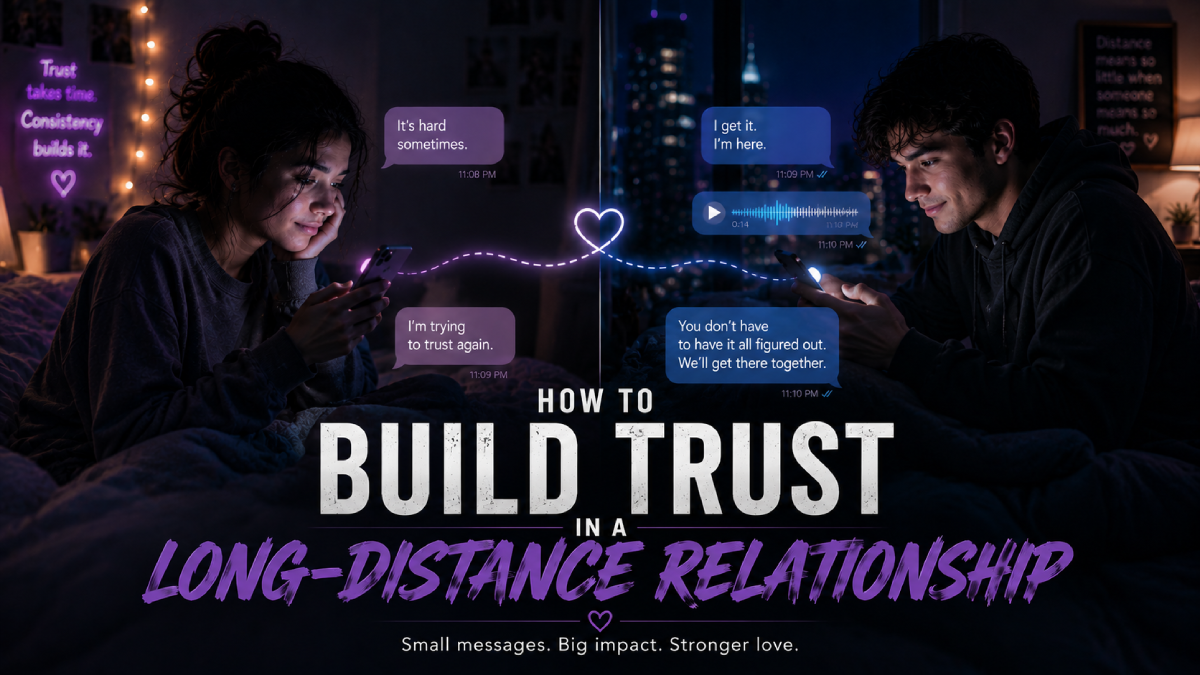
How to Build Trust in a Long-Distance Relationship
How to Build Trust When Your Mind Keeps Doubting
How do you trust someone when you love them deeply, but you cannot always see their daily life?
Maybe they replied late, and your mind started creating stories.
Maybe they have new friends, a busy schedule, a social life you are not part of, or moments you only hear about later.
Maybe they say they love you, but distance still makes your heart ask:
“Can I really trust this?”
“Am I being insecure?”
“What if something changes and I don’t even know?”
“What if I am the only one taking this seriously?”
And the hardest part is, you may not even want to think this way.
You may want to be calm.
You may want to trust easily.
You may want to be the kind of partner who does not overthink every late reply, every online status, every cancelled call, every new person in their life.
But long distance can make trust feel harder than usual.
Not because your love is weak.
Not because you are dramatic.
Not because you are “too much.”
But because in a long-distance relationship, you are asked to believe in love without daily physical evidence.
You cannot always see how they look at you.
You cannot always feel their presence.
You cannot casually meet and calm the confusion.
You cannot hug after a misunderstanding.
So your mind starts looking for proof in whatever it can find.
Their messages.
Their tone.
Their reply speed.
Their effort.
Their consistency.
Their social media activity.
Their willingness to reassure you.
Kabhi kabhi trust ka issue pyaar ki kami se nahi hota. Kabhi kabhi trust difficult isliye lagta hai kyunki distance mein proof kam hota hai, aur fear zyada loud ho jata hai.
So if you are trying to understand how to build trust in a long-distance relationship, the answer is not simply, “Just trust them.”
That advice sounds easy, but it does not help a heart that is already scared.
Trust in a long-distance relationship is not built by forcing yourself to stop worrying.
It is built through consistent communication, honest updates, clear expectations, emotional reassurance, healthy transparency, conflict repair, future planning, and behavior that matches words.
This guide will help you understand why trust issues in long-distance relationships happen, how to trust your partner without ignoring your feelings, and when doubt is actually pointing to a real problem.
Why Trust Feels Harder in a Long-Distance Relationship
Trust feels harder in a long-distance relationship because distance creates emotional unknowns.
In a close-distance relationship, you often get daily proof of love without asking for it.
You see their face.
You feel their energy.
You notice their effort.
You experience their presence.
You can read their mood through body language, not just text.
But in long-distance, you often have to trust what you cannot see.
That can feel scary.
Especially if your partner is inconsistent, if you have been hurt before, or if your mind already tends to overthink.
Because You Have Less Daily Evidence of Love
Trust needs evidence.
Not dramatic evidence.
Daily evidence.
Small repeated signs that say:
“I am still here.”
“I am honest with you.”
“You matter to me.”
“My actions match my words.”
“You do not have to chase me to feel secure.”
In a long-distance relationship, that evidence has to come through communication, consistency, reassurance, transparency, and follow-through.
If those things are missing, your mind may struggle to feel safe.
Physical Presence Naturally Reassures the Heart
When someone is physically present, reassurance happens in small ways.
A hug.
A glance.
A soft smile.
A quick visit.
A hand on your shoulder.
A random moment of affection.
These things calm the body.
They tell your nervous system, “We are okay.”
But in long-distance, that kind of physical reassurance is limited.
So emotional reassurance has to become stronger.
Not because you are insecure.
Because the relationship has fewer natural ways to calm fear.
Emotional Impact Line
When you cannot see love in daily actions, your mind starts looking for proof in messages, timing, tone, and consistency.
That is why one late reply can feel bigger than it should.
It is not just about the reply.
It is about what your mind thinks the reply means.
Micro Takeaway
Trust needs evidence, not just promises.
And in long distance, evidence looks like consistency, honesty, reassurance, and care repeated over time.
Because Unknown Space Can Become Emotional Fear
Distance creates unknown space.
You do not always know where they are.
You do not always know who they are with.
You do not always know what mood they are in.
You do not always know why they replied differently today.
And when love matters deeply, unknown space can become emotional fear.
Your mind may start filling in the blanks.
And when fear fills the blanks, it rarely chooses a peaceful story.
You Do Not Always Know Their Mood, Environment, or Social Life
Maybe they are genuinely busy.
Maybe they are tired.
Maybe their day was stressful.
Maybe they are with friends.
Maybe they are not emotionally available for a deep conversation right now.
But because you cannot see the full situation, your mind starts guessing.
“Are they hiding something?”
“Are they avoiding me?”
“Are they losing interest?”
“Is there someone else?”
Sometimes these thoughts come from fear.
Sometimes they come from real inconsistency.
That is why it is important to look at patterns, not just panic.
Example
“They said they were busy, but my mind started wondering what they were really doing.”
This thought is common in long-distance relationships.
It does not automatically mean you do not trust them.
It may mean you need more clarity, more predictable communication, or more emotional reassurance.
Because Past Hurt Can Make Present Distance Feel Unsafe
Sometimes trust issues are not only about this relationship.
They come from old pain.
Maybe someone lied to you before.
Maybe someone cheated.
Maybe someone disappeared emotionally.
Maybe someone made you feel replaceable.
Maybe in a past relationship, your intuition was right, and now your mind is always trying to protect you.
So when your long-distance partner replies late or sounds different, your body does not only react to the present moment.
It reacts to old wounds too.
Old Betrayal, Lying, or Abandonment Can Make You More Alert
If you have been betrayed before, distance can make you extra alert.
You may notice small changes quickly.
You may feel anxious when plans change.
You may need more reassurance.
You may struggle to relax even when your partner has done nothing wrong.
This does not mean you are broken.
It means your heart remembers what it felt like to be hurt.
But healing means learning the difference between:
“This is my old fear speaking.”
And:
“This is a present pattern I need to pay attention to.”
Both matter.
Because Long Distance Makes Inconsistency Feel Louder
In any relationship, inconsistency hurts.
But in long distance, inconsistency feels louder.
Because you already have less access to each other.
So when your partner does not follow through, it hits harder.
A missed call can feel like rejection.
A broken promise can feel like emotional distance.
A vague explanation can feel like secrecy.
A sudden change in effort can make your mind spiral.
A Missed Call or Broken Promise Can Feel Bigger From Far Away
If your partner says, “I’ll call tonight,” and then disappears without explanation, that can hurt deeply.
Not because you are obsessed with one call.
But because you may have waited for that moment all day.
That call may have been your emotional anchor.
So when it does not happen, your heart feels let down.
In long-distance, follow-through matters because it helps the relationship feel real.
If plans keep breaking without care, trust starts cracking.
How to Build Trust in a Long-Distance Relationship: 9 Practical Steps
Trust is not built in one emotional conversation.
It is built through repeated behavior.
Small things.
Done consistently.
Over time.
This is important because many people think trust means, “I should stop doubting immediately.”
But real trust is not forced.
It grows when the relationship gives your heart enough emotional evidence to feel safe.
1. Build Trust Through Consistency, Not Big Promises
Big promises can sound beautiful.
“I’ll never hurt you.”
“You can always trust me.”
“You’re the only one.”
“Distance won’t change anything.”
These words may feel comforting in the moment.
But trust does not grow from emotional declarations alone.
Trust grows when someone’s behavior keeps proving the words.
Do What You Say You Will Do
If you say you will call, call.
If you cannot call, explain and reschedule.
If you say you will update them, update them.
If you say something matters, act as if it matters.
Consistency is not about perfection.
It is about emotional reliability.
Your partner should not have to wonder every time:
“Will they follow through this time?”
Practical Example
If you say you will call at night, call — or explain and reschedule with care.
A simple message like this can protect trust:
“I’m really sorry, today got hectic, and I won’t be able to call properly. I don’t want you to feel ignored. Can we talk tomorrow evening?”
This is not a perfect situation.
But it is emotionally responsible.
It says:
“I cannot do what I promised, but I still care about how this affects you.”
That builds trust.
2. Create Clear Communication Expectations
Trust becomes easier when both people know what to expect.
Many trust issues in long-distance relationships begin because communication expectations are unclear.
One person thinks daily calls are normal.
The other thinks texting is enough.
One person expects updates when plans change.
The other does not realize silence feels scary.
One person needs reassurance.
The other thinks reassurance should not be needed if love is real.
And then both people feel misunderstood.
Talk About Replies, Calls, Busy Days, and Emotional Needs
Have an honest conversation about:
- How often do we want to talk?
- What should we do when one of us is busy?
- How should we handle late replies?
- What kind of reassurance helps?
- What makes each of us feel ignored?
- How do we communicate when we need space?
- What does trust look like for both of us?
- What feels controlling vs what feels caring?
This conversation can prevent so many unnecessary fights.
Because once expectations are clear, your mind has less room to guess.
Conversation Starter
“I don’t need constant updates, but I feel safer when I know when we’ll properly connect.”
This sentence is honest without sounding controlling.
It says:
“I respect your space, but I also need emotional predictability.”
And that is a very valid need in long-distance.
3. Practice Healthy Transparency Without Turning the Relationship Into Surveillance
Transparency is important.
But surveillance is not trust.
There is a difference between making your partner feel included and making them feel monitored.
Healthy transparency says:
“I want you to feel safe in my life.”
Control says:
“I need to check everything to feel okay.”
One builds trust.
The other creates fear.
Share Enough to Create Safety, Not Control
Healthy transparency can look like:
“I’m going out with friends tonight, I’ll text you when I’m back.”
“I’ll be busy during the day, but we can talk at night.”
“My old friend messaged me, and I wanted to tell you instead of hiding it.”
“I know this might make you overthink, so I’d rather be open.”
This kind of transparency is not about asking permission.
It is about protecting emotional safety.
Difference
Transparency says, “I want you to feel included.”
Control says, “I need to monitor you to feel okay.”
This difference matters.
Because trust cannot grow if one person feels watched all the time.
But trust also cannot grow if one person is secretive and dismissive.
The middle path is honest openness with respect.
4. Offer Reassurance Before Your Partner Has to Beg for It
Reassurance is one of the strongest trust-builders in a long-distance relationship.
Not forced reassurance.
Not repeated reassurance every five minutes.
But thoughtful reassurance.
The kind that comes before your partner reaches their breaking point.
Reassurance Builds Emotional Safety
Sometimes a simple sentence can calm a whole spiral.
“I know I’ve been busy, but we’re okay.”
“You still matter to me.”
“I miss you too.”
“I’m not pulling away. I’m just tired today.”
“Distance is hard, but I’m still choosing this.”
These words are small, but emotionally powerful.
They give your partner something to hold onto when distance feels heavy.
Script
“I know I’ve been busy, but you still matter to me. We’re okay.”
This kind of reassurance tells the heart:
“You do not have to panic. I am still here.”
And in long-distance, that matters more than people admit.
5. Talk About Jealousy Without Shame or Accusation
Jealousy can feel embarrassing.
You may not want to admit it.
You may not want to sound possessive.
You may not want to start a fight.
So you hide it.
Or you become cold.
Or you make sarcastic comments.
Or you start checking things silently.
But jealousy does not disappear when it is ignored.
It grows in silence.
The healthier way is to name it gently.
Jealousy Usually Points to Fear, Not Just Possessiveness
Jealousy often has fear underneath it.
Fear of being replaced.
Fear of being forgotten.
Fear of not being enough.
Fear that someone closer to them physically will become closer emotionally too.
When you understand the fear under jealousy, the conversation becomes softer.
Instead of attacking, you can explain.
Instead of accusing, you can ask.
Instead of controlling, you can seek reassurance.
Better Script
“I felt insecure when I saw that, and I want to talk about it calmly instead of assuming the worst.”
This script is mature because it takes responsibility for the feeling without pretending the feeling does not matter.
It says:
“I am triggered, but I want connection, not conflict.”
That is how trust conversations should begin.
6. Repair Broken Trust Quickly and Honestly
Trust can break in many ways.
Lying.
Hiding.
Disappearing.
Breaking promises.
Flirting.
Being vague.
Ignoring boundaries.
Saying one thing and doing another.
Even small breaches can feel big in long-distance because distance already requires faith.
If trust is broken, do not pretend time alone will fix it.
Trust needs repair.
Trust Needs Accountability, Not Just Apologies
An apology is a beginning.
Not the whole repair.
If someone says sorry but repeats the same pattern, trust will not rebuild.
If someone apologizes but makes you feel guilty for being hurt, trust will not rebuild.
If someone wants instant trust without changed behavior, trust will not rebuild.
Repair requires accountability.
That means:
“I understand why this hurt you.”
“I should have handled it differently.”
“Here is what I will change.”
“I know it may take time for you to feel safe again.”
That is repair.
Repair Framework
Name what happened → validate the hurt → explain honestly → change the pattern → rebuild through consistency.
For example:
“I should have told you earlier instead of hiding it. I understand why it made you doubt me. I was afraid of conflict, but that does not make it okay. I will be more transparent going forward, and I know it may take time for you to trust me again.”
This is very different from:
“I said sorry. Why are you still upset?”
The first builds trust.
The second breaks it further.
7. Do Not Hide Small Things That Could Become Big Doubts Later
In long-distance relationships, small hidden things can become big doubts.
Not because every detail must be reported.
But because secrecy creates emotional insecurity.
If something could hurt your partner more if they discovered it later, it is usually better to be honest early.
Secrecy Makes Distance Feel More Dangerous
When someone hides small things, the other person starts wondering:
“If they hid this, what else are they hiding?”
That question damages trust.
Not only because of the thing itself.
But because secrecy makes the relationship feel unsafe.
Honesty may create a difficult conversation.
But hiding creates a deeper wound.
Emotional Clarity
In long-distance, small hidden things can create big emotional cracks.
So choose honesty before the small thing becomes a trust issue.
8. Build a Future Plan So the Relationship Feels Secure
Trust is not only about today.
It is also about where the relationship is going.
If there is no plan, no timeline, no visit discussion, and no clarity about closing the distance, trust may become harder.
Because the heart starts asking:
“What am I trusting?”
“What are we building?”
“Is this going somewhere?”
Long distance becomes emotionally heavier when the future feels vague.
Trust Grows When Both People Know What They Are Moving Toward
You do not need every detail solved.
But you need honest conversations.
A possible visit.
A future timeline.
A shared direction.
A willingness to talk about reality.
This helps the relationship feel more grounded.
Trust becomes easier when both people know the distance has meaning.
Future Questions
When will we meet next?
How long can we do distance?
What are we working toward?
What needs to happen before we close the distance?
Are we both serious about this future?
What kind of effort do we both need to make?
These questions are not pressure when asked with maturity.
They are part of emotional safety.
9. Watch Patterns, Not Panic
This is one of the most important trust lessons.
Do not judge the whole relationship from one anxious moment.
But also do not ignore repeated patterns.
One late reply may be busyness.
Repeated disappearing is different.
One cancelled call may be understandable.
Repeated broken plans without care are different.
One vague explanation may be poor communication.
A pattern of hiding things is different.
One Moment May Trigger Fear, But Repeated Behavior Reveals Trustworthiness
When you feel triggered, ask:
Is this a moment or a pattern?
Do they usually show up?
Do they repair when they hurt me?
Do their actions match their words overall?
Do I feel emotionally safe most of the time?
Do they care when I need clarity?
The answer to these questions will tell you more than panic will.
Micro Takeaway
Trust is built by repeated emotional reliability.
Not one perfect promise.
Not one perfect call.
Repeated reliability.
That is what makes distance feel safer.
How to Trust Your Partner Without Ignoring Your Feelings
Some people think trusting your partner means ignoring every uncomfortable feeling.
But that is not trust.
That is self-abandonment.
Real trust includes your partner and yourself.
It means you trust their love, but you also trust your ability to notice when something feels wrong.
You do not need to become suspicious.
But you also do not need to silence your intuition completely.
The goal is emotional balance.
Separate Facts From Fear
When you feel anxious, separate what happened from what your mind is predicting.
This helps you respond with clarity instead of panic.
A fact is something you know.
A fear is something your mind is imagining.
Both may feel intense, but they are not the same.
Ask What Actually Happened vs What Your Mind Is Predicting
For example:
Fact: They replied late.
Fear: They are losing interest.
Fact: They went out with friends.
Fear: They will find someone better.
Fact: They sounded tired.
Fear: They do not enjoy talking to me anymore.
Fact: They cancelled one call.
Fear: I am not important.
This does not mean your fear is stupid.
It means your fear needs to be checked before it becomes a conclusion.
Example
Fact: “They replied late.”
Fear: “They are losing interest.”
Now ask:
What else could be true?
Maybe they were busy.
Maybe they were tired.
Maybe they planned to reply later.
Maybe they are overwhelmed.
Maybe they need rest.
Maybe there is no emotional meaning behind the delay.
This gives your mind more than one story.
And that can reduce the spiral.
Notice Whether Their Behavior Usually Feels Safe
Your body often reacts to patterns.
If your partner is mostly consistent, kind, honest, and reassuring, your fear may soften with clarity.
But if your partner is often vague, defensive, secretive, or emotionally unavailable, your body may stay alert for a reason.
So ask yourself:
Does this relationship usually feel safe?
Or do I feel anxious most of the time?
Your Body Often Reacts to Patterns, Not Just Thoughts
Sometimes your anxiety comes from old wounds.
Sometimes it comes from the current relationship.
And sometimes it is both.
That is why you need gentle self-awareness.
Do not assume every trigger is truth.
But do not assume every trigger is irrational either.
Look at the pattern.
Ask for Clarity Instead of Silently Investigating
When you feel doubtful, it is tempting to investigate silently.
Checking online status.
Looking at comments.
Watching who they follow.
Reading old chats.
Comparing their current tone with old messages.
But silent investigation rarely creates trust.
It usually creates more anxiety.
Do Not Turn Yourself Into a Detective
If you feel confused, ask.
Directly.
Calmly.
Respectfully.
This is healthier than building a case in your head.
Of course, if someone has given you serious reasons not to trust them, that needs a deeper conversation.
But if you are mostly reacting to uncertainty, clarity is better than checking.
Script
“I noticed I started overthinking. Can you help me understand what happened?”
This script is soft and honest.
It does not accuse.
It invites explanation.
It gives the relationship a chance to create safety.
Build Self-Trust Too
This is the part many people forget.
Trust is not only about trusting your partner.
It is also about trusting yourself.
Trusting yourself to ask questions.
Trusting yourself to notice patterns.
Trusting yourself to speak up when something hurts.
Trusting yourself to leave if the relationship becomes emotionally unsafe.
Without self-trust, partner-trust becomes fear.
Because you keep thinking:
“What if something is wrong and I ignore it?”
Trusting Them Should Not Mean Abandoning Yourself
You do not have to choose between being trusting and being aware.
You can love someone and still notice behavior.
You can trust them and still ask for clarity.
You can be secure and still have boundaries.
You can give grace without ignoring disrespect.
That is emotional maturity.
Emotional Insight
A secure relationship is not only “I trust you.”
It is also “I trust myself to notice if something is wrong.”
That kind of trust gives you peace.
Because you are no longer depending only on the other person to keep you safe.
You are also standing with yourself.
How to Deal With Jealousy in a Long-Distance Relationship
Jealousy in a long-distance relationship can feel intense.
Especially when your partner has a life you cannot fully see.
New friends.
Parties.
Coworkers.
College groups.
Social media interactions.
Someone commenting.
Someone appearing in stories.
Someone they mention more than once.
Your mind may start asking:
“Should I be worried?”
“Am I being possessive?”
“What if they get closer to someone else?”
Jealousy is uncomfortable, but it is not always evil.
Sometimes it is fear asking for reassurance.
Sometimes it is insecurity asking for care.
Sometimes it is your intuition noticing something that needs a conversation.
The key is how you handle it.
Name the Fear Under the Jealousy
Before reacting, ask yourself:
What am I actually afraid of?
Am I afraid they will replace me?
Am I afraid I am not enough?
Am I afraid they are hiding something?
Am I afraid distance makes me less important?
Am I afraid someone physically closer has an advantage?
Naming the fear helps you communicate better.
Are You Afraid of Being Replaced, Forgotten, or Lied To?
These are different fears.
Fear of being replaced needs reassurance.
Fear of being forgotten needs emotional inclusion.
Fear of being lied to needs transparency and trust repair.
If you do not name the real fear, you may react to the wrong thing.
For example, you may fight about a friend when the real issue is:
“I feel far from you, and I need to feel chosen.”
That is the deeper truth.
Do Not Attack Their Social Life Immediately
It is natural to feel insecure sometimes.
But attacking your partner’s social life can create defensiveness.
If you immediately say:
“Who is that?”
“Why are you always with them?”
“You clearly like them.”
Your partner may feel accused.
And the conversation may turn into a fight before the real feeling is understood.
Curiosity Creates Better Conversations Than Accusation
Try curiosity first.
“I noticed I felt a little insecure when I saw that. Can you tell me more about this friendship?”
Or:
“I don’t want to assume anything, but I felt uncomfortable. Can we talk about it?”
This creates space for honesty.
Not an attack.
Create Agreements Around Boundaries
Trust grows when both people understand what feels respectful.
Do not assume your partner knows your boundaries.
Talk about them.
Not in a controlling way.
In a relationship-protecting way.
Discuss Flirting, Exes, New Friends, Parties, Privacy, and Social Media
Talk about things like:
- What counts as flirting?
- Are exes part of either person’s life?
- What social media behavior feels disrespectful?
- How much privacy does each person need?
- What should be shared openly?
- What makes either person uncomfortable?
- How do we handle friendships with people who may be interested?
These conversations may feel awkward.
But they prevent bigger pain later.
Boundaries are not about controlling someone’s life.
They are about protecting the relationship’s emotional safety.
Reassure Each Other Without Giving Up Personal Freedom
A healthy long-distance relationship needs both security and space.
You should not have to give up your whole social life to prove loyalty.
But you also should not behave in ways that repeatedly make your partner feel unsafe.
Balance matters.
Healthy Love Needs Both Security and Space
Security says:
“You matter to me.”
Space says:
“I still have my own life.”
A healthy relationship can hold both.
You can have friends and still be transparent.
You can go out and still reassure your partner.
You can have privacy and still avoid secrecy.
You can be independent and still emotionally responsible.
When Jealousy Needs a Reality Check
Sometimes jealousy comes from fear.
But sometimes it comes from real behavior that deserves attention.
If your partner is secretive, flirty, dismissive, or inconsistent, your jealousy may not be random.
It may be reacting to something real.
If Their Behavior Is Secretive, Flirty, or Repeatedly Dismissive, Your Discomfort Deserves Attention
You do not have to accuse immediately.
But you also do not have to silence yourself.
Say:
“I am not trying to control you, but this behavior is affecting my trust. Can we talk honestly about it?”
A caring partner may not agree instantly, but they will care enough to understand.
A dismissive partner will make you feel guilty for noticing.
That difference matters.
How to Rebuild Trust in a Long-Distance Relationship After Hurt
Rebuilding trust after hurt is possible.
But it is not easy.
Especially in long-distance.
Because the hurt partner cannot always see the changed behavior directly.
They have to rely on words, actions, consistency, and time.
That is why repair needs to be intentional.
Not rushed.
Not minimized.
Not turned into, “Why are you still upset?”
Trust does not come back because someone says sorry.
Trust comes back when safety returns.
First, Be Honest About What Broke the Trust
You cannot repair trust if you avoid naming what broke it.
Was it lying?
Was it cheating?
Was it hiding something?
Was it disappearing?
Was it broken promises?
Was it emotional neglect?
Was it flirting?
Was it inconsistency?
Be specific.
Because vague apologies create vague repair.
Was It Lying, Cheating, Disappearing, Broken Promises, or Emotional Neglect?
Different wounds need different repair.
Lying needs honesty.
Cheating needs deep accountability and changed boundaries.
Disappearing needs communication agreements.
Broken promises need follow-through.
Emotional neglect needs consistent care.
If you name the wound clearly, you can understand what healing requires.
The Hurt Partner Needs Validation, Not Pressure to “Move On”
If you were hurt, you may need time.
That is normal.
You may not feel safe immediately.
You may ask questions.
You may have triggers.
You may need reassurance.
This does not mean you are trying to punish your partner.
It means trust was shaken.
Trust Cannot Be Rushed Back Into Place.
A person who truly wants to rebuild trust must understand that healing takes time.
They cannot say:
“I said sorry. Why are you still bringing it up?”
That is not repair.
That is pressure.
A better response is:
“I understand why this still hurts. I will keep showing you through my actions that I am serious about repairing this.”
That is emotional responsibility.
The Person Who Broke Trust Must Show Changed Behavior
Apologies matter.
But patterns matter more.
If someone apologizes and keeps doing the same thing, the apology loses meaning.
Changed behavior is the only apology your nervous system can truly trust.
Apologies Matter, But Patterns Matter More
If they broke trust by disappearing, they need to communicate more clearly.
If they broke trust by hiding things, they need to become more transparent.
If they broke trust by lying, they need to tell the truth even when it is uncomfortable.
If they broke trust by dismissing your feelings, they need to start validating your pain.
Trust rebuilds when the wound is not repeated.
Create a Temporary Repair Plan
After trust is broken, the relationship may need extra structure for a while.
This does not mean control forever.
It means repair needs support.
More Transparency, Clearer Communication, and Consistent Follow-Through
A temporary repair plan may include:
- More clarity around plans
- Clearer communication when busy
- More reassurance during triggers
- Honest answers to reasonable questions
- Consistent follow-through
- Boundaries around the behavior that caused hurt
- Regular check-ins about how repair is going
This helps the hurt partner feel safer while trust rebuilds.
Know When Trust Cannot Be Rebuilt Alone
Trust repair requires both people.
One person cannot rebuild trust alone.
The hurt partner cannot heal if the other person keeps avoiding accountability.
The person who broke trust cannot repair it if the hurt partner refuses any possibility of healing.
Both have work.
But the person who caused the breach must carry real responsibility.
Both People Must Participate in Repair
One person needs to show changed behavior.
The other needs to honestly notice whether repair is happening.
Not instantly forgive.
Not punish forever.
Just observe honestly.
Is there real change?
Is there emotional safety returning?
Is there consistency?
Is there humility?
Is there care?
These answers matter.
Emotional Clarity
Rebuilding trust is possible, but only when accountability is stronger than excuses.
Without accountability, trust becomes a performance.
With accountability, trust has a chance to become real again.
Common Mistakes That Damage Trust in Long Distance
Trust can be damaged slowly.
Not always through one big betrayal.
Sometimes through small repeated patterns.
Broken promises.
Vague answers.
Defensiveness.
Unexplained disappearances.
Hidden things.
Unrepaired hurt.
Let’s talk about the common mistakes that make long-distance trust harder.
Mistake 1: Saying “Trust Me” Without Changing Behavior
This is one of the most painful mistakes.
If someone keeps saying “trust me” but their actions keep creating doubt, the words become frustrating.
Trust cannot be demanded.
It has to be earned.
Why It Is Harmful
It asks for trust without giving emotional evidence.
The anxious partner may start feeling guilty for doubting, but still unsafe inside.
That creates inner conflict.
“Maybe I should trust them.”
“But why do I still feel so uneasy?”
Emotional Consequence
The anxious partner feels guilty, but still unsafe.
And guilt is not the same as trust.
Trust should feel calm.
Not forced.
Mistake 2: Hiding Things to Avoid Conflict
Some people hide things because they do not want to fight.
They think:
“If I tell them, they’ll overthink.”
“It’s better if they don’t know.”
“I didn’t want drama.”
But hiding creates more damage than honesty usually would.
Why It Is Harmful
Small secrecy creates bigger doubt later.
When the truth comes out, the issue is no longer only what happened.
The issue becomes:
“Why did you hide it?”
That question is harder to repair.
Mistake 3: Checking Everything Instead of Talking Honestly
If you feel insecure, you may start checking.
Online status.
Followers.
Likes.
Stories.
Comments.
Old messages.
This can feel like control, but it usually creates more anxiety.
Why It Is Harmful
It creates control, not real trust.
Even if you find nothing, your mind may still want to check again.
Because checking does not heal the emotional fear underneath.
Honest conversation is harder, but healthier.
Mistake 4: Making One Partner Responsible for All the Reassurance
Reassurance matters.
But one person cannot carry the entire emotional safety of the relationship alone.
The anxious partner also needs self-soothing.
The more avoidant partner also needs emotional responsibility.
Both people have work.
Why It Is Harmful
Trust becomes emotional labor for one person.
If one person is always calming, explaining, reassuring, repairing, and proving, they may feel exhausted.
If the other person is always doubting, checking, and panicking, they may feel ashamed and unsafe.
Healthy trust needs teamwork.
Mistake 5: Ignoring Broken Promises Because “Distance Is Hard”
Distance is hard.
But distance should not excuse repeated broken promises.
If someone keeps saying they will call and does not…
If they keep saying they will change and do not…
If they keep saying they are serious but avoid every future conversation…
That pattern matters.
Why It Is Harmful
You may normalize inconsistency that deserves repair.
Long distance requires patience.
But patience should not become permission for emotional carelessness.
When Trust Issues Are Actually a Red Flag
Not every trust issue is insecurity.
Sometimes doubt is your mind noticing something your heart is scared to admit.
This section matters because you should not blame yourself for every uneasy feeling.
Sometimes you need self-soothing.
Sometimes you need reassurance.
And sometimes, you need to pay attention.
They Regularly Disappear Without Explanation
Everyone gets busy.
But regularly disappearing without explanation damages trust.
A healthy partner may need space, but they communicate it.
They do not leave you confused for hours or days and then act like your hurt is unreasonable.
They Get Defensive Every Time You Ask for Clarity
If every calm question becomes a fight, something is off.
Clarity should not be treated like an attack.
A trustworthy partner may feel uncomfortable sometimes, but they will still care about helping you understand.
Defensiveness every time can make trust feel impossible.
They Hide Their Social Life or Change Stories
If their stories keep changing…
If they hide who they are with…
If they avoid simple questions…
If you keep finding out things later…
That is not just your anxiety.
That is inconsistency.
And inconsistency deserves attention.
They Make You Feel Crazy for Noticing Inconsistency
This is a serious red flag.
If you notice something real and they make you feel irrational for bringing it up, that can damage your self-trust.
A healthy partner can explain without making you feel stupid.
A dismissive partner makes your concern the problem instead of addressing the behavior.
They Break Promises and Expect Instant Trust
If someone breaks trust, they should not demand immediate trust afterward.
They need to rebuild it.
If they say:
“Why don’t you trust me?”
After repeatedly breaking promises, that is unfair.
Trust needs evidence.
They Avoid Every Conversation About the Future
Avoiding the future can create trust issues too.
If you are investing emotionally but they never want to talk about where the relationship is going, your fear may be valid.
Long-distance relationships need direction.
Without it, trust becomes fragile.
Emotional Clarity
Trust issues are not always insecurity.
Sometimes they are your mind noticing patterns your heart is scared to admit.
So listen to your feelings, but check them against behavior.
That is how you protect both love and self-respect.
When to Walk Away From a Long-Distance Relationship Without Trust
Walking away from someone you love is painful.
Especially when part of you still hopes things can change.
You may think:
“Maybe I need to trust more.”
“Maybe I am the problem.”
“Maybe distance is making this worse.”
“Maybe if I wait, they will become more consistent.”
Maybe.
But also maybe your heart is tired because trust has been broken too many times.
A long-distance relationship cannot survive if trust has to be begged for every day.
Walk Away When Trust Has Been Broken Repeatedly and Never Repaired
One mistake can be repaired.
Repeated harm without repair becomes a pattern.
If someone keeps hurting you and then expects you to reset every time, that is not love.
That is emotional exhaustion.
You deserve changed behavior, not repeated apologies.
Walk Away When You Are Always Investigating Instead of Feeling Loved
If the relationship has turned you into someone who is always checking, doubting, stalking, analyzing, and investigating, pause.
Ask yourself:
“Is this who I want to become in love?”
A healthy relationship should not make you feel like you need to become a detective to feel safe.
Walk Away When They Use Your Anxiety to Avoid Accountability
If your partner labels every concern as “overthinking,” they may be avoiding responsibility.
Yes, anxiety can exaggerate things.
But real inconsistency still deserves accountability.
A caring partner helps you separate fear from fact.
A harmful partner uses your fear to dismiss every fact.
Know the difference.
Walk Away When There Is No Honesty, No Repair, and No Emotional Safety
Trust cannot survive without honesty.
Love cannot feel safe without repair.
Distance cannot feel manageable without emotional care.
If there is no honesty, no effort, no future clarity, no reassurance, and no willingness to repair, you may be holding onto a relationship that is already hurting you deeply.
Reality Check
Love cannot survive long distance if trust has to be begged for every day.
Trust should not feel like a daily negotiation.
It should feel like something both people are building together.
Final Thoughts: Trust Is Built Through Emotional Reliability
Trust in a long-distance relationship is not about becoming emotionless.
It is not about pretending you never feel scared.
It is not about ignoring late replies, vague stories, broken promises, or your own discomfort.
And it is definitely not about forcing blind faith while your heart feels unsafe.
Trust is built through emotional reliability.
It is built when actions match words.
When someone communicates with care.
When they explain instead of disappear.
When they reassure instead of dismiss.
When they repair instead of defend.
When they include you instead of hiding things.
When they show you, again and again:
“You can feel safe with me, even from far away.”
Reassurance
You do not build trust in a long-distance relationship by forcing yourself to stop feeling scared.
You build it through consistent actions, honest conversations, reassurance, transparency, and repair.
And if you are the one struggling with doubt, please know this:
You are not weak for needing emotional safety.
You are not wrong for wanting clarity.
You are not dramatic for needing reassurance sometimes.
But you also deserve to build self-trust, so your fear does not control you and your love does not make you abandon yourself.
Emotional Closure
Distance may limit what you can see, but it should not limit honesty, effort, or emotional safety.
A trustworthy long-distance relationship will not be perfect.
There will still be busy days.
Late replies.
Misunderstandings.
Moments of insecurity.
Hard conversations.
But overall, it should feel like both people are trying to protect the connection.
Not one person doubting and the other dismissing.
Not one person begging and the other avoiding.
Not one person carrying all the emotional work.
Trust is not built by one heart alone.
It is built when both people keep choosing honesty over hiding, reassurance over ego, repair over defensiveness, and consistency over empty promises.
And when that happens, distance may still be hard.
But it does not have to feel unsafe.
If trust issues are making you overthink, read next:
How to Stop Overthinking in a Long-Distance Relationship
Because sometimes the next step is not blaming yourself for doubt.
Sometimes the next step is learning how to calm your mind, ask for reassurance clearly, and understand whether your fear is coming from old wounds or present patterns.