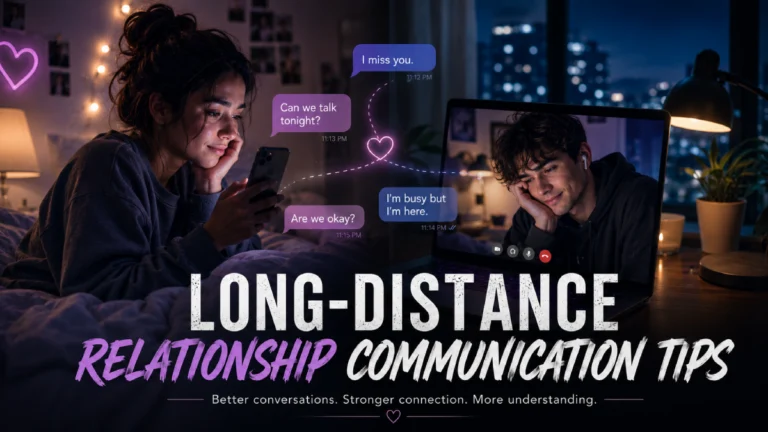
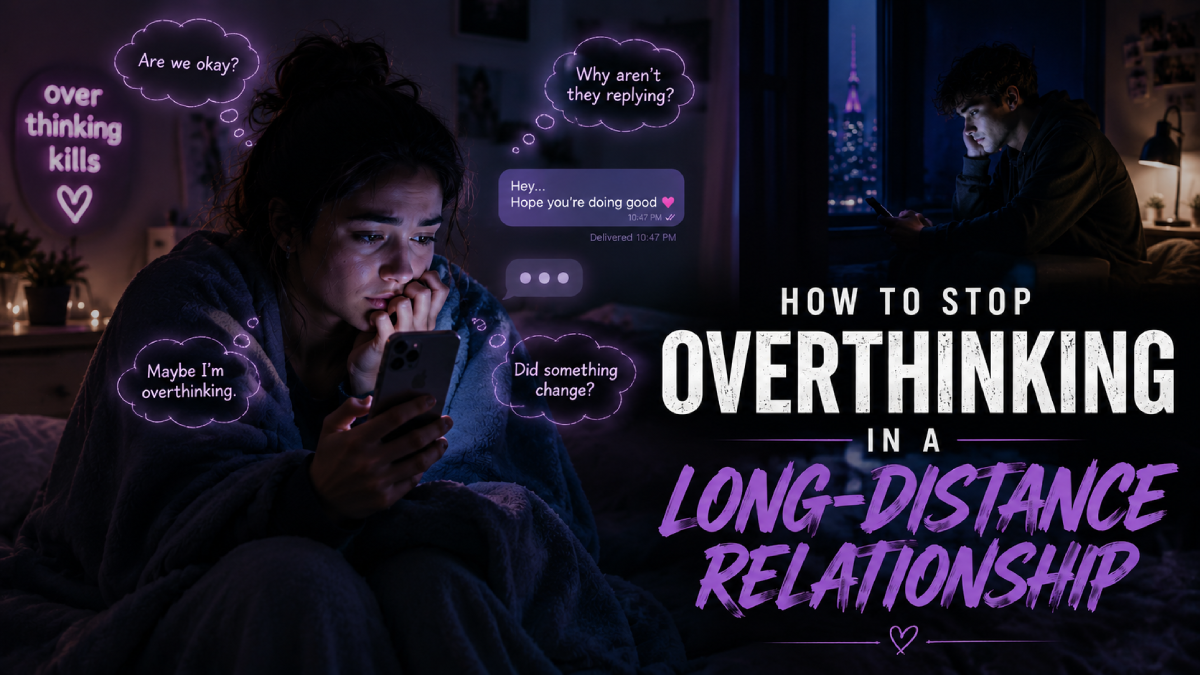
How to Stop Overthinking in a Long-Distance Relationship
How to stop overthinking when they reply late
Why does one late reply in a long-distance relationship feel like your whole mood has changed?
Maybe they are just busy.
Maybe their phone is away.
Maybe they are tired, sleeping, working, studying, or dealing with something you do not know about.
But your mind does not stay that calm.
It starts creating stories.
“Why are they online but not replying?”
“Did I say something wrong?”
“Are they losing interest?”
“Why does their energy feel different?”
“Am I overthinking, or is something actually wrong?”
And the hardest part is, sometimes overthinking feels like intuition.
You are sitting there with your phone in your hand, trying to act normal, but inside your heart is checking every tiny signal.
The reply speed.
The tone.
The emoji.
The message length.
The last seen.
The story view.
The cancelled call.
Long-distance love can make small things feel emotionally huge.
Kabhi kabhi ek late reply bhi itna heavy lagta hai jaise connection dheere-dheere kam ho raha ho.
And if you are searching for how to stop overthinking in a long-distance relationship, you are probably not looking for someone to simply say, “Just trust them.”
Because if it were that easy, you would have already done it.
You need emotional clarity.
You need a way to calm your body before your mind creates a full heartbreak story.
You need to understand whether this anxiety is coming from your own fear, their inconsistency, or the natural difficulty of long-distance.
So here is the answer first.
To stop overthinking in a long-distance relationship, you need to calm your body first, separate facts from fear, create predictable communication, ask for reassurance clearly, reduce digital checking, and notice whether your anxiety comes from past wounds or present relationship patterns.
This guide will help you understand why long-distance relationship anxiety happens, what to do when your mind spirals, how to ask for reassurance without sounding needy, and how to know when your overthinking is actually pointing to a real problem.
Why You Overthink in a Long-Distance Relationship
Overthinking in a long-distance relationship does not always mean your relationship is weak.
It does not always mean you are insecure.
It does not always mean your partner is doing something wrong.
Sometimes, it simply means your heart is trying to feel safe in a relationship where physical closeness is missing.
When someone is far away, you cannot easily read their face, body language, routine, mood, or energy.
So your mind starts reading whatever it can.
Texts.
Calls.
Timing.
Tone.
Online activity.
And because love matters so much, every little thing starts feeling important.
Because Distance Creates Emotional Uncertainty
Distance creates uncertainty because you do not have full access to your partner’s world.
You may know they love you, but you do not always know what their day feels like.
You may know they are busy, but you do not always know why their energy changed.
You may know they are committed, but you still miss the daily comfort of seeing them choose you in small, physical ways.
That uncertainty can make your mind restless.
It starts asking questions because it wants certainty.
It wants safety.
It wants proof that the connection is still okay.
You Cannot Easily Read Their Mood, Energy, or Daily Reality
In a close-distance relationship, you can often understand your partner’s mood by being around them.
You can see if they are tired.
You can notice if they are stressed.
You can feel if they are still affectionate.
You can sense whether the relationship feels warm.
But in long-distance, you are often working with incomplete information.
A short reply may mean they are busy.
Or tired.
Or distracted.
Or emotionally off.
Or maybe nothing serious at all.
But because you cannot see the full picture, your mind starts filling in the blanks.
And sadly, an anxious mind rarely fills blanks with peaceful stories.
Emotional Impact Line
Your mind does not always overthink because love is weak.
Sometimes it overthinks because information is missing.
And when information is missing, fear tries to become the answer.
Micro Takeaway
Overthinking often starts where emotional clarity is missing.
So the goal is not to shame yourself for needing clarity.
The goal is to create more emotional safety in the relationship.
Because Texts Become Proof of Love
In long-distance relationships, texts carry a lot of emotional weight.
A simple message can make you feel close.
A dry reply can make you feel rejected.
A goodnight text can calm you.
A missed message can trigger anxiety.
That is because when physical presence is missing, digital communication becomes the main way love is felt.
So naturally, you start reading meaning into small things.
Reply Speed, Tone, Emojis, and Message Length Start Feeling Personal
Maybe earlier they used to send long messages.
Now they send short replies.
Maybe earlier they used heart emojis.
Now they just say, “okay.”
Maybe earlier they replied quickly.
Now they take hours.
Maybe earlier they sounded excited.
Now they sound normal.
And your mind starts comparing.
“They were different before.”
“Something changed.”
“Maybe they are losing feelings.”
Sometimes your observation may be valid.
But sometimes, your anxiety may be turning normal changes into emotional danger.
This is why you need to pause before believing every thought.
Example
A simple “okay” can feel normal one day and heartbreaking another day.
If you are feeling secure, you may read it as normal.
If you are already anxious, you may read it as cold.
Same word.
Different emotional state.
That is why overthinking is not only about what they did.
It is also about what your nervous system is feeling when you receive it.
Because Your Attachment System Gets Triggered
Long distance can trigger attachment wounds very easily.
Attachment is basically the way your heart responds to closeness, distance, reassurance, and fear of losing connection.
When you love someone, and they are far away, your attachment system may become more alert.
It starts checking:
“Are they still here?”
“Are they still interested?”
“Am I still important?”
“Will they leave?”
This is especially common if you have experienced emotional inconsistency before.
Maybe in past relationships.
Maybe in childhood.
Maybe in friendships.
Maybe in this same relationship.
Your mind remembers how painful uncertainty feels.
So when distance creates uncertainty, old fear can wake up.
Anxious Attachment May Need More Reassurance
If you lean anxious in relationships, long distance may make you crave more communication and reassurance.
You may feel sensitive to delayed replies.
You may reread messages.
You may feel emotionally unsettled when plans change.
You may need to hear, “We are okay,” more often than your partner realizes.
This does not make you weak.
It means emotional distance activates your fear of disconnection.
But here is the important part.
Needing reassurance is not wrong.
Trying to get reassurance through panic, testing, accusations, or constant checking can hurt the relationship.
So the work is not to become emotionless.
The work is to ask for reassurance in a clearer, healthier way.
Avoidant Partners May Need More Space
If your partner leans avoidant, they may need more emotional space when things feel intense.
They may pull back when conversations become too heavy.
They may not express feelings as frequently.
They may feel overwhelmed by constant emotional checking.
This can be painful if you need reassurance.
You may feel they are abandoning you.
They may feel they are being pressured.
And slowly, both of you may feel misunderstood.
But remember this clearly:
Space is not always rejection.
But repeated emotional disappearance is not healthy either.
The difference matters.
The Push-Pull Cycle Can Make Overthinking Worse
In long-distance relationships, this anxious-avoidant pattern can become stronger.
One person reaches for closeness.
The other pulls away.
The more one pulls away, the more the other panics.
The more one panics, the more the other withdraws.
And then the relationship becomes a loop of fear.
One person thinks, “Why am I always asking?”
The other thinks, “Why is nothing ever enough?”
This is where overthinking grows.
Not because love is absent.
But because safety is missing.
Because Social Media Gives You Too Many Half-Signals
Modern long-distance relationships are not only affected by calls and messages.
They are affected by online signals too.
They were active but did not reply.
They watched your story but did not text.
They posted something but left your message unseen.
They liked someone’s photo.
They seemed happy online while you were waiting for them.
These small things can trigger a whole emotional spiral.
And the worst part?
They feel like evidence.
Online Status, Story Views, Likes, and Delayed Replies Can Feel Like Evidence
Your mind may say:
“They had time to post but not reply to me.”
“They saw my story, so they know I exist.”
“They are online. They are choosing not to talk.”
“They are ignoring me intentionally.”
Maybe that is true sometimes.
But many times, it is incomplete information.
Being online does not always mean emotionally available.
Posting does not always mean they have energy for a serious conversation.
Watching a story does not always mean they are avoiding you.
But when you already feel insecure, half-information starts feeling like full truth.
Emotional Insight
Half-information can create full anxiety.
That is why social media can be dangerous for an anxious heart.
It gives you just enough information to worry, but not enough clarity to feel safe.
Is Overthinking Normal in a Long-Distance Relationship?
Yes, some overthinking is normal in a long-distance relationship.
When you miss someone, when you cannot see them, when communication becomes your main form of closeness, your mind may naturally become more sensitive.
You are not strange for feeling this.
You are not “too much” for needing reassurance sometimes.
But there is a difference between normal overthinking and constant emotional distress.
One needs comfort and clarity.
The other may need a deeper relationship reality check.
Yes, Some Overthinking Is Normal When You Miss Someone
When you miss someone deeply, your emotional needs become louder.
You want to feel remembered.
You want to feel chosen.
You want to feel like the relationship is still alive.
So if a text feels different or a call gets cancelled, it can hurt more than expected.
Not because you are immature.
But because your heart was waiting for connection.
Missing Them Can Make Your Need for Reassurance Stronger
Missing someone is not just a thought.
It is a full-body feeling.
You may feel restless.
You may check your phone more.
You may feel emotional at night.
You may imagine being with them.
You may crave their voice.
And when that longing does not get comfort, it can turn into anxiety.
This is why reassurance matters in long-distance relationships.
Not constant reassurance.
Not forced reassurance.
But gentle, consistent reminders that say:
“I am still here.”
“You still matter.”
“We are okay.”
But Constant Anxiety Should Not Become Your Relationship’s Normal
Some anxiety is understandable.
But if your relationship makes you feel anxious every day, that needs attention.
If you are always checking, waiting, crying, doubting, apologizing for needing love, or feeling emotionally unsafe, something deeper may be happening.
Long distance is hard.
But love should not feel like permanent survival mode.
Healthy Love Should Not Keep You in Survival Mode
A healthy relationship may trigger fear sometimes.
But it should also offer repair.
It should offer reassurance.
It should offer consistency.
It should offer emotional safety.
If your partner’s behavior keeps making you spiral and they refuse to understand or improve, then the issue may not be only your overthinking.
It may be the relationship pattern.
And you deserve to be honest about that.
The Difference Between Normal Overthinking and Emotional Alarm
This distinction is very important.
Because sometimes people blame themselves for overthinking when their anxiety is actually reacting to real inconsistency.
And sometimes people assume something is wrong when their fear is coming from past wounds, not present reality.
So look at the pattern.
Not just the feeling.
Normal Overthinking Usually Calms Down With Reassurance
Normal overthinking may feel intense in the moment, but it usually softens when your partner responds with care.
For example:
You feel anxious because they replied late.
They explain kindly.
They reassure you.
Their behavior is mostly consistent.
You feel calmer.
That is normal overthinking.
Emotional Alarm Gets Stronger When Patterns Keep Repeating
Emotional alarm is different.
It grows when your partner repeatedly does things that make you feel unsafe.
They disappear often.
They avoid hard conversations.
They mock your feelings.
They make promises but do not follow through.
They only reassure you after you break down.
They make you feel guilty for needing basic connection.
In that case, your anxiety may be trying to tell you something important.
Quick Comparison Table
Normal Overthinking | Possible Real Concern |
They reply late once | They regularly disappear without explanation |
You feel anxious after a busy day | You feel unsafe most of the time |
You need reassurance sometimes | They shame you for needing reassurance |
You misread tone once | Their effort has clearly changed |
You feel insecure after missing them | They avoid every serious conversation |
How to Stop Overthinking in a Long-Distance Relationship: 8 Practical Steps
Now let’s talk about what actually helps.
Not the generic “just stop thinking.”
Because honestly, nobody stops overthinking just because someone tells them to.
Overthinking needs emotional safety, mental clarity, and practical habits.
You need to calm your body.
You need to question your thoughts.
You need to reduce digital checking.
You need better communication.
And sometimes, you need to admit when the relationship itself is feeding your anxiety.
1. Calm Your Body Before You Try to Solve the Relationship
When you are anxious, your brain thinks everything is urgent.
You feel like you need to text now.
Ask now.
Check now.
Know now.
But anxiety does not always give wise timing.
It gives intense timing.
So before you send a message, pause.
Not to ignore your feeling.
But to stop panic from driving the conversation.
Anxiety Makes Every Thought Feel Urgent
When your body is activated, every thought feels like truth.
“They are ignoring me.”
“Something changed.”
“I need to ask right now.”
“If I don’t say something, I’ll lose them.”
But many times, your body is reacting before your mind has enough facts.
So first, calm the body.
Then decide what to do.
Quick Grounding Step
Put the phone down for 10 minutes.
Breathe slowly.
Drink water.
Feel your feet on the floor.
Look around your room.
Name five things you can see.
Let your body come out of panic before you send a message.
This sounds simple, but it matters.
A calmer body writes a very different message than an anxious body.
2. Separate Facts From Fear
This is one of the most powerful tools for long-distance relationship overthinking.
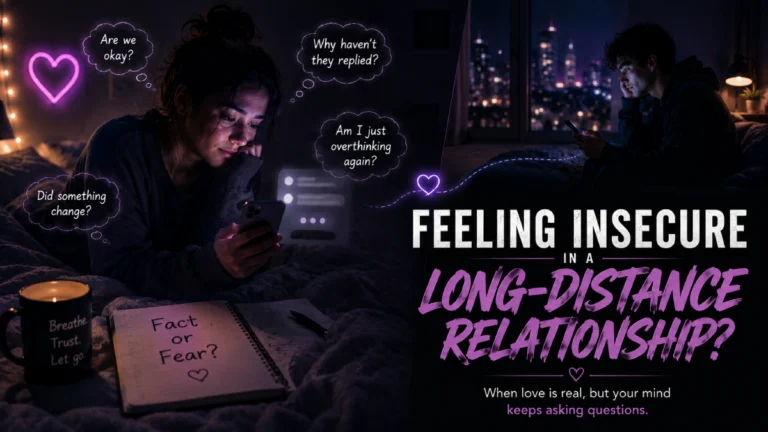
Write down two columns:
Fact.
Fear.
A fact is what actually happened.
A fear is what your mind is predicting.
This helps you see whether you are responding to reality or to a story your anxiety created.
Write Down What Actually Happened vs What Your Mind Is Predicting
For example:
Fact: They have not replied for three hours.
Fear: They are losing interest.
Fact: Their message was short.
Fear: They are becoming cold.
Fact: They cancelled the call today.
Fear: I am not a priority anymore.
Fact: They watched my story.
Fear: They are ignoring me intentionally.
This does not mean your fear is stupid.
It means your fear is not automatically fact.
Example
Fact: “They have not replied for three hours.”
Fear: “They are losing interest.”
Now ask:
What else could be true?
Maybe they are busy.
Maybe they are tired.
Maybe they saw it and planned to reply later.
Maybe their phone battery died.
Maybe they are overwhelmed.
Maybe they are not emotionally available today, but that does not mean they stopped loving you.
This exercise gives your mind more than one story.
And when your mind has more than one story, it becomes less trapped in the scariest one.
Micro Takeaway
Not every painful thought is a true signal.
Some thoughts are fear wearing the clothes of intuition.
3. Stop Checking Online Status Like It Can Give You Peace
This one is hard, but necessary.
Checking online status rarely gives peace.
It gives temporary information.
Then more questions.
They are online, but why not replying?
They were active five minutes ago; who were they talking to?
They posted a story; why not text me?
They liked something, why ignore my message?
Checking creates more checking.
It gives anxiety more material to analyze.
Digital Checking Usually Feeds the Spiral
When you check once, you may feel tempted to check again.
Then again.
Then again.
And each time, your brain thinks:
“Maybe this time I’ll find clarity.”
But most of the time, you do not find clarity.
You find another trigger.
This is why online status becomes addictive in long-distance anxiety.
It gives you the illusion of control.
But emotionally, it keeps you stuck.
Why It Is Harmful
It gives your anxiety more material but not more clarity.
You are not actually becoming safer.
You are becoming more hyper-aware.
A healthier rule:
When you feel triggered, do not check their online activity.
Check your own emotional state first.
Ask:
“What am I needing right now?”
Usually, the answer is not “more checking.”
It is reassurance, grounding, clarity, or rest.
4. Create a Communication Rhythm With Your Partner
Overthinking reduces when communication becomes more predictable.
Not constant.
Predictable.
There is a big difference.
Constant communication can feel suffocating.
Predictable communication feels safe.
When you know there will be a proper call later, you do not panic as much over slow replies during the day.
When you know your partner gives small updates when busy, silence does not feel as scary.
When you know you have a weekly emotional check-in, you do not have to carry every worry alone.
Predictable Communication Reduces Emotional Guessing
A communication rhythm is not about controlling each other.
It is about reducing unnecessary uncertainty.
You can discuss:
- How often do we want to call?
- What should we do when one of us is busy?
- Do goodnight texts matter to us?
- How do we communicate when we need space?
- What makes each of us feel ignored?
- How can we reassure each other without pressure?
This kind of conversation can prevent many late-night spirals.
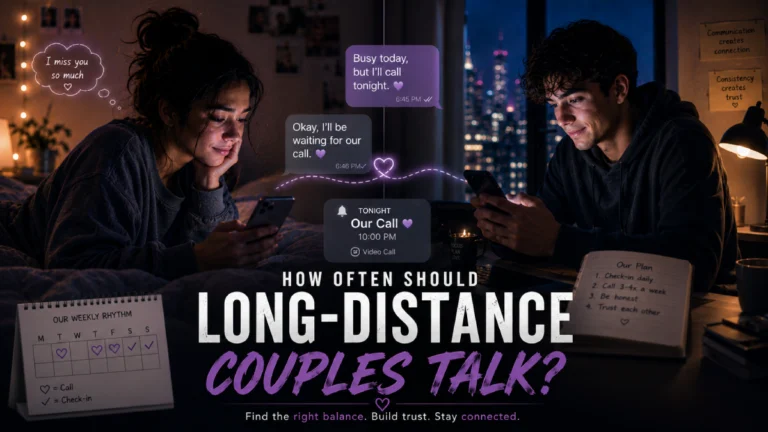
Practical Rhythm
Daily small updates + planned calls + one weekly emotional check-in.
For example:
- Small daytime messages when possible
- A short update if one person will be unavailable
- Two or three proper calls a week
- One weekly emotional conversation
- One fun virtual date or shared activity
This gives the relationship structure without making it feel like a job.
5. Ask for Reassurance Without Accusing Them
Reassurance is not neediness.
Reassurance is relationship care.
But the way you ask for it matters.
If you ask through blame, your partner may become defensive.
If you ask through silence, they may not understand.
If you ask through panic, the conversation may become heavier than necessary.
The goal is to express the need clearly and softly.
Reassurance Is Healthier When It Is Asked Clearly
Instead of saying:
“You don’t care anymore.”
Try:
“I’ve been feeling a little anxious today, and I need some reassurance.”
Instead of:
“You never make time.”
Try:
“I miss feeling close to you. Can we plan a proper call?”
Instead of:
“Why are you ignoring me?”
Try:
“I noticed I started overthinking when I didn’t hear from you. Are we okay?”
This keeps the door open for connection.
Not conflict.
Better Script
“I know you may be busy, but I’ve been feeling a little anxious today. Can you reassure me that we’re okay?”
This sentence is powerful because it does not attack.
It says what you feel.
It asks for what you need.
It gives your partner a clear way to support you.
And if someone genuinely cares, this should not feel like a burden every time.
6. Build Self-Soothing Habits That Do Not Depend on Their Reply
This is very important.
Your emotional peace cannot depend only on one notification.
Because if it does, your whole nervous system becomes controlled by their availability.
They reply, you feel okay.
They do not reply, you spiral.
They sound warm, you relax.
They sound dry, you panic.
That is exhausting.
You need ways to return to yourself even when they are unavailable.
Your Emotional Peace Cannot Depend Only on One Notification
This does not mean you stop needing your partner.
It means you stop abandoning yourself while waiting for them.
You need emotional anchors outside the relationship too.
Your body.
Your routine.
Your friends.
Your goals.
Your hobbies.
Your work.
Your creativity.
Your own life.
Because long distance becomes much harder when your whole day revolves around one person’s reply.
Examples
When you feel yourself spiraling, try:
- Go for a short walk
- Journal what you feel
- Voice-note yourself instead of sending a panic text
- Clean your room
- Call a friend
- Work on one small task
- Take a shower
- Make tea
- Listen to calming music
- Read something grounding
- Do something creative
- Write the message, but do not send it yet
The goal is not distraction forever.
The goal is emotional regulation first, communication later.
7. Talk About Triggers When You Are Calm
The best time to talk about your overthinking is not in the middle of a spiral.
When you are panicking, your words may come out sharper than your real heart.
You may accuse when you actually need comfort.
You may demand when you actually need reassurance.
You may cry from fear and then feel embarrassed later.
So talk about triggers when you are calm.
Do Not Bring Up Every Fear in the Middle of Panic
If every fear becomes an immediate conversation, your partner may start feeling overwhelmed.
And you may start feeling ashamed afterward.
Instead, notice patterns.
Write them down.
Wait until you are calmer.
Then talk about the trigger with clarity.
For example:
“I noticed that when plans change suddenly, I start feeling disconnected. Can we handle cancelled calls in a way that feels safer for both of us?”
This is mature.
It gives the relationship a chance to improve.
Conversation Starter
“I noticed late replies trigger me sometimes. I do not want to pressure you, but can we find a way to communicate that feels safer for both of us?”
This is such a healthy line because it shows responsibility without self-blame.
You are not saying, “Everything is your fault.”
You are also not saying, “My feelings do not matter.”
You are saying, “This affects me, and I want us to handle it better.”
That is emotional maturity.
8. Check Whether Your Partner’s Behavior Is Actually Consistent
Sometimes, the problem is not your overthinking.
Sometimes, your anxiety is being fed by real inconsistency.
This is why you should not automatically blame yourself for every trigger.
Ask yourself:
Do they usually follow through?
Do they communicate when busy?
Do they reassure me when I ask calmly?
Do they repair after conflict?
Do their words and actions match?
Do I feel loved overall, even when I miss them?
These questions matter.
Because healthy self-awareness does not mean ignoring real problems.
Do Not Blame Yourself for Anxiety That Is Being Fed by Real Inconsistency
If someone repeatedly disappears, avoids future conversations, breaks trust, cancels plans without care, or makes you feel guilty for needing basic reassurance, your anxiety may be reacting to reality.
In that case, the solution is not just “stop overthinking.”
The solution is to address the pattern.
A relationship should not constantly make your nervous system feel unsafe.
Reality Check
Sometimes the goal is not to stop overthinking.
Sometimes the goal is to stop ignoring what your overthinking is reacting to.
That does not mean every fear is true.
But it does mean your feelings deserve honest attention.
What to Do When They Reply Late and Your Mind Starts Spiraling
Late replies are one of the biggest triggers in long-distance relationships.
Not because a late reply is always serious.
But because it creates space.
And when you miss someone, space can quickly become fear.
So when they reply late, and your mind starts spiraling, you need a clear emotional process.
Not panic.
Not testing.
Not angry paragraphs.
A process.
Step 1: Do Not Send the Panic Text Immediately
When you are triggered, your first message may not reflect your real need.
You may want to say:
“Wow, okay.”
“You clearly don’t care.”
“Forget it.”
“Why are you ignoring me?”
“Do whatever you want.”
But underneath those words may be a softer truth:
“I missed you.”
“I felt unimportant.”
“I need reassurance.”
“I got scared.”
Do not let panic speak before your real feeling gets a chance.
Give Yourself a Short Pause Before Reacting
Pause for ten to twenty minutes.
Not to punish them.
Not to suppress yourself.
But to let your message come from clarity instead of fear.
Ask yourself:
What am I feeling?
What do I actually need?
What do I know for sure?
What am I assuming?
What would I say if I felt safe?
That last question is very powerful.
Step 2: Ask, “What Are Three Possible Explanations?”
Anxious thoughts usually give you one explanation.
The worst one.
So train your mind to create three possible explanations before believing the scary story.
This does not mean lying to yourself.
It means widening the picture.
Train Your Mind to See More Than the Scary Story
If they have not replied, possible explanations could be:
- They are busy.
- They are tired.
- They saw it and planned to reply later.
- They are with family.
- Their phone is on silent.
- They are emotionally drained.
- They are not good at multitasking.
- They do not realize how much this affects you.
Again, this does not excuse repeated neglect.
But it prevents one late reply from becoming instant heartbreak.
Example
They may be busy.
They may be tired.
They may have seen it and planned to reply later.
Give your mind more than one story.
Your peace needs options.
Step 3: Use a Reassurance Request Instead of an Accusation
If you still feel uneasy after calming down, ask for reassurance.
But ask in a way that invites connection.
Not defense.
Accusations may give temporary emotional release, but they often create distance.
Reassurance requests create repair.
Say What You Feel Without Making Them Defend Themselves
Instead of:
“You were online and ignored me.”
Try:
“I felt a little anxious when I didn’t hear from you. Can we talk when you’re free?”
Instead of:
“You don’t care about me.”
Try:
“I miss feeling close to you today.”
The second version is more vulnerable.
And vulnerability usually reaches the heart better than blame.
Script
“I know I might be overthinking, but I felt a little disconnected today. Can we talk when you’re free?”
This script gives your partner context.
It does not shame them.
It simply says, “I need connection.”
Step 4: Watch the Pattern, Not One Moment
This is one of the most important things to remember.
One late reply does not define the relationship.
One dry text does not always mean they stopped caring.
One cancelled call does not always mean you are not a priority.
But repeated patterns matter.
If late replies happen with care, explanation, and repair, that is different.
If late replies happen with avoidance, defensiveness, and emotional coldness, that is different.
One Late Reply Is Not the Same as Repeated Emotional Neglect
Look at the larger pattern.
Do they come back warmly?
Do they explain when needed?
Do they make time overall?
Do they care when you feel anxious?
Do they try to understand your triggers?
Or do they keep dismissing you?
The pattern will tell you more than one moment.
Micro Takeaway
Your peace should come from patterns, not panic.
Do not judge the entire relationship from one anxious moment.
But do not ignore repeated emotional neglect either.
How to Ask for Reassurance Without Sounding Needy
First, let’s clear something.
Asking for reassurance does not automatically make you needy.
Everyone needs reassurance sometimes.
Especially in long-distance relationships, where physical closeness is limited.
The problem is not needing reassurance.
The problem is when reassurance is demanded through blame, panic, control, or constant testing.
So the goal is not to stop needing reassurance.
The goal is to ask for it healthily.
Reframe Reassurance as Relationship Maintenance
Think of reassurance like emotional maintenance.
Just like relationships need time, affection, repair, and honesty, they also need reassurance.
Especially during hard seasons.
A simple loving sentence can prevent a big emotional spiral.
“We are okay.”
“I miss you too.”
“I know I’ve been busy, but I still care.”
“You matter to me.”
These are not dramatic things.
They are small emotional anchors.
Healthy Couples Reassure Each Other Without Making It a Power Struggle
In healthy relationships, reassurance is not treated like weakness.
It is treated like care.
Of course, one partner should not have to reassure every five minutes.
But occasional reassurance should not be used against someone.
If your partner makes you feel pathetic for needing comfort, that is not emotional safety.
Use Clear “I Feel” Language
The phrase “I feel” can soften a hard conversation.
It helps you speak from your experience instead of accusing your partner’s character.
Instead of saying:
“You don’t care.”
Say:
“I feel a little far from you today.”
Instead of:
“You are ignoring me.”
Say:
“I felt anxious when I didn’t hear from you.”
This does not mean your partner has no responsibility.
It simply helps the conversation start less defensively.
Avoid “You Never” and “You Don’t Care”
These phrases may come from real pain, but they often make the other person defend themselves.
They may say:
“That’s not true.”
“I was busy.”
“You always overthink.”
“Nothing is enough for you.”
And then the real need gets lost.
You were not trying to fight.
You were trying to feel close.
So choose words that reveal the need, not just the hurt.
Better Examples
“I feel a little far from you today.”
“I miss feeling close to you.”
“I need a soft reminder that we’re okay.”
“I know you are busy, but reassurance helps me feel grounded.”
“I am not trying to pressure you. I just want to feel emotionally connected.”
These lines are gentle, but not weak.
They are clear.
Ask for a Specific Action
Sometimes partners want to help but do not know what reassurance looks like for you.
So be specific.
Do you need a call?
A voice note?
A goodnight text?
A message when they are busy?
A plan?
A softer tone?
A little more affection?
Specific needs are easier to meet than vague pain.
Do You Need a Call, a Voice Note, a Goodnight Text, or a Future Plan?
Ask yourself:
What would help me feel safe right now?
If the answer is a call, ask for a call.
If the answer is reassurance, ask for reassurance.
If the answer is clarity about plans, ask for clarity.
If the answer is consistency, talk about rhythm.
For example:
“Can you send me a small update when your day gets busy? It helps me not spiral.”
That is specific.
And it gives your partner a real action.
Appreciate the Reassurance When They Offer It
This part matters too.
When your partner reassures you, receive it.
Do not immediately ask five more questions.
Do not test whether they “really mean it.”
Do not reject the comfort your heart was asking for.
Let it land.
If they are genuinely trying, acknowledge it.
Let Them Know What Helps You Feel Safe
Say:
“Thank you. That helped.”
“I needed to hear that.”
“I feel calmer now.”
“I appreciate you making time.”
This teaches your partner what works.
And it turns reassurance into a bonding moment, not a burden.
Example
“Thank you for saying that. It genuinely helps me calm down.”
Simple.
Soft.
Emotionally mature.
Common Mistakes That Make Overthinking Worse
When you are anxious, you may do things that feel helpful in the moment but make the spiral worse later.
These mistakes are common.
So do not shame yourself if you recognize them.
Just notice them.
Because awareness gives you a choice.
Mistake 1: Rereading Old Messages for Hidden Meaning
When you are anxious, you may scroll through old chats.
You may compare how they used to talk.
You may look for proof that their energy changed.
You may analyze punctuation, emojis, timing, and words.
But the more you reread, the more confused you may become.
Why It Is Harmful
Your anxious brain will keep finding new interpretations.
A message that seemed sweet yesterday may seem suspicious today.
A normal reply may suddenly look cold.
A small change may become a big emotional story.
Rereading rarely gives peace.
It usually gives more material for fear.
Emotional Consequence
You feel worse even when nothing new has happened.
That is the painful part.
The relationship did not change in that moment.
But your interpretation did.
Mistake 2: Checking Their Online Status Again and Again
Checking online status feels like control.
But it is usually anxiety in disguise.
You think you are gathering information.
But really, you are feeding the part of your mind that cannot rest.
Why It Is Harmful
It creates a false sense of control.
You may know they are online.
But you still do not know what they are doing, how they feel, or why they have not replied.
So the checking does not complete the story.
It only opens more questions.
Mistake 3: Testing Their Love With Silence
Sometimes you may go silent to see if they care.
You may stop texting first.
You may reply coldly.
You may wait to see whether they notice your mood.
This usually comes from hurt.
You want to feel chosen without asking.
You want them to prove they care.
That desire is understandable.
But testing rarely creates secure love.
Why It Is Harmful
It creates confusion instead of connection.
Your partner may not understand what is happening.
They may think you need space.
They may mirror your coldness.
They may get defensive.
And then you feel even more unwanted.
Instead of testing, try expressing.
It is scarier, but healthier.
Mistake 4: Asking for Reassurance Through Accusations
When you feel scared, you may say things like:
“You don’t care.”
“You never make time.”
“You’re ignoring me.”
“You’ve changed.”
Sometimes there may be truth underneath.
But the delivery can be harder to repair.
Why It Is Harmful
Your partner may become defensive instead of comforting.
They may focus on proving they are not wrong instead of understanding your pain.
And then you feel unheard.
So the real need remains unmet.
Try saying the softer truth underneath the accusation.
Usually, that truth is:
“I miss you.”
“I feel insecure.”
“I need reassurance.”
“I am scared we are drifting.”
That is what needs to be heard.
Mistake 5: Blaming Yourself for Every Trigger
Not every anxious feeling is your fault.
Yes, you are responsible for how you respond to your emotions.
But your partner is also responsible for how they show up in the relationship.
If they are inconsistent, dismissive, vague, or emotionally unavailable, your anxiety may not be random.
It may be reacting to the relationship environment.
Why It Is Harmful
You may ignore real relationship patterns that deserve attention.
You may keep saying:
“I’m just overthinking.”
When the truth is:
“I’m reacting to repeated inconsistency.”
Both self-awareness and reality-checking are important.
Do not use healing language to silence your own valid discomfort.
When Overthinking Is Actually a Sign Something Is Wrong
This section matters because not all overthinking is irrational.
Sometimes your anxiety is exaggerated.
Sometimes it is protective.
Sometimes it is pointing toward a pattern you have been trying to ignore.
So how do you know when overthinking is actually a sign something is wrong?
Look at behavior.
Not just feelings.
Patterns.
Not just one moment.
They Regularly Disappear Without Explanation
Everyone gets busy.
But regularly disappearing without explanation creates emotional instability.
If your partner vanishes for long periods, then returns as if nothing happened, it makes sense that your mind does not feel safe.
Healthy space includes communication.
Unhealthy disappearance leaves you confused.
Their Words and Actions Do Not Match
They say they love you, but they do not make time.
They say they miss you, but never initiate.
They say you matter, but dismiss your feelings.
They say they are serious, but avoid every future conversation.
When words and actions do not match, overthinking grows naturally.
Because your mind is trying to understand the contradiction.
They Make You Feel Guilty for Normal Emotional Needs
Wanting reassurance is not wrong.
Wanting communication is not wrong.
Wanting clarity is not wrong.
Wanting emotional effort is not wrong.
Of course, needs should be expressed respectfully.
But if your partner makes you feel guilty for having basic relationship needs, that is not healthy.
You should not have to act emotionless to be loved.
They Avoid Every Conversation About the Future
Long-distance needs future clarity.
Not immediate answers.
But willingness to talk.
If they avoid every conversation about meeting, planning, commitment, or closing the distance, your anxiety may be reacting to uncertainty that is genuinely important.
You are not wrong for wanting to know where your relationship is going.
They Only Reassure You After You Break Down
If your partner only offers care when you are crying, panicking, or emotionally exhausted, that creates a painful cycle.
You should not have to reach a breaking point to receive softness.
Healthy love offers reassurance before someone collapses.
Not only after.
You Feel More Anxious Than Loved Most of the Time
This is one of the clearest emotional signs.
Every relationship has hard moments.
But overall, love should not feel like constant fear.
If most of your relationship experience is waiting, worrying, checking, crying, doubting, and shrinking your needs, something needs to change.
Emotional Clarity
Overthinking is not always the problem.
Sometimes it is a signal that your relationship needs more honesty, consistency, or repair.
And sometimes, the bravest thing is admitting that your anxiety is not coming from nowhere.
When to Walk Away From a Long-Distance Relationship That Keeps Triggering You
Walking away is not always because love is gone.
Sometimes it is because peace is gone.
Sometimes it is because trust keeps breaking.
Sometimes it is because you are tired of begging for basic emotional care.
And that is painful.
Because you may still love them.
You may still hope.
You may still remember the good moments.
But love should not require you to live in constant emotional fear.
Walk Away When You Are Always Begging for Basic Communication
If you have to beg for every reply, every call, every update, every plan, every conversation — the relationship may be deeply imbalanced.
Basic communication should not feel like a prize.
You deserve to feel considered.
Not every second.
Not unrealistically.
But consistently enough that your heart does not feel abandoned.
Walk Away When Your Anxiety Is Being Used Against You
If your partner says things like:
“You’re crazy.”
“You always overthink.”
“No one else would tolerate you.”
“You’re too needy.”
“This is why I don’t tell you things.”
Be careful.
There is a difference between helping you manage anxiety and using your anxiety to dismiss your pain.
A loving partner may say:
“I understand this triggers you. Let’s find a better way.”
A harmful partner may say:
“This is all your problem.”
Notice the difference.
Walk Away When They Refuse to Repair Broken Trust
Trust can heal.
But only with accountability.
If someone broke your trust and then expects you to instantly feel secure, that is unfair.
Repair requires patience.
Honesty.
Changed behavior.
Consistency.
If they refuse all of that, your overthinking may continue because the relationship has not been repaired.
Walk Away When You Keep Shrinking Your Needs to Avoid Losing Them
This one hurts deeply.
If you stop asking for calls because you fear they will get annoyed…
If you pretend late replies do not hurt because you do not want to seem dramatic…
If you silence your needs because you are afraid they will leave…
If you keep accepting less just to keep them…
Then the relationship is costing you yourself.
And love should not make you disappear.
Reality Check
A healthy relationship may trigger old fears sometimes, but it should not constantly keep you emotionally unsafe.
Distance is hard.
But emotional neglect is different.
Do not confuse the two.
Final Thoughts: You Are Not Weak for Overthinking, But You Do Need Safety
Overthinking in a long-distance relationship does not mean you are broken.
It often means your heart is trying to feel safe with limited information.
You are trying to love someone through a screen.
You are trying to trust what you cannot always see.
You are trying to stay calm when silence feels loud.
Of course it gets hard.
Of course some nights feel heavier.
Of course late replies can hurt when you already miss them.
But you do not have to live inside every anxious thought.
You can learn to pause.
To separate facts from fear.
To ask for reassurance clearly.
To stop feeding the spiral with online checking.
To build a communication rhythm.
To notice patterns.
To soothe yourself without abandoning your needs.
Reassurance
Overthinking in a long-distance relationship does not mean you are broken.
It often means your heart is trying to feel safe with limited information.
And that deserves compassion.
Not shame.
You are allowed to need reassurance.
You are allowed to want consistency.
You are allowed to miss them.
You are allowed to ask for clarity.
But you also deserve to feel emotionally grounded inside yourself.
Not completely dependent on one message to feel okay.
Emotional Closure
The goal is not to become someone who never needs reassurance.
The goal is to build a relationship where reassurance, trust, and emotional consistency exist enough that your mind does not have to panic every night.
Because love should feel safe more often than it feels scary.
Even in long distance.
Even when you miss them.
Even when life is busy.
Even when replies are not instant.
A healthy long-distance relationship will not remove every fear.
But it will give you enough emotional safety to not feel alone inside the fear.
And that is what you are really looking for.
Not constant texting.
Not perfect availability.
Not control.
Safety.
Softness.
Consistency.
A love that says:
“I may be far, but I am not careless with your heart.”
If your overthinking comes from trust issues, read next:
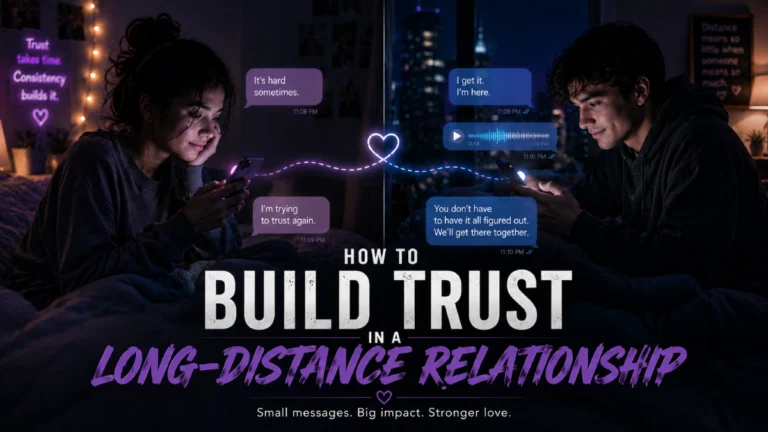
How to Build Trust in a Long-Distance Relationship
Because sometimes the next step is not blaming yourself for anxiety.
Sometimes the next step is learning what real trust, reassurance, and emotional consistency should look like from far away.