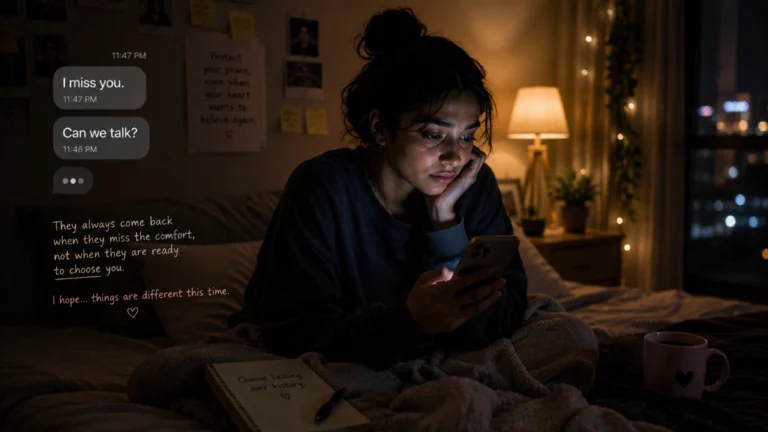

Emotionally Unavailable Signs : Why they Never Fully Let You In
Why They Feel Close but Never Fully Let You In
Have you ever felt close to someone, but still strangely alone with them? There are some signs to look for if they are emotionally unavailable to you.
Maybe they text you.
Maybe they spend time with you.
Maybe they say they care.
Maybe there are moments where they look at you, talk to you, or hold space for you in a way that makes you think, “Maybe this is real.”
But then something shifts.
When the conversation becomes emotional, they go quiet.
When you ask where things are going, they become vague.
When you need reassurance, they act like your feelings are too much.
When things start feeling serious, they pull away.
And you are left wondering:
Are these emotionally unavailable signs, or am I just overthinking?
Emotionally unavailable signs include avoiding deep conversations, pulling away when intimacy grows, giving inconsistent effort, dismissing your feelings, avoiding commitment, staying vague about the future, and making you feel emotionally lonely even when they are present.
But the confusing part is this:
Emotionally unavailable people are not always cold from the beginning.
Sometimes they are charming.
Sometimes they are affectionate.
Sometimes they make you feel special.
Sometimes they give just enough warmth to keep your hope alive.
And that is why it hurts so much.
Because you are not attached to anything.
You are attached to the moments where they almost let you in.
Woh paas hote hue bhi emotionally door lagte hain. Aur yahi distance sabse zyada todta hai.
Emotional unavailability is confusing because the person may be physically present, romantically interested, or affectionate sometimes, but still unable to offer emotional consistency and depth.
And no, wanting emotional closeness does not make you needy.
Wanting honesty does not make you dramatic.
Wanting consistency does not make you “too much.”
Sometimes, your heart is not asking for a fairy tale.
It is simply asking not to feel alone inside a connection.
What Does Emotionally Unavailable Mean?
Before we talk about emotionally unavailable signs, let’s understand what the term actually means in simple words.
Because sometimes people use this phrase casually.
“He’s emotionally unavailable.”
“She’s emotionally unavailable.”
“They’re avoidant.”
“They have commitment issues.”
But when you are the one experiencing it, it is not just a label.
It feels like loving someone through a locked door.
You can sense something inside them.
But you cannot fully reach it.
Emotional Unavailability Meaning in Simple Words
Emotional unavailability means someone struggles to be emotionally open, responsive, vulnerable, or consistent in close relationships.
They may care about you.
They may enjoy your company.
They may feel attracted to you.
They may even miss you when you are not around.
But when emotional closeness asks for depth, responsibility, honesty, or commitment, they struggle.
They may shut down.
They may avoid.
They may become defensive.
They may act distant.
They may make you feel like your normal emotional needs are too heavy.
In simple words:
An emotionally unavailable person may want connection, but they may not know how to emotionally show up for it.
That is the painful contradiction.
They may want the comfort of love.
But not the vulnerability of love.
They may want your presence.
But not your emotional needs.
They may enjoy being cared for.
But struggle to care for you in the way that makes you feel safe.
Emotional Unavailability Is Not Always Cruel, But It Can Still Hurt
This part is important.
Emotionally unavailable people are not always bad people.
Some are carrying past hurt.
Some grew up in homes where emotions were ignored, punished, or mocked.
Some learned to survive by staying detached.
Some are afraid of getting close because closeness once cost them something.
Some have avoidant attachment patterns.
Some are simply immature and have never learned how to sit with another person’s emotions.
So yes, there may be reasons behind their emotional distance.
But reasons do not erase impact.
You can understand why someone built walls and still admit that those walls are hurting you.
You can feel compassion for their past and still protect your present.
You can say, “I understand why they are like this,” without saying, “I must keep accepting this.”
Woh bure insaan na bhi ho, phir bhi unki emotional absence aapko hurt kar sakti hai.
Sometimes that is the hardest truth to accept.
They do not have to be cruel for the connection to be painful.
They do not have to be toxic for the relationship to feel lonely.
They do not have to hate you to hurt you.
They can care in their own limited way and still not be able to love you in a way that feels safe.
Understanding why someone is emotionally unavailable does not mean you have to keep accepting emotional loneliness.
You are allowed to understand them.
But you are also allowed to ask:
“Is this connection emotionally healthy for me?”
Because clarity is not only about decoding them.
It is also about coming back to yourself.
Emotionally Unavailable Signs You Should Not Ignore
Emotionally unavailable signs are not always loud.
They do not always look like someone disappearing completely or saying they do not care.
Sometimes they look like small emotional absences.
A conversation that never goes deeper.
A person who is warm only when things are easy.
A relationship where you feel close, but not secure.
A connection where you keep asking for very basic emotional presence and somehow still feel like you are asking for too much.
The signs below are not meant to make you panic.
They are meant to help you see the pattern clearly.
Because sometimes, what you call “overthinking” is actually your heart noticing inconsistency.
1. They Avoid Deep Emotional Conversations
Maybe they are fun to talk to.
Maybe they can joke for hours.
Maybe they send memes, flirt, share random updates, and talk about surface-level things easily.
But the moment the conversation becomes emotional, they pull back.
You ask how they really feel, and they say, “I don’t know.”
You ask what they want, and they say, “Let’s not make this serious.”
You express hurt, and they suddenly become quiet.
You try to talk about the future, and they change the topic.
This is one of the clearest emotionally unavailable signs.
Not because everyone needs to be emotionally expressive all the time.
But a connection cannot deepen if one person keeps avoiding emotional honesty.
Behavior Explanation
Deep conversations require vulnerability.
They require someone to admit feelings, fears, intentions, mistakes, and emotional needs.
For an emotionally unavailable person, that can feel exposing.
So they stay in safer zones.
Jokes.
Flirting.
Casual updates.
Physical affection.
Distraction.
Anything that creates closeness without requiring emotional truth.
And at first, this may not bother you.
You may think, “Maybe they just need time.”
But after a while, you may notice that every emotional door stays half-closed.
You are allowed near them.
But not fully inside.
Emotional Consequence
You start feeling like the connection has access to your heart, but not their truth.
And that is lonely.
Because you may be sharing your inner world while they keep theirs protected.
You may be trying to build intimacy with someone who keeps changing the subject every time intimacy becomes real.
2. They Pull Away When Things Get Serious
In the beginning, they may feel very present.
They may text often.
They may make plans.
They may say sweet things.
They may make you feel like something beautiful is starting.
Then, as soon as feelings deepen or expectations become real, they pull away.
Their replies slow down.
Their energy changes.
They become “busy.”
They seem distant after emotional moments.
They act warm one day and unavailable the next.
And you are left wondering what happened.
Maybe you start blaming yourself.
“Did I say too much?”
“Did I show too much interest?”
“Did I scare them?”
But sometimes, you did not scare them.
The closeness did.
Emotional Line
They like the beginning, but struggle with the depth.
The early stage feels exciting because it does not demand too much.
It is flirting.
It is chemistry.
It is attention.
It is a possibility.
But seriousness asks for consistency.
It asks for clarity.
It asks for emotional responsibility.
And that is where emotionally unavailable people often begin to distance themselves.
Micro Takeaway
If they disappear every time emotional closeness grows, the issue may not be your needs.
It may be their capacity.
You are not wrong for wanting the connection to move beyond uncertainty.
But they may not be emotionally ready to meet you there.
3. Their Effort Is Inconsistent
Some days, they make you feel wanted.
Other days, you feel forgotten.
Some days, they are soft, present, and emotionally available.
Other days, they become distant, vague, or uninterested.
They may come close when you pull away.
Then become distant when you start trusting them again.
This inconsistency can become emotionally addictive.
Not because you enjoy pain.
But because the good moments feel like proof.
You think:
“See, they do care.”
“Maybe they are just going through something.”
“Maybe this time it will be different.”
And then the cycle repeats.
Behavior Explanation
Inconsistent effort keeps your mind searching for the “real” version of them.
Is the real them the affectionate one?
Or the distant one?
Is the real connection the warm phase?
Or the silence after it?
This uncertainty keeps you emotionally alert.
You start waiting for the next good moment.
You start accepting small signs as a big hope.
You start feeling grateful for the effort that should have been normal.
Emotional Consequence
You may become attached to their good moments and ignore the overall pattern.
And this is where many people get stuck.
They do not stay because the person is consistently loving.
They stay because sometimes the person becomes exactly who they hoped they would be.
But emotional safety is not built on “sometimes.”
It is built on consistency.
4. They Dismiss Your Feelings or Call You “Too Sensitive.”
When you express hurt, they minimize it.
When you say something bothered you, they call it drama.
When you ask for reassurance, they say you are overthinking.
When you try to explain your emotional experience, they become irritated.
They may say:
- “You are too sensitive.”
- “It is not that deep.”
- “Why do you always make things serious?”
- “You are overthinking again.”
- “I cannot deal with this drama.”
- “You expect too much.”
And slowly, you stop trusting your own feelings.
You start wondering if maybe you really are too emotional.
Maybe you should not have said anything.
Maybe you should be more chill.
Maybe your needs are the problem.
But maybe they are not.
Maybe your feelings are asking for care, and they do not know how to give it.
Emotional Impact
This can make you doubt your own emotional reality.
That is one of the most painful parts of dealing with emotional unavailability.
You are not only hurt.
You are made to feel wrong for being hurt.
You start editing your emotions before sharing them.
You rehearse your words.
You soften everything.
You make your pain sound smaller so they do not feel uncomfortable.
But a connection where you have to make your hurt digestible all the time is not emotionally safe.
Micro Takeaway
A safe person may not always understand your feelings immediately, but they will not punish you for having them.
They may need time.
They may ask questions.
They may disagree.
But they will not make you feel ashamed for needing emotional care.
5. They Avoid Labels, Commitment, or Future Conversations
They may like being close to you.
They may enjoy your attention.
They may act like a partner in private.
But whenever the topic of labels, commitment, or the future comes up, they become vague.
They may say:
“Let’s go with the flow.”
“Why do we need labels?”
“I am not ready.”
“Let’s not complicate it.”
“I like what we have.”
“I don’t want pressure.”
These lines can sound harmless.
Sometimes they are.
But if the connection has been emotionally intimate for a while and they still avoid clarity, that matters.
Because avoiding labels is not always about being modern or free.
Sometimes it is a way to keep benefits without responsibility.
Behavior Explanation
Avoiding commitment allows them to keep emotional access without emotional responsibility.
They can receive your care.
They can enjoy your presence.
They can call you when they are lonely.
They can act romantic when it suits them.
But they do not have to clearly choose you.
They do not have to define expectations.
They do not have to be accountable for your emotional confusion.
And that imbalance can quietly break your heart.
Emotional Consequence
You may feel close enough to care, but not secure enough to relax.
That is a very painful place to be.
Because your heart is attached, but the relationship is undefined.
You are emotionally invested, but still unsure whether you have a real place in their life.
6. You Feel Lonely Even When You Are With Them
This sign is quiet, but powerful.
They may be physically present.
They may sit beside you.
They may talk to you.
They may even hold your hand.
But emotionally, you feel alone.
You feel like there is a wall between you.
You feel like you cannot fully reach them.
You feel like your deeper feelings have nowhere to land.
Sometimes, being with an emotionally unavailable person feels lonelier than being single.
Because when you are single, you know you are alone.
But when someone is next to you, and you still feel alone, the loneliness becomes confusing.
Emotional Line
Kabhi-kabhi sabse zyada tanhaai tab mehsoos hoti hai jab koi paas hote hue bhi dil se door ho.
You may start asking yourself:
“Why do I feel empty after spending time with them?”
“Why do I miss them even when they are here?”
“Why do I feel like I am loving someone from a distance?”
That feeling matters.
Do not dismiss it.
Your body may be noticing emotional absence before your mind can explain it.
7. They Are Comfortable Receiving Emotional Support, But Struggle to Give It
They may come to you when they are sad.
They may share their stress.
They may open up when life feels heavy.
They may depend on your patience, your comfort, and your emotional warmth.
And because you care, you show up.
You listen.
You understand.
You make space.
You become their safe place.
But when you need the same emotional support, they disappear.
They become uncomfortable.
They change the topic.
They give short replies.
They tell you they do not know what to say.
They leave you alone with feelings you helped them carry.
Behavior Explanation
This creates emotional imbalance.
You become their safe place, but they do not become yours.
The connection starts revolving around their emotional comfort.
Their stress matters.
Their mood matters.
Their wounds matter.
Their fears matter.
But your needs become inconvenient.
That is not mutual emotional intimacy.
That is emotional one-sidedness wearing the mask of closeness.
Emotional Consequence
You may feel useful, but not held.
And sometimes that feeling can trick you.
Being needed can feel like being loved.
But they are not the same.
Someone needing your comfort does not always mean they are capable of giving you care.
8. They Make You Feel Like Asking for Closeness Is Pressure
When you ask for consistency, they act suffocated.
When you ask for clarity, they call it pressure.
When you ask for effort, they say you are expecting too much.
When you express hurt, they say you are making things complicated.
So you start reducing your needs.
You ask less.
You wait longer.
You pretend to be okay.
You try to become easy.
You become careful with your own heart.
But the truth is, asking for basic emotional closeness is not pressure.
Wanting honesty is not pressure.
Wanting a reply, a plan, a conversation, or clarity is not pressure.
It only feels like pressure to someone who wants access without accountability.
Reality Check
Basic emotional needs are not pressure.
They only feel like pressure to someone who wants a connection without responsibility.
And this is where you need to be gentle with yourself.
You are not “too much” for wanting the connection to feel emotionally safe.
You may just be asking someone for something they are not ready or willing to give.
9. Their Past Relationships Were Always “Too Much” or “Complicated.”
Pay attention to how they describe their past relationships.
If every ex was “crazy,” “needy,” “dramatic,” “too emotional,” or “complicated,” pause.
Maybe some of those relationships were genuinely difficult.
But if every person who needed emotional clarity becomes “too much” in their story, there may be a pattern.
They may not recognize their own emotional avoidance.
They may believe they are always the calm one.
They may see other people’s emotional needs as problems because they do not know how to meet them.
And one day, your needs may become part of the same story.
Behavior Explanation
Sometimes, emotionally unavailable people frame normal emotional needs as excessive because they struggle to meet them.
A request for clarity becomes pressure.
A request for care becomes drama.
A request for consistency becomes neediness.
This helps them avoid responsibility.
Because if you are “too emotional,” they do not have to ask whether you are too absent.
Micro Takeaway
If everyone before you was “too much,” you may eventually be called “too much” too.
So listen carefully.
Not with fear.
With awareness.
10. They Keep the Relationship Surface-Level
You may spend time together.
You may talk often.
You may share laughs.
You may even have chemistry.
But the relationship does not deepen.
You do not really know their emotional world.
You do not know what scares them.
You do not know what they truly want.
You do not know how they process feelings.
You do not know where you stand.
Everything stays in a comfortable, shallow zone.
Fun enough to keep going.
Not deep enough to feel secure.
Emotional Consequence
The relationship may feel active, but not intimate.
You are spending time, but not building emotional closeness.
And that can be confusing.
Because from the outside, it looks like something is happening.
But inside, you feel stuck at the same emotional level.
There is movement, but no depth.
There is contact, but no real closeness.
11. They Become Defensive When You Bring Up Problems
You try to talk.
They defend.
You express hurt.
They explain why you should not feel that way.
You ask for change.
They focus on how your tone made them feel.
You bring up a problem.
They turn the conversation into your reaction.
This makes emotional repair almost impossible.
Because instead of understanding you, they protect themselves.
They may shut down.
They may blame you.
They may become cold.
They may say you are attacking them.
They may disappear after difficult conversations.
Over time, you stop bringing things up.
Not because the problems are solved.
Because talking about them feels too expensive.
Emotional Impact
You stop bringing up your needs because every conversation becomes emotionally expensive.
That is a quiet kind of emotional exhaustion.
You start asking yourself:
“Is this worth mentioning?”
“Will they get upset?”
“Will they pull away?”
“Will I regret saying anything?”
And when you start silencing yourself to keep the peace, the relationship may already be costing you too much.
12. They Give Affection, But Not Emotional Security
This one is important.
An emotionally unavailable person may still be affectionate.
They may hold your hand.
They may say sweet things.
They may miss you.
They may be physically close.
They may make romantic gestures sometimes.
And this can make you question your own confusion.
You think:
“If they are emotionally unavailable, why do they act loving sometimes?”
Because affection and emotional availability are not the same thing.
Affection can be moment-based.
Emotional availability is pattern-based.
Affection can happen when things are easy.
Emotional availability shows up when things are uncomfortable, too.
Behavior Explanation
Affection is not the same as emotional availability.
Someone can like you and still not be able to show up consistently.
Someone can be romantic and still avoid accountability.
Someone can touch your hand and still avoid your heart.
This is why you should not judge the whole connection only by sweet moments.
Look at what happens when you need clarity.
Look at what happens when you are hurt.
Look at what happens when the connection requires honesty.
That is where emotional availability reveals itself.
13. You Keep Feeling Like You Are Asking for the Bare Minimum
At some point, you may realize you are not asking for grand gestures anymore.
You are not asking for perfection.
You are not asking them to read your mind.
You are asking for basic things.
A clear answer.
A little consistency.
Some emotional honesty.
Respect when you express hurt.
An effort that does not disappear when things become serious.
And somehow, even that feels like too much.
This is one of the most painful emotionally unavailable signs.
Because it slowly lowers your standards.
You start feeling grateful for small things that should be normal.
A reply.
A call.
A little reassurance.
A moment of warmth.
You start surviving on emotional crumbs and calling it patience.
Emotional Clarity
If you have to beg for emotional basics, the connection may be teaching you to accept less than you need.
And you were not made to live on less.
You were not made to keep shrinking your heart so someone else does not feel uncomfortable.
You were not made to turn your emotional needs into apologies.
Why Are Some People Emotionally Unavailable?
After recognizing the signs, you may ask:
“But why are they like this?”
And that is a fair question.
Understanding the psychology can help you stop taking everything personally.
But remember, understanding the reason should not become a reason to ignore the impact.
You are not here to diagnose them.
You are here to see the pattern clearly.
They Learned to Avoid Vulnerability
Some people grew up in environments where emotions were not safe.
Maybe feelings were dismissed.
Maybe crying was mocked.
Maybe vulnerability was seen as weakness.
Maybe nobody taught them how to talk about emotional needs.
So they learned to cope by staying controlled.
Detached.
Self-protective.
Private.
They may not know how to sit with emotional openness because they were never shown how.
When you ask them to open up, it may feel unfamiliar or unsafe to them.
But still, your need for emotional connection is valid.
Their past may explain why they avoid vulnerability.
It does not mean you have to live without emotional intimacy.
They Fear Intimacy or Commitment
For some people, closeness feels risky.
They may fear losing independence.
They may fear being hurt.
They may fear being trapped.
They may fear disappointing someone.
They may fear being truly seen.
So they stay at a distance where connection feels comfortable but not too demanding.
This is why they may seem interested until things become serious.
They enjoy the warmth.
But when the connection asks for commitment, they panic.
Not always loudly.
Sometimes quietly.
Through slow replies.
Vague answers.
Sudden busyness.
Emotional withdrawal.
It can feel personal.
But often, it is their fear of responding to closeness.
They Have Avoidant Attachment Patterns
Avoidant attachment can make emotional intimacy feel overwhelming.
Someone with avoidant patterns may value independence strongly.
They may feel uncomfortable relying on others.
They may pull away when someone gets too close.
They may need space, but struggle to explain it in a way that feels reassuring.
They may want love, but fear the emotional dependency that love can create.
This does not make them evil.
But it can create a painful push-and-pull dynamic.
They come close.
You feel hopeful.
Then they pull away.
You feel anxious.
You reach out.
They feel pressured.
They distance themselves more.
And suddenly, both people are stuck in a cycle where one person wants closeness, and the other protects themselves through distance.
They Are Still Carrying Past Hurt
Past betrayal, heartbreak, rejection, or abandonment can make someone build emotional walls.
They may have loved deeply before and got hurt.
They may have trusted someone and regretted it.
They may have been left when they opened up.
So now they protect themselves by not fully opening.
This can make them seem emotionally unavailable even if they do have feelings.
But again, compassion needs balance.
Their hurt may be real.
But so is yours.
Their walls may protect them.
But those same walls may leave you feeling shut out.
You can be gentle with their pain without making a home inside their emotional absence.
They Want Connection Without Responsibility
This is less soft, but important.
Some people are emotionally unavailable, not because they are deeply wounded, but because they enjoy the benefits of connection without wanting responsibility.
They like attention.
They like comfort.
They like intimacy.
They like being wanted.
They like having someone emotionally available to them.
But they do not want to offer the same level of care in return.
They do not want commitment.
They do not want accountability.
They do not want to deal with your emotional needs.
This is where emotional unavailability becomes especially painful.
Because they are not just afraid.
They are benefiting from your availability while staying unavailable themselves.
Micro Takeaway
The reason behind emotional unavailability may explain the behavior, but it does not erase the impact.
A reason is not always an excuse.
A wound is not always permission.
Fear is not always a free pass.
And your feelings matter too.
Can an Emotionally Unavailable Person Love You?
This is one of the questions that keeps people stuck.
Because if the answer is “no,” maybe it becomes easier to leave.
But if the answer is “yes,” hope comes rushing back.
So let’s answer this gently and honestly.
Yes, an emotionally unavailable person can have feelings for you.
They can miss you.
They can care.
They can feel attached.
They can feel jealous.
They can feel comfort with you.
They can even love you in the way they understand love.
But love is not only a feeling.
Love also needs emotional presence.
They Can Have Feelings, But Still Lack Emotional Capacity
Someone can feel something deeply and still not have the capacity to handle it maturely.
They may like you, but avoid clarity.
They may miss you, but not show up consistently.
They may care, but dismiss your needs.
They may want you, but not be ready for commitment.
They may love you, but not know how to create emotional safety.
That is why asking “Do they love me?” may not be enough.
Because sometimes the answer is complicated.
Maybe they do.
But can they love you in a way that does not keep hurting you?
That is the deeper question.
Love is not only a feeling. It Is Emotional Presence
A healthy connection needs more than affection.
It needs honesty.
Consistency.
Repair.
Vulnerability.
Respect.
Emotional responsiveness.
The ability to talk when things are uncomfortable.
The willingness to understand how your actions affect someone else.
If someone says they love you but repeatedly leaves you emotionally alone, that love may not be enough to build safety.
Feelings matter.
But patterns matter more.
Because you do not live inside someone’s hidden feelings.
You live inside their behavior.
Reality Check
Do not only ask, “Do they love me?”
Ask:
“Does their love feel emotionally safe for me?”
That question may bring a different kind of clarity.
Because love that keeps you anxious, small, confused, and emotionally hungry may not be the love your nervous system can rest in.
What Should You Do If Someone Is Emotionally Unavailable?
When you realize someone may be emotionally unavailable, your first instinct may be to try harder.
To explain better.
To love more softly.
To be more patient.
To become less demanding.
To prove you are safe.
To show them that you will not hurt them.
And while your intention may be loving, this can slowly turn into self-abandonment.
You cannot single-handedly make someone emotionally available.
They have to want that growth too.
Your job is not to break their walls.
Your job is to notice whether staying outside those walls is hurting you.
Step 1: Stop Trying to Decode Every Small Signal
When someone is inconsistent, every small thing can feel meaningful.
A late reply.
A heart reaction.
A sudden call.
A good morning text after days of distance.
A soft tone.
A cold tone.
A seen message.
A story view.
You may start analyzing everything.
But decoding every signal will not create emotional safety.
It will only keep you emotionally stuck.
Clear Action
Look at the pattern, not one message.
Ask yourself:
Are they generally consistent?
Do they make me feel emotionally safe?
Can I express feelings without fear?
Do they respond with care when I am vulnerable?
Do they take responsibility when they hurt me?
Do I feel more peaceful or more anxious with them?
One sweet message does not erase a painful pattern.
One distant day does not define the whole person either.
The pattern is the truth-teller.
Step 2: Name What You Need Honestly
Before you talk to them, be honest with yourself.
Not the version of you that wants to sound cool.
Not the version of you that is afraid of losing them.
The real you.
Ask yourself:
- Do I need more consistency?
- Do I need clarity?
- Do I need emotional openness?
- Do I need commitment?
- Do I need reassurance?
- Do I need them to stop dismissing my feelings?
- Am I pretending to be okay with less?
- Am I staying because I feel safe, or because I am attached?
This step matters because many people do not clearly name their needs.
They only feel pain.
Then they either explode or go silent.
But when you understand your own need, you can speak from clarity instead of fear.
You can say, “This is what I need to feel emotionally safe.”
That is very different from begging someone to love you.
Step 3: Have One Calm, Direct Conversation
Once you understand what you need, have one honest conversation.
Not a dramatic confrontation.
Not a long emotional speech where you try to prove your pain.
Not a fight.
A clear, calm conversation.
You can say:
“I care about this connection, but I’ve been feeling emotionally alone in it. I need to understand whether you are able and willing to show up more clearly.”
Or:
“I don’t need perfection, but I do need emotional consistency. I feel like whenever things get serious, you pull away. Is this something you are willing to work on?”
Or:
“I like you, but I cannot keep feeling confused about where I stand. I need clarity, not just affection.”
These messages are not needy.
They are emotionally honest.
Why This Works
It is clear without begging.
It speaks from your experience without attacking them.
It gives them a chance to respond honestly.
And it gives you a chance to see whether they can meet emotional truth with maturity.
Because the conversation itself matters.
But their response matters even more.
Step 4: Watch Their Behavior After the Conversation
After you communicate, do not only listen to their words.
Watch what changes.
An emotionally unavailable person may say the right thing in the moment because they do not want to lose you.
They may say:
“I care.”
“I will try.”
“You matter.”
“I do not want to hurt you.”
“I am just bad at this.”
And maybe they mean it.
But emotional availability is not proven by one comforting conversation.
It is proven by changed behavior.
Green Signs
They may be willing to grow if:
- They listen without blaming you
- They acknowledge your feelings
- They make a consistent effort
- They are willing to talk about emotional needs
- They do not punish you for being honest
- They take responsibility without becoming defensive
- They make small but visible changes
- They ask what emotional safety looks like for you
- They do not use their past as an excuse forever
These signs do not mean everything becomes perfect.
But they show willingness.
And willingness matters.
Red Signs
Be careful if:
- They dismiss you
- They disappear
- They call you too sensitive
- They make no real change
- They return only when you pull away
- They become affectionate for a few days, then repeat the same pattern
- They make your needs sound like pressure
- They avoid every serious conversation
- They expect you to understand them, but do not try to understand you
This is where you need to be honest with yourself.
If nothing changes after clear communication, the pattern is answering you.
Step 5: Stop Over-Giving to Compensate for Their Absence
This is hard for emotionally caring people.
When someone is emotionally unavailable, you may start giving more.
More patience.
More understanding.
More love.
More reassurance.
More silence.
More chances.
You may think that if you love them well enough, they will finally feel safe enough to open up.
But sometimes, your over-giving only makes the imbalance more comfortable for them.
They stay unavailable.
You keep adjusting.
They give less.
You explain more.
They avoid.
You understand.
And slowly, you become the person holding the entire emotional weight of the connection.
Emotional Reassurance
You can love someone deeply and still decide their emotional availability is not enough for you.
That does not make your love fake.
It makes your self-respect alive.
You are not abandoning them by choosing yourself.
You are simply refusing to abandon yourself for them.
Common Mistakes People Make With Emotionally Unavailable People
When you care about someone emotionally unavailable, it is easy to make choices based on hope.
Hope is soft.
Hope says, “Maybe they will change.”
Hope says, “Maybe they just need love.”
Hope says, “Maybe if I stay, they will finally open up.”
And sometimes people do grow.
But not because someone else sacrificed themselves completely.
They grow when they choose responsibility.
So let’s talk about the mistakes that quietly keep people stuck.
Mistake 1: Trying to Heal Them Into Loving You Properly
You may see their wounds.
You may understand their past.
You may feel their fear.
You may think, “They are not bad; they are just hurt.”
And maybe that is true.
But then you start becoming their healer.
Their emotional teacher.
Their safe place.
Their unpaid therapist.
Their proof that love can be safe.
You keep trying to love them into emotional availability.
But you cannot do their inner work for them.
Why It Is Harmful
You become their emotional project manager instead of their partner.
You start measuring progress through tiny signs.
They opened up a little.
They replied better today.
They admitted one feeling.
They said they will try.
And while you are celebrating small emotional crumbs, your own needs remain unmet.
Emotional Consequence
You may spend months loving their potential while your needs stay unmet.
And one day, you may realize you were not in a relationship with who they are.
You were in a relationship with who you hoped they could become.
Mistake 2: Confusing Their Pain With Permission to Hurt You
Their pain may be real.
Their trauma may be real.
Their fear may be real.
Their difficulty with emotions may be real.
But your pain is real, too.
Sometimes caring people become so focused on understanding the other person’s wounds that they forget to notice their own.
You keep saying:
“They had a difficult past.”
“They are scared.”
“They do not know how to express.”
“They need patience.”
Yes.
Maybe.
But do they also need accountability?
Yes.
Absolutely.
Why It Is Harmful
Their past may explain their walls, but it does not give them the right to dismiss your feelings.
A person can be hurt and still responsible for how they treat you.
A person can struggle emotionally and still learn to communicate.
A person can be afraid and still not make you feel constantly unsafe.
Compassion without boundaries becomes self-erasure.
And you deserve better than disappearing inside someone else’s pain.
Mistake 3: Accepting Breadcrumbs as Emotional Effort
When you are emotionally hungry, small gestures can feel huge.
A sweet text.
A sudden “I miss you.”
A vulnerable moment.
A late-night call.
A little jealousy.
A soft apology.
And suddenly, your hope returns.
You think, “Maybe this means things are changing.”
But ask yourself:
Is this a real pattern of change?
Or is this just another moment of warmth inside the same cycle?
Why It Is Harmful
Small moments of affection can keep you attached to a pattern that is still emotionally unsafe.
Breadcrumbs do not nourish you.
They keep you waiting.
They keep you emotionally available.
They keep you believing the full meal is coming.
But love should not feel like surviving on tiny pieces of someone’s attention.
You deserve more than occasional softness.
You deserve emotional consistency that does not disappear every time things become real.
Mistake 4: Becoming “Low Maintenance” to Keep Them
You may start hiding your needs.
You may stop asking questions.
You may pretend you are fine.
You may become careful with your tone.
You may act less emotionally.
You may try to be the easiest person to love.
Not because you genuinely need less.
But because you are afraid that needing more will make them leave.
This is a painful way to live.
Because you start becoming smaller to fit into their emotional limits.
Why It Is Harmful
You start hiding your needs, so they do not feel pressured.
But hidden needs do not disappear.
They turn into resentment.
Sadness.
Anxiety.
Overthinking.
Emotional exhaustion.
You may keep the connection alive, but lose yourself inside it.
Emotional Consequence
You become easier for them to keep, but harder for yourself to recognize.
One day, you may look at yourself and realize you have become quiet in places where you used to be honest.
Careful in places where you used to be open.
Grateful for things that used to be basic.
That is not love.
That is emotional survival.
Mistake 5: Waiting Without a Timeline
Patience can be beautiful.
But waiting endlessly for someone to become emotionally available can slowly damage your self-worth.
You may tell yourself:
“They need time.”
“They will change.”
“They are trying.”
“They had a difficult past.”
“I should not give up.”
But if there is no real effort, no accountability, no emotional movement, and no timeline, waiting becomes painful.
Not because waiting is always wrong.
But because waiting without direction becomes emotional limbo.
Why It Is Harmful
Waiting becomes painful when there is no effort, no accountability, and no direction.
You keep giving time to a pattern that is not changing.
And the more time you give, the harder it becomes to leave.
Because now you are attached not only to them, but to everything you have already invested.
Your time.
Your hope.
Your softness.
Your patience.
Your emotional energy.
But staying longer does not always make something more meaningful.
Sometimes it only makes the wound deeper.
When Should You Walk Away From an Emotionally Unavailable Person?
Walking away from an emotionally unavailable person can feel complicated.
Because they may not be entirely bad.
They may have beautiful qualities.
They may have moments of warmth.
They may care in their own way.
They may even be trying a little.
And that “little” can make you stay longer than you should.
But you do not need to prove someone is terrible before you choose yourself.
Sometimes the only truth you need is:
“This connection is hurting me more than it is holding me.”
Walk Away When They Keep Dismissing Your Feelings
If they repeatedly make your emotions feel like a burden, that is a serious sign.
You should not have to apologize for being hurt.
You should not have to defend your need for care.
You should not have to make your pain smaller so they can stay comfortable.
A person who cares may not always respond perfectly.
But they will try to understand.
They will not keep making you feel foolish for feeling.
If every emotional conversation ends with you feeling ashamed, unheard, or guilty, the connection may not be safe for your heart.
Walk Away When Nothing Changes After You Communicate Clearly
A person may need time.
A person may need support.
A person may need to learn.
But if you have clearly expressed your needs and nothing changes, that is information.
If they say they understand but repeat the same behavior, notice that.
If they promise effort but stay inconsistent, notice that.
If they apologize but never repair, notice that.
If every conversation gives you hope for a few days and then the old pattern returns, notice that too.
Clarity is not always in what they say.
Sometimes clarity is in what they keep repeating.
Walk Away When You Feel More Lonely Than Loved
This may be the clearest sign.
Ask yourself:
Do I feel loved here?
Or do I feel like I am trying to earn closeness?
Do I feel emotionally safe?
Or do I feel anxious most of the time?
Do I feel seen?
Or do I feel like I am constantly explaining myself?
Do I feel chosen?
Or do I feel like I am waiting for them to finally let me in?
If being with them feels lonelier than being alone, listen to that.
Your loneliness is not random.
It is telling you that something important is missing.
Walk Away When You Are Shrinking Yourself to Keep Them
If you have become less honest to keep them comfortable, pause.
If you ask for less than you need because you fear losing them, pause.
If you keep pretending their distance does not hurt, pause.
If you are becoming “low maintenance” at the cost of your emotional truth, pause.
Love should not require you to shrink.
You should not have to become smaller, quieter, easier, and less emotionally alive just to keep someone close.
The right connection may challenge you.
But it will not require you to disappear.
Emotional Clarity
You do not need to prove that they are a bad person to choose yourself.
Sometimes, “they cannot meet me emotionally” is enough.
Sometimes “I feel lonely here” is enough.
Sometimes, “I have communicated, and nothing has changed” is enough.
Sometimes, “I love them, but this is hurting me” is enough.
You are allowed to leave a connection that keeps asking you to survive on hope.
FAQs About Emotionally Unavailable Signs
What are the biggest emotionally unavailable signs?
The biggest emotionally unavailable signs are avoiding deep emotional conversations, pulling away when things get serious, giving inconsistent effort, dismissing your feelings, avoiding labels or commitment, and making you feel emotionally lonely.
One sign alone may not mean someone is emotionally unavailable.
But if these signs repeat as a pattern, it is worth taking seriously.
The pattern matters more than the occasional sweet moment.
Can an emotionally unavailable person miss you?
Yes, an emotionally unavailable person can miss you.
They may think about you.
They may feel your absence.
They may come back when they feel lonely.
They may even say they miss you.
But missing you does not automatically mean they can show up consistently.
Someone can miss your presence and still not be emotionally ready for your needs.
So instead of asking only, “Do they miss me?”
Ask:
“Do they show up differently when they come back?”
That answer will tell you more.
Are emotionally unavailable people avoidant?
Some emotionally unavailable people have avoidant attachment patterns, but not all.
Emotional unavailability can also come from stress, past hurt, emotional immaturity, fear of vulnerability, commitment issues, or simply not having the skills to handle emotional intimacy.
Avoidant attachment is one possible reason.
But the label is less important than the pattern.
If someone repeatedly avoids emotional closeness, dismisses your feelings, and pulls away when things get serious, the impact on you still matters.
Can emotionally unavailable people change?
Yes, emotionally unavailable people can change.
But only if they recognize the pattern, take responsibility, and actively work on becoming more emotionally open.
They may need self-reflection, therapy, healthier relationship experiences, emotional education, or a real willingness to grow.
But you cannot change them by loving harder.
You cannot heal them by over-giving.
You cannot make them emotionally available by becoming endlessly patient.
Change has to come from them.
Your love may support growth, but it cannot replace their responsibility.
Is emotional unavailability a red flag?
Emotional unavailability can be a red flag when it becomes a repeated pattern that leaves you anxious, lonely, dismissed, or afraid to express your needs.
It does not automatically mean the person is bad.
But it may mean the connection is not emotionally safe for you.
A relationship does not need perfection.
But it does need emotional presence.
If someone’s emotional absence keeps hurting you, that is not something to ignore.
Should I wait for an emotionally unavailable person?
Waiting only makes sense if they are actively working on change.
Not just saying they will try.
Actually trying.
Listening differently.
Showing up more consistently.
Taking responsibility.
Communicating better.
Making emotional effort.
If they keep avoiding, dismissing, confusing, or hurting you, waiting may become self-abandonment.
You are allowed to give someone time.
But do not give unlimited access to someone who gives no emotional progress.
Your heart is not a waiting room for someone else’s readiness.
Conclusion: Their Emotional Distance Is Not Proof That You Are Too Much
Someone being emotionally unavailable can make you question yourself.
You may wonder if you asked for too much.
If you cared too deeply.
If you became too attached.
If you had been more chill.
If you ruined things by wanting clarity.
If your emotions were the problem.
But wanting emotional closeness does not make you needy.
Wanting consistency does not make you dramatic.
Wanting honesty does not make you difficult.
Wanting to feel safe with someone who has access to your heart is not too much.
Sometimes, their emotional distance is not proof that you are too much.
It is proof that they do not have enough emotional capacity to meet you fully.
And that truth can hurt.
Because maybe you saw something beautiful in them.
Maybe you felt their softness in small moments.
Maybe you know they are not heartless.
Maybe you still believe they could love you better if they just tried.
But love cannot live only in potential.
Love needs presence.
Love needs effort.
Love needs emotional responsibility.
Love needs the courage to stay open when things become real.
Aap zyada nahi maang rahe. Bas shayad galat jagah maang rahe hain.
You do not have to hate them to choose yourself.
You do not have to prove they are wrong.
You do not have to wait until you are completely broken.
You can simply say:
“This connection matters to me, but it does not feel emotionally safe anymore.”
And that can be enough.
If this felt familiar, you may want to read next:
- Why Do They Pull Away When Things Get Serious?
- What Is a Situationship?
- Why Do They Give Mixed Signals?
Because sometimes clarity does not come from decoding their every move.
Sometimes clarity comes from finally asking:
“Is this connection emotionally safe for me?”